Home > Press > Exploring superconducting properties of 3-D printed parts: Australian researchers use 3-D printing to create a resonant microwave cavity via an aluminum-silicon alloy that boasts superconductivity when cooled below the critical temperature of aluminum
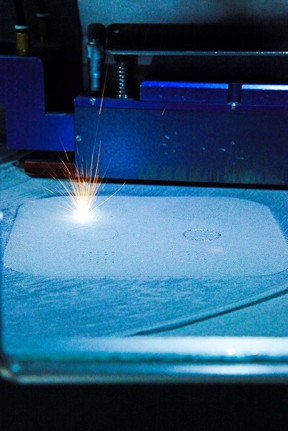 |
| This is the selective laser melting process in action.
Image courtesy of Tim Sercombe/University of Western Australia |
Abstract:
3-D printing is revolutionizing many areas of manufacturing and science. In particular, 3-D printing of metals has found novel applications in fields as diverse as customized medical implants, jet engine bearings and rapid prototyping for the automotive industry.
Exploring superconducting properties of 3-D printed parts: Australian researchers use 3-D printing to create a resonant microwave cavity via an aluminum-silicon alloy that boasts superconductivity when cooled below the critical temperature of aluminum
Washington, DC | Posted on July 20th, 2016While many techniques can be used for 3-D printing with metals, most rely on computer-controlled melting or sintering of a metal alloy powder by a laser or electron beam. The mechanical properties of parts produced by this method have been well studied, but not enough attention has focused on their electrical properties.
Now in a paper appearing this week on the cover of the journal Applied Physics Letters, from AIP Publishing, a team of University of Melbourne and University of Western Australia researchers report creating a resonant microwave cavity that they 3-D printed via an aluminum-silicon alloy (Al-12Si). It exhibits superconductivity when cooled below the critical temperature of aluminum (1.2 Kelvin).
"Conductivity is a measure of how easily an electrical current flows through a material, while 'superconductivity' is this measure taken to its extreme," explained Professor Michael Tobar, University of Western Australia node director of the Center for Engineered Quantum Systems. "It's an effect observed within a number of materials, characterized by the complete vanishing of any resistance to the flow of electrical current when cooled below a certain temperature."
Superconducting cavities are useful for numerous areas of physics -- from quantum physics to particle accelerators. But designing superconducting cavities is becoming more complex, often involving nonstandard geometries and arrays of resonators, which makes conventional machining more challenging.
So two groups at the University of Western Australia -- one led by Professor Tim Sercombe, an expert in materials and 3-D printing, and the other led by Tobar, an expert in engineered quantum systems and novel cavity designs -- combined their expertise and launched a pilot study to explore the superconducting properties of 3-D printed parts.
"The physics of superconductivity is well understood, and it has been known for decades that aluminum exhibits superconductivity," Tobar said. "But the 3-D printing process relies on aluminum that's far from pure and it undergoes several processes -- atomization, laser melting, furnace annealing, etc. So we wanted to explore whether a range of known superconducting metals could successfully be 3-D printed and retain their desirable electrical property."
A process known as "selective laser melting" (SLM) tends to produce a finished material with a very small grain and, for a number of metals, the critical temperature at which superconductivity occurs can be strongly linked to grain size.
"Materials such as lanthanum, molybdenum, and niobium all respond differently," Tobar said. "Grain size has been observed to both increase and decrease this critical temperature. Superconductors with high critical temperatures are particularly interesting, so this 3-D printing process may have some advantage in reducing grain size. The SLM process may also enable rapid testing of new alloys with varying percentages of elements that haven't been measured before."
Beyond measuring the superconductivity, the group wanted to show that they could do something potentially useful with this technique so they decided to 3-D print a resonant microwave cavity.
"Using a device called a 'vector network analyzer,' we excited electromagnetic modes of resonance at microwave frequencies inside the cavity and measured its quality factor, aka 'Q'. This is a measure of how long injected microwaves are stored within the cavity before being lost. It's directly related to the surface resistance of the cavity walls," he explained.
Through measurements of the Q-factor, the researchers were able to indirectly determine this resistance and show that the material becomes superconducting at 1.2 Kelvin.
This result was "surprising, given the very large concentration of nonsuperconducting silicon within the alloy," Tobar noted. "It may open new possibilities for printing novel cavity configurations."
The team's results are immediately useful -- people can now craft a variety of components based on their work.
"Because superconductors expel magnetic fields, magnetic shielding can be printed for experiments," Tobar said. "Also, any cavity experiment requiring a Q-factor on the order of 1 million can benefit from this technology."
For technologies requiring much sharper line-widths and higher Q-factors, according to Tobar, starting materials such as high-purity niobium powder may be ideal.
"There is relatively little in the literature regarding 3-D printed superconductors, so further work must be done to determine more appropriate materials and how to improve the surface finish and resistance of the parts -- possibly via heat treatment or chemical polishing/etching," he added.
Next steps? The team wants to attempt 3-D printing cavities with highly pure niobium powder.
"Niobium is an excellent and widely used material for superconducting cavities," Tobar said. "We anticipate that using a very pure metal powder for the SLM process will provide great results."
####
For more information, please click here
Contacts:
AIP Media Line
301-209-3090
Copyright © American Institute of Physics
If you have a comment, please Contact us.Issuers of news releases, not 7th Wave, Inc. or Nanotechnology Now, are solely responsible for the accuracy of the content.
Bookmark:


| Related Links |
| Related News Press |
News and information
 Quantum computer improves AI predictions April 17th, 2026
Flexible sensor gains sensitivity under pressure April 17th, 2026
A reusable chip for particulate matter sensing April 17th, 2026
Detecting vibrational quantum beating in the predissociation dynamics of SF6 using time-resolved photoelectron spectroscopy April 17th, 2026
Superconductivity
MXene nanomaterials enter a new dimension Multilayer nanomaterial: MXene flakes created at Drexel University show new promise as 1D scrolls January 30th, 2026
3D & 4D printing/Additive-manufacturing
Presenting: Ultrasound-based printing of 3D materials—potentially inside the body December 8th, 2023
Fiber sensing scientists invent 3D printed fiber microprobe for measuring in vivo biomechanical properties of tissue and even single cell February 10th, 2023
3D-printed decoder, AI-enabled image compression could enable higher-res displays December 9th, 2022
Researchers design new inks for 3D-printable wearable bioelectronics: Potential uses include printing electronic tattoos for medical tracking applications August 19th, 2022
Possible Futures
A fundamentally new therapeutic approach to cystic fibrosis: Nanobody repairs cellular defect April 17th, 2026
UC Irvine physicists discover method to reverse ‘quantum scrambling’ : The work addresses the problem of information loss in quantum computing system April 17th, 2026
Announcements
A fundamentally new therapeutic approach to cystic fibrosis: Nanobody repairs cellular defect April 17th, 2026
UC Irvine physicists discover method to reverse ‘quantum scrambling’ : The work addresses the problem of information loss in quantum computing system April 17th, 2026
Interviews/Book Reviews/Essays/Reports/Podcasts/Journals/White papers/Posters
A fundamentally new therapeutic approach to cystic fibrosis: Nanobody repairs cellular defect April 17th, 2026
UC Irvine physicists discover method to reverse ‘quantum scrambling’ : The work addresses the problem of information loss in quantum computing system April 17th, 2026
 |
||
 |
||
| The latest news from around the world, FREE | ||
 |
||
|
|
||
| Premium Products | ||
 |
||
|
Only the news you want to read!
Learn More |
||
 |
||
|
Full-service, expert consulting
Learn More |
||
|
|
||