Home > Press > Easier, faster, cheaper: A full-filling approach to making nanotubes of consistent quality: Approach opens a straightforward route for engineering the properties of single-wall carbon nanotubes
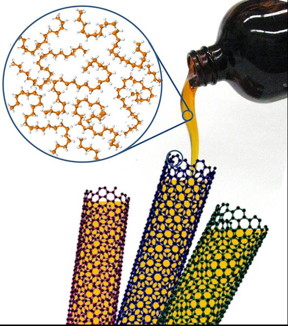 |
| To prevent cores of single-wall carbon nanotubes from filling with water or other detrimental substances, the NIST researchers advise intentionally prefilling them with a desired chemical of known properties. Taking this step before separating and dispersing the materials, usually done in water, yields a consistently uniform collection of nanotubes, especially important for optical applications. CREDIT: Fagan/NIST |
Abstract:
Just as many of us might be resigned to clogged salt shakers or rush-hour traffic, those working to exploit the special properties of carbon nanotubes have typically shrugged their shoulders when these tiniest of cylinders fill with water during processing. But for nanotube practitioners who have reached their Popeye threshold and "can't stands no more," the National Institute of Standards and Technology (NIST) has devised a cheap, quick and effective strategy that reliably enhances the quality and consistency of the materials--important for using them effectively in applications such as new computing technologies.
Easier, faster, cheaper: A full-filling approach to making nanotubes of consistent quality: Approach opens a straightforward route for engineering the properties of single-wall carbon nanotubes
Gaithersburg, MD | Posted on July 19th, 2016To prevent filling of the cores of single-wall carbon nanotubes with water or other detrimental substances, the NIST researchers advise intentionally prefilling them with a desired chemical of known properties. Taking this step before separating and dispersing the materials, usually done in water, yields a consistently uniform collection of nanotubes. In quantity and quality, the results are superior to water-filled nanotubes, especially for optical applications such as sensors and photodetectors.
The approach opens a straightforward route for engineering the properties of single-wall carbon nanotubes--rolled up sheets of carbon atoms arranged like chicken wire or honey combs--with improved or new properties.
"This approach is so easy, inexpensive and broadly useful that I can't think of a reason not to use it," said NIST chemical engineer Jeffrey Fagan.
In their proof-of-concept experiments, the NIST team inserted more than 20 different compounds into an assortment of single-wall carbon nanotubes with an interior diameter that ranged from more than 2 down to about 0.5 nanometers. Led by visiting researcher Jochen Campo, the scientists tested their strategy by using hydrocarbons called alkanes as fillers.
The alkanes, which include such familiar compounds as propane and butane, served to render the nanotube interiors unreactive. In other words, the alkane-filled nanotubes behaved almost as if they were empty--precisely the goal of Campo, Fagan and colleagues.
Compared with nanotubes filled with water and possibly ions, acids and other unwanted chemicals encountered during processing, empty nanotubes possess far superior properties. For example, when stimulated by light, empty carbon nanotubes fluoresce far brighter and with sharper signals.
Yet, "spontaneous ingestion" of water or other solvents by the nanotubes during processing is an "endemic but often neglected phenomenon with strong implications for the development of nanotube applications," the NIST team wrote in a recent article in Nanoscale Horizons.
Perhaps because of the additional cost and effort required to filter out and gather nanotubes, researchers tend to tolerate mixed batches of unfilled (empty) and mostly filled single-wall carbon nanotubes. Separating unfilled nanotubes from these mixtures requires expensive ultracentrifuge equipment and, even then, the yield is only about 10 percent, Campo estimates.
"If your goal is to use nanotubes for electronic circuits, for example, or for fluorescent anti-cancer image contrast agents, then you require much greater quantities of materials of consistent composition and quality," Campo explained, who was exploring these applications while doing postdoctoral research at the University of Antwerp. "This particular need inspired development of the new prefilling method by asking the question, can we put some passive chemical into the nanotube instead to keep the water out."
From the very first simple experiments, the answer was yes. And the benefits can be significant. In fluorescence experiments, alkane-filled nanotubes emitted signals two to three times stronger than those emitted by water-filled nanotubes. Performance approached that of empty nanotubes--the gold standard for these comparisons.
As important, the NIST-developed prefilling strategy is controllable, versatile and easily incorporated into existing methods for processing single-wall carbon nanotubes, according to the researchers.
####
For more information, please click here
Contacts:
Mark Bello
301-975-3776
Copyright © National Institute of Standards and Technology (NIST)
If you have a comment, please Contact us.Issuers of news releases, not 7th Wave, Inc. or Nanotechnology Now, are solely responsible for the accuracy of the content.
Bookmark:


| Related Links |
| Related News Press |
News and information
 Quantum computer improves AI predictions April 17th, 2026
Flexible sensor gains sensitivity under pressure April 17th, 2026
A reusable chip for particulate matter sensing April 17th, 2026
Detecting vibrational quantum beating in the predissociation dynamics of SF6 using time-resolved photoelectron spectroscopy April 17th, 2026
Laboratories
Researchers develop molecular qubits that communicate at telecom frequencies October 3rd, 2025
A battery’s hopping ions remember where they’ve been: Seen in atomic detail, the seemingly smooth flow of ions through a battery’s electrolyte is surprisingly complicated February 16th, 2024
Govt.-Legislation/Regulation/Funding/Policy
Quantum computer improves AI predictions April 17th, 2026
Metasurfaces smooth light to boost magnetic sensing precision January 30th, 2026
New imaging approach transforms study of bacterial biofilms August 8th, 2025
Possible Futures
A fundamentally new therapeutic approach to cystic fibrosis: Nanobody repairs cellular defect April 17th, 2026
UC Irvine physicists discover method to reverse ‘quantum scrambling’ : The work addresses the problem of information loss in quantum computing system April 17th, 2026
Chip Technology
A reusable chip for particulate matter sensing April 17th, 2026
Metasurfaces smooth light to boost magnetic sensing precision January 30th, 2026
Nanotubes/Buckyballs/Fullerenes/Nanorods/Nanostrings/Nanosheets
Tiny nanosheets, big leap: A new sensor detects ethanol at ultra-low levels January 30th, 2026
Enhancing power factor of p- and n-type single-walled carbon nanotubes April 25th, 2025
Chainmail-like material could be the future of armor: First 2D mechanically interlocked polymer exhibits exceptional flexibility and strength January 17th, 2025
Innovative biomimetic superhydrophobic coating combines repair and buffering properties for superior anti-erosion December 13th, 2024
Sensors
Flexible sensor gains sensitivity under pressure April 17th, 2026
Tiny nanosheets, big leap: A new sensor detects ethanol at ultra-low levels January 30th, 2026
From sensors to smart systems: the rise of AI-driven photonic noses January 30th, 2026
Sensors innovations for smart lithium-based batteries: advancements, opportunities, and potential challenges August 8th, 2025
Discoveries
Quantum computer improves AI predictions April 17th, 2026
Flexible sensor gains sensitivity under pressure April 17th, 2026
A reusable chip for particulate matter sensing April 17th, 2026
Detecting vibrational quantum beating in the predissociation dynamics of SF6 using time-resolved photoelectron spectroscopy April 17th, 2026
Announcements
A fundamentally new therapeutic approach to cystic fibrosis: Nanobody repairs cellular defect April 17th, 2026
UC Irvine physicists discover method to reverse ‘quantum scrambling’ : The work addresses the problem of information loss in quantum computing system April 17th, 2026
Interviews/Book Reviews/Essays/Reports/Podcasts/Journals/White papers/Posters
A fundamentally new therapeutic approach to cystic fibrosis: Nanobody repairs cellular defect April 17th, 2026
UC Irvine physicists discover method to reverse ‘quantum scrambling’ : The work addresses the problem of information loss in quantum computing system April 17th, 2026
Photonics/Optics/Lasers
Metasurfaces smooth light to boost magnetic sensing precision January 30th, 2026
From sensors to smart systems: the rise of AI-driven photonic noses January 30th, 2026
 |
||
 |
||
| The latest news from around the world, FREE | ||
 |
||
|
|
||
| Premium Products | ||
 |
||
|
Only the news you want to read!
Learn More |
||
 |
||
|
Full-service, expert consulting
Learn More |
||
|
|
||