Home > Press > New photonic sensor opens the door to high-speed biodetection
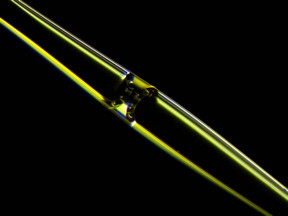 |
| Photograph of a fluid meniscus inside an opto-mechano-fluidic resonator (OMFR) made of high purity silica glass. Particles flowing through the internal microchannel can be detected optically at extremely high speed. CREDIT: University of Illinois |
Abstract:
Researchers from the University of Illinois at Urbana-Champaign have developed a new technique for extremely high speed photonic sensing of the mechanical properties of freely flowing particles using an opto-mechano-fluidic resonator (OMFR). This research potentially opens up completely new mechanical "axes of measurement" on micro/nanoparticles and bioparticles.
New photonic sensor opens the door to high-speed biodetection
Urbana, IL | Posted on June 7th, 2016"It is known that diseases such as cancers and anemia can correlate with mechanical properties of cells such as compressibility and viscoelasticity, but these properties are not used diagnostically due to absence of tools with enough speed and sensitivity to perform the measurement," explained Gaurav Bahl, an assistant professor of mechanical science and engineering at Illinois. "Because of this, we have a substantial knowledge-gap, and have barely scratched the surface of understanding of how diseases modify the mechanical properties of cells in our body. Developing knowledge around the mechanics of cells and bioparticles can help us understand the mobility of these micro-objects throughout the human body, about how tumors form, about how cells and bacteria can propagate through us, how diseases spread, and more."
High-speed optical detection methods, such as flow cytometry, are routinely used for analysis of large populations of particles through measurements of their optical properties, with analysis speeds approaching 50,000 particles/second. Optical sensors, however, cannot directly measure any mechanical properties of the particles (such as mass, density, compressibility, stiffness, etc). Until now, mechanical sensors have not approached the speed of optical flow cytometers, which makes routine measurements on large cell populations simply impractical.
"In this study, we aimed to blend the best features of optical sensing, i.e. the extremely high bandwidth and sensitivity, with mechanical sensing which gives us the ability to measure mechanical properties," stated Kewen Han, a doctoral candidate and first author of the paper appearing in the June 2016 edition of Optica. "To achieve this, we have developed a new microfluidic opto-mechanical device that optically detects the mechanical perturbations created by individual microparticles flowing through the fluidic channel at very high speed.
Using bakers' yeast and two types of microbeads, the researchers explored the particle-sensing capabilities of the OMFR.
"The OMFR's multimode sensing capability permits measurement of multiple particles with redundancy, and indicates future potential for inertial imaging," Han said. "The system also detects mechanical energy loss associated with individual particles, likely related to viscoelastic properties of the soft material and boundary loss at interface of particle and liquid."
"We have shown that our technique is sensitive to the density and compressibility of each individual particle as it passes by," Bahl added. "The smallest detectable particle as reported in this work is around 660 nm.
"This work presents a new approach to perform resonantly enhanced optical sensing of freely flowing particles through the action of long-range phonons that extend between solid and fluid phases of the sensor and sample."
####
For more information, please click here
Contacts:
Gaurav Bahl
217-300-2194
Copyright © University of Illinois College of Engineering
If you have a comment, please Contact us.Issuers of news releases, not 7th Wave, Inc. or Nanotechnology Now, are solely responsible for the accuracy of the content.
Bookmark:


| Related Links |
| Related News Press |
News and information
 Quantum computer improves AI predictions April 17th, 2026
Flexible sensor gains sensitivity under pressure April 17th, 2026
A reusable chip for particulate matter sensing April 17th, 2026
Detecting vibrational quantum beating in the predissociation dynamics of SF6 using time-resolved photoelectron spectroscopy April 17th, 2026
Imaging
Simple algorithm paired with standard imaging tool could predict failure in lithium metal batteries August 8th, 2025
Cancer
New molecular technology targets tumors and simultaneously silences two ‘undruggable’ cancer genes August 8th, 2025
Possible Futures
A fundamentally new therapeutic approach to cystic fibrosis: Nanobody repairs cellular defect April 17th, 2026
UC Irvine physicists discover method to reverse ‘quantum scrambling’ : The work addresses the problem of information loss in quantum computing system April 17th, 2026
Nanomedicine
A fundamentally new therapeutic approach to cystic fibrosis: Nanobody repairs cellular defect April 17th, 2026
New molecular technology targets tumors and simultaneously silences two ‘undruggable’ cancer genes August 8th, 2025
New imaging approach transforms study of bacterial biofilms August 8th, 2025
Electrifying results shed light on graphene foam as a potential material for lab grown cartilage June 6th, 2025
Sensors
Flexible sensor gains sensitivity under pressure April 17th, 2026
Tiny nanosheets, big leap: A new sensor detects ethanol at ultra-low levels January 30th, 2026
From sensors to smart systems: the rise of AI-driven photonic noses January 30th, 2026
Sensors innovations for smart lithium-based batteries: advancements, opportunities, and potential challenges August 8th, 2025
Discoveries
Quantum computer improves AI predictions April 17th, 2026
Flexible sensor gains sensitivity under pressure April 17th, 2026
A reusable chip for particulate matter sensing April 17th, 2026
Detecting vibrational quantum beating in the predissociation dynamics of SF6 using time-resolved photoelectron spectroscopy April 17th, 2026
Announcements
A fundamentally new therapeutic approach to cystic fibrosis: Nanobody repairs cellular defect April 17th, 2026
UC Irvine physicists discover method to reverse ‘quantum scrambling’ : The work addresses the problem of information loss in quantum computing system April 17th, 2026
Interviews/Book Reviews/Essays/Reports/Podcasts/Journals/White papers/Posters
A fundamentally new therapeutic approach to cystic fibrosis: Nanobody repairs cellular defect April 17th, 2026
UC Irvine physicists discover method to reverse ‘quantum scrambling’ : The work addresses the problem of information loss in quantum computing system April 17th, 2026
Tools
Metasurfaces smooth light to boost magnetic sensing precision January 30th, 2026
From sensors to smart systems: the rise of AI-driven photonic noses January 30th, 2026
Japan launches fully domestically produced quantum computer: Expo visitors to experience quantum computing firsthand August 8th, 2025
Nanobiotechnology
A fundamentally new therapeutic approach to cystic fibrosis: Nanobody repairs cellular defect April 17th, 2026
New molecular technology targets tumors and simultaneously silences two ‘undruggable’ cancer genes August 8th, 2025
New imaging approach transforms study of bacterial biofilms August 8th, 2025
Electrifying results shed light on graphene foam as a potential material for lab grown cartilage June 6th, 2025
Photonics/Optics/Lasers
Metasurfaces smooth light to boost magnetic sensing precision January 30th, 2026
From sensors to smart systems: the rise of AI-driven photonic noses January 30th, 2026
 |
||
 |
||
| The latest news from around the world, FREE | ||
 |
||
|
|
||
| Premium Products | ||
 |
||
|
Only the news you want to read!
Learn More |
||
 |
||
|
Full-service, expert consulting
Learn More |
||
|
|
||