Home > Press > Gigantic ultrafast spin currents: Scientists from TU Wien (Vienna) are proposing a new method for creating extremely strong spin currents. They are essential for spintronics, a technology that could replace today's electronics
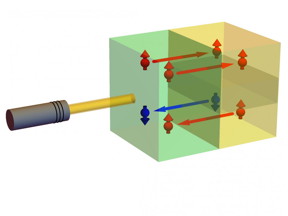 |
| A laser pulse hits nickel (green). Spin-up-electrons (red) change into silicon (yellow). Electrons with both spin-orientations change back from silicon into nickel. CREDIT: TU Wien |
Abstract:
In our computer chips, information is transported in form of electrical charge. Electrons or other charge carriers have to be moved from one place to another. For years scientists have been working on elements that take advantage of the electrons angular momentum (their spin) rather than their electrical charge. This new approach, called "spintronics" has major advantages compared to common electronics. It can operate with much less energy.
Gigantic ultrafast spin currents: Scientists from TU Wien (Vienna) are proposing a new method for creating extremely strong spin currents. They are essential for spintronics, a technology that could replace today's electronics
Vienna, Austria | Posted on May 25th, 2016However, it is difficult to create such a spin current, which is required in spintronics. In the journal Physical Review Letters, physicists from TU Wien (Vienna) have now proposed a new method to produce gigantic spin currents in a very small period of time. The secret is using ultra short laser pulses.
Magnets and Semiconductors
For every electron, two different spin-states are possible; they are called "spin up" and "spin down". The electron spin is responsible for ferromagnetism: when many electron spins in a metal are aligned, they can collectively create a magnetic field. Therefore, using ferromagnets to create spin flux seems like a straightforward idea. "There have been attempts to send an electric current through a combination of magnets and semiconductors", says Professor Karsten Held (TU Wien). "The idea is to create a flux of electrons with uniform spin, which can then be used for spintronic circuits. But the efficiency of this method is very limited."
Karsten Held and Marco Battiato found another way. In computer simulations, they analysed the behaviour of electrons in a thin layer of nickel when it is attached to silicon and hit with ultra short laser pulses. "Such a laser pulse has an overwhelming effect on the electrons in nickel", says Marco Battiato. They are swept away and accelerated towards the silicon.
An electric field builds up at the interface between nickel and silicon, which stops the current. Electrons still keep on migrating between the nickel layer and silicon, but the motion in both directions cancel each other, there is no net charge transfer.
Spin Up and Spin Down
But even when no electric charge is transported, it is still possible to transport spin. "In the nickel layer, there are both spin-up electrons as well as spin-down electrons", says Karsten Held. "But the metal atoms influence both kinds of electrons in different ways. The spin-up electrons can move rather freely. The spin-down electrons however have a much higher probability of being scattered at the nickel atoms."
When the electrons are scattered, they change their direction and lose energy. Therefore, the majority of the electrons which do make it all the way to the nickel-silicon interface are spin-up electrons. Electrons which move in the opposite direction have equal probabilities of being in the spin-up or spin-down state.
This spin-selective effect leads to a dominance of spin-up electrons in the silicon. This means that a spin current has been injected into the silicon without creating a charge current. "Our calculations show that this spin-polarization is extremely strong -- much stronger than we could create with other methods", says Marco Battiato. "And this spin flux can be created in femtoseconds." Time is of the essence: today's computer processors operate with gigahertz frequencies. Billions of operations per second are possible. Even higher frequencies in the terahertz range can only be reached with extremely fast elements.
So far, the method has only been tested in computer simulations. But Battiato and Held are already working with experimentalists who want to measure this laser-triggered spin flux. "Spintronics has the potential to become a key technology of the next few decades", says Held. "With our spin injection method there is now finally a way to create ultrafast, extremely strong spin currents."
####
For more information, please click here
Contacts:
Florian Aigner
0043-158-801-41027
Prof. Karsten Held
Institute of Solid State Physics
TU Wien
Wiedner Hauptstraße 8, 1040 Vienna
T: 43-1-58801-13710
Dr. Marco Battiato
Institute of Solid State Physics
TU Wien
Wiedner Hauptstraße 8, 1040 Vienna
T: 43-1-58801-13768
Copyright © Vienna University of Technology
If you have a comment, please Contact us.Issuers of news releases, not 7th Wave, Inc. or Nanotechnology Now, are solely responsible for the accuracy of the content.
Bookmark:


| Related Links |
| Related News Press |
News and information
 Quantum computer improves AI predictions April 17th, 2026
Flexible sensor gains sensitivity under pressure April 17th, 2026
A reusable chip for particulate matter sensing April 17th, 2026
Detecting vibrational quantum beating in the predissociation dynamics of SF6 using time-resolved photoelectron spectroscopy April 17th, 2026
Possible Futures
A fundamentally new therapeutic approach to cystic fibrosis: Nanobody repairs cellular defect April 17th, 2026
UC Irvine physicists discover method to reverse ‘quantum scrambling’ : The work addresses the problem of information loss in quantum computing system April 17th, 2026
Spintronics
Quantum materials: Electron spin measured for the first time June 9th, 2023
Chip Technology
A reusable chip for particulate matter sensing April 17th, 2026
Metasurfaces smooth light to boost magnetic sensing precision January 30th, 2026
Discoveries
Quantum computer improves AI predictions April 17th, 2026
Flexible sensor gains sensitivity under pressure April 17th, 2026
A reusable chip for particulate matter sensing April 17th, 2026
Detecting vibrational quantum beating in the predissociation dynamics of SF6 using time-resolved photoelectron spectroscopy April 17th, 2026
Announcements
A fundamentally new therapeutic approach to cystic fibrosis: Nanobody repairs cellular defect April 17th, 2026
UC Irvine physicists discover method to reverse ‘quantum scrambling’ : The work addresses the problem of information loss in quantum computing system April 17th, 2026
Interviews/Book Reviews/Essays/Reports/Podcasts/Journals/White papers/Posters
A fundamentally new therapeutic approach to cystic fibrosis: Nanobody repairs cellular defect April 17th, 2026
UC Irvine physicists discover method to reverse ‘quantum scrambling’ : The work addresses the problem of information loss in quantum computing system April 17th, 2026
Energy
Sensors innovations for smart lithium-based batteries: advancements, opportunities, and potential challenges August 8th, 2025
Simple algorithm paired with standard imaging tool could predict failure in lithium metal batteries August 8th, 2025
 |
||
 |
||
| The latest news from around the world, FREE | ||
 |
||
|
|
||
| Premium Products | ||
 |
||
|
Only the news you want to read!
Learn More |
||
 |
||
|
Full-service, expert consulting
Learn More |
||
|
|
||