Home > Press > Nanoscale Trojan horses treat inflammation
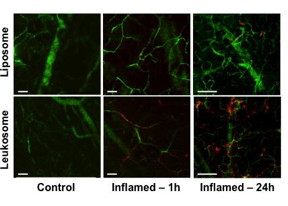 |
| IVM images of inflamed-vasculature targeting. Compared with control liposomes, leukosomes showed a five-fold and eight-fold increase in accumulation at one hour and 24 hours after particles' injection, respectively. CREDIT: Houston Methodist |
Abstract:
Nanosized Trojan horses created from a patient's own immune cells have successfully treated inflammation by overcoming the body's complex defense mechanisms, perhaps leading to broader applications for treating diseases characterized by inflammation, such as cancer and cardiovascular diseases.
Nanoscale Trojan horses treat inflammation
Houston, TX | Posted on May 24th, 2016An international team, led by researchers at Houston Methodist Research Institute, described the creation of nanoparticles called leukosomes and evaluated their ability to treat localized inflammation in the May 23 issue of Nature Materials (early online).
Recent approaches to treating inflammatory diseases have been unsuccessful because an already overactive immune system treats simple nanoparticles as foreign invaders and clears them from the body, preventing them from reaching their target.
"A better approach for building effective drug delivery platforms is to find inspiration for their design in the composition of the immune cells of our body," said Ennio Tasciotti, Ph.D., director of the Center for Biomimetic Medicine at Houston Methodist Research Institute and the paper's senior author. "Immune cells such as leukocytes freely circulate in blood vessels, recognize inflammation, and accumulate in inflamed tissues. They do so by using special receptors and ligands on their surface. We purified leukocytes from a patient, then integrated their special ligands and receptors into the leukosome surface. Using the body's own materials, we built a drug delivery system camouflaged as our own body's defense system--thus the Trojan horse."
In its normal form, acute inflammation is a necessary and beneficial part of the body's defense against infection. However, under certain conditions, inflammation can turn from a friend to a vicious foe, damaging or destroying healthy cells. This is the case for autoimmune disorders such as rheumatoid arthritis, lupus and inflammatory bowel disease, or in illnesses such as Alzheimer's, cancer, cardiovascular disease and Type 2 diabetes.
Leukosomes are able to target inflamed tissues because they retain the same surface properties of the immune cell membranes from which they are made. To evaluate leukosomes' effectiveness as drug carriers, Tasciotti and his colleagues created vesicles from mouse leukocytes and filled them with dexamethasone (DXM), an anti-inflammatory agent.
"We used 'personalized' DXM-loaded leukosomes to treat inflammation in mice," Tasciotti said. "After administering the leukosomes, we observed their attachment to the surface of blood vessels surrounding the inflamed tissue, and they selectively delivered DXM to the affected cells."
The treated mice showed definite signs of improvement, including resolution of the inflammation, a significant reduction in tissue thickness, and a reversal of the immune response that is commonly seen in inflammation.
The success of the team's initial leukosome trial is encouraging, Tasciotti said, and suggests that membranes purified from any other cell types could also be used as biomimetic nanocarriers to treat other diseases.
"By combining cell biology with nanotechnology, we can create valuable medical tools that work within, and not around, the laws of nature," he said.
###
The research was supported by the National Institutes of Health (1R21CA173579-01A1 and 5U54CA143837 PSOC Pilot project), the Department of Defense (W81XWH-12-10414 BCRP Innovator Expansion), George J. and Angelina P. Kostas Charitable Foundation, The Brown Foundation Inc., William Randolph Hearst Foundation, and The Cullen Trust for Health Care.
The researchers who collaborated with Tasciotti on the Nature Materials paper are: Roberto Molinaro, Claudia Corbo, Jonathan O. Martinez, Francesca Taraballi, Michael Evangelopoulos, Silvia Minardi, Picheng Zhao, Enrica De Rosa, Naama E. Toledano Furman, Xin Wang and Alessandro Parodi (Houston Methodist Research Institute, Houston, Texas); and Michael Sherman (University of Texas Medical Branch, Galveston, Texas). Corbo, Taraballi and De Vita also are on the staff of research institutions in Italy.
Nature Materials is part of the Nature family of journals and has an impact factor of 36.5.
####
For more information, please click here
Contacts:
Gale Smith
281-627-0439
Copyright © Houston Methodist
If you have a comment, please Contact us.Issuers of news releases, not 7th Wave, Inc. or Nanotechnology Now, are solely responsible for the accuracy of the content.
Bookmark:


| Related Links |
| Related News Press |
News and information
 Quantum computer improves AI predictions April 17th, 2026
Flexible sensor gains sensitivity under pressure April 17th, 2026
A reusable chip for particulate matter sensing April 17th, 2026
Detecting vibrational quantum beating in the predissociation dynamics of SF6 using time-resolved photoelectron spectroscopy April 17th, 2026
Cancer
New molecular technology targets tumors and simultaneously silences two ‘undruggable’ cancer genes August 8th, 2025
Ben-Gurion University of the Negev researchers several steps closer to harnessing patient's own T-cells to fight off cancer June 6th, 2025
Self-propelled protein-based nanomotors for enhanced cancer therapy by inducing ferroptosis June 6th, 2025
Govt.-Legislation/Regulation/Funding/Policy
Quantum computer improves AI predictions April 17th, 2026
Metasurfaces smooth light to boost magnetic sensing precision January 30th, 2026
New imaging approach transforms study of bacterial biofilms August 8th, 2025
Possible Futures
A fundamentally new therapeutic approach to cystic fibrosis: Nanobody repairs cellular defect April 17th, 2026
UC Irvine physicists discover method to reverse ‘quantum scrambling’ : The work addresses the problem of information loss in quantum computing system April 17th, 2026
Nanomedicine
A fundamentally new therapeutic approach to cystic fibrosis: Nanobody repairs cellular defect April 17th, 2026
New molecular technology targets tumors and simultaneously silences two ‘undruggable’ cancer genes August 8th, 2025
New imaging approach transforms study of bacterial biofilms August 8th, 2025
Electrifying results shed light on graphene foam as a potential material for lab grown cartilage June 6th, 2025
Discoveries
Quantum computer improves AI predictions April 17th, 2026
Flexible sensor gains sensitivity under pressure April 17th, 2026
A reusable chip for particulate matter sensing April 17th, 2026
Detecting vibrational quantum beating in the predissociation dynamics of SF6 using time-resolved photoelectron spectroscopy April 17th, 2026
Announcements
A fundamentally new therapeutic approach to cystic fibrosis: Nanobody repairs cellular defect April 17th, 2026
UC Irvine physicists discover method to reverse ‘quantum scrambling’ : The work addresses the problem of information loss in quantum computing system April 17th, 2026
Interviews/Book Reviews/Essays/Reports/Podcasts/Journals/White papers/Posters
A fundamentally new therapeutic approach to cystic fibrosis: Nanobody repairs cellular defect April 17th, 2026
UC Irvine physicists discover method to reverse ‘quantum scrambling’ : The work addresses the problem of information loss in quantum computing system April 17th, 2026
Military
Quantum engineers ‘squeeze’ laser frequency combs to make more sensitive gas sensors January 17th, 2025
Chainmail-like material could be the future of armor: First 2D mechanically interlocked polymer exhibits exceptional flexibility and strength January 17th, 2025
Single atoms show their true color July 5th, 2024
NRL charters Navy’s quantum inertial navigation path to reduce drift April 5th, 2024
Grants/Sponsored Research/Awards/Scholarships/Gifts/Contests/Honors/Records
Quantum computer improves AI predictions April 17th, 2026
Detecting vibrational quantum beating in the predissociation dynamics of SF6 using time-resolved photoelectron spectroscopy April 17th, 2026
Metasurfaces smooth light to boost magnetic sensing precision January 30th, 2026
Nanobiotechnology
A fundamentally new therapeutic approach to cystic fibrosis: Nanobody repairs cellular defect April 17th, 2026
New molecular technology targets tumors and simultaneously silences two ‘undruggable’ cancer genes August 8th, 2025
New imaging approach transforms study of bacterial biofilms August 8th, 2025
Electrifying results shed light on graphene foam as a potential material for lab grown cartilage June 6th, 2025
 |
||
 |
||
| The latest news from around the world, FREE | ||
 |
||
|
|
||
| Premium Products | ||
 |
||
|
Only the news you want to read!
Learn More |
||
 |
||
|
Full-service, expert consulting
Learn More |
||
|
|
||