Home > Press > Innovative Exeter research pioneers nanotechnology for gas sensing
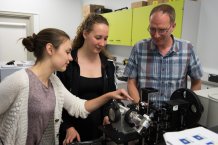 |
| Hannah Barnard left, Katya Zossimova centre and Professor Geoff Nash right.
Credit: University of Exeter |
Abstract:
A team of scientists from the University of Exeter have created a new type of device that could be used to develop cost-effective gas sensors.
Innovative Exeter research pioneers nanotechnology for gas sensing
Exeter, UK | Posted on April 15th, 2016The pioneering team, which includes two second year Exeter undergraduates, have created a new type of device that emits light in the infrared part of the spectrum. Many important gases strongly absorb infrared light and this characteristic absorption can be used as a way of sensing them.
However, most existing infrared gas sensors use conventional "light-bulb" incandescent sources of infrared light, which have a number of considerable shortcomings including limited lifetimes due to the fragility of the filament. The new sensors could be used for a diverse range of applications including the sensing of atmospheric pollutants such as nitrogen dioxide, which is emitted from car exhausts and which can have a significant effect on public health.
The Exeter team used a sandwich of different 2D materials, which are only a few atoms thick, to create a device that is similar to a nanoscale light-bulb, but where the filament is extremely hard to break. In addition, the team believe that these devices could ultimately be more cost effective and sustainable to manufacture than semiconductor based light emitting diodes emitting at these long wavelengths.
The research, which is led by Professor Geoff Nash, is published in the highly-respected scientific journal Applied Physics Letters.
The team included undergraduate students Hannah Barnard and Katya Zossimova, who began working as part of Professor Nash's group last summer whilst in their first year.
Professor Nash, Professor of Engineering Physics and Director of Natural Sciences, from the University of Exeter, said: "Previous devices we've made really only operated in vacuum and would break very quickly when exposed to air. By encapsulating the nanoscale filament in a protective coating, we have shown that these devices can operate in air for well over 1000 hours, paving the way for the development of practical infrared sources that could be used in sensor applications."
Commenting on the makeup of his research team, he went on to add that "It's a privilege to work alongside our some of our fantastic students, who have brought energy, enthusiasm and a different perspective to our research. Hannah and Katya, and other undergraduates before, have made a real impact to the work of my group."
Katya, who is studying Physics, said: "It's been really exciting to be part of the research team, everyone has been really welcoming and I have learned a lot from the experience. I feel that this opportunity has given me the confidence to consider postgraduate studies in Physics."
Hannah, who is studying Natural Sciences, said that the experience gave her "invaluable insight into being a research scientist within the University." She added: "Since taking part in the internship I have achieved things I never even thought were possible and pushed all of my personal boundaries. I have loved being able to apply what I learn in the labs to my taught modules and vice versa."
Natural Sciences at Exeter is an innovative flagship programme designed to explore the scientific concepts needed to explain the natural world, from the nanoscale to the complex systems of the Earth's climate and our solar system.
Research-inspired, inquiry-led learning is the cornerstone of the University's Education Strategy and undergraduates are engaged in the world-leading research at the University in many different ways.
Professor Tim Quine, Deputy Vice-Chancellor (Education), commented that "the synergies between education and research are vital in the approach the University takes to the discovery and dissemination of knowledge. The work of Hannah and Katya, supported by Professor Nash, is a perfect example of the great relationships between our students and academics".
###
The research was undertaken as part of an UK Engineering and Physical Sciences Research Council Fellowship, held by Professor Nash, in Frontier Manufacturing.
####
For more information, please click here
Contacts:
Duncan Sandes
44-013-927-22062
Copyright © University of Exeter
If you have a comment, please Contact us.Issuers of news releases, not 7th Wave, Inc. or Nanotechnology Now, are solely responsible for the accuracy of the content.
Bookmark:


| Related News Press |
News and information
 Quantum computer improves AI predictions April 17th, 2026
Flexible sensor gains sensitivity under pressure April 17th, 2026
A reusable chip for particulate matter sensing April 17th, 2026
Detecting vibrational quantum beating in the predissociation dynamics of SF6 using time-resolved photoelectron spectroscopy April 17th, 2026
Govt.-Legislation/Regulation/Funding/Policy
Quantum computer improves AI predictions April 17th, 2026
Metasurfaces smooth light to boost magnetic sensing precision January 30th, 2026
New imaging approach transforms study of bacterial biofilms August 8th, 2025
Possible Futures
A fundamentally new therapeutic approach to cystic fibrosis: Nanobody repairs cellular defect April 17th, 2026
UC Irvine physicists discover method to reverse ‘quantum scrambling’ : The work addresses the problem of information loss in quantum computing system April 17th, 2026
Sensors
Flexible sensor gains sensitivity under pressure April 17th, 2026
Tiny nanosheets, big leap: A new sensor detects ethanol at ultra-low levels January 30th, 2026
From sensors to smart systems: the rise of AI-driven photonic noses January 30th, 2026
Sensors innovations for smart lithium-based batteries: advancements, opportunities, and potential challenges August 8th, 2025
Discoveries
Quantum computer improves AI predictions April 17th, 2026
Flexible sensor gains sensitivity under pressure April 17th, 2026
A reusable chip for particulate matter sensing April 17th, 2026
Detecting vibrational quantum beating in the predissociation dynamics of SF6 using time-resolved photoelectron spectroscopy April 17th, 2026
Announcements
A fundamentally new therapeutic approach to cystic fibrosis: Nanobody repairs cellular defect April 17th, 2026
UC Irvine physicists discover method to reverse ‘quantum scrambling’ : The work addresses the problem of information loss in quantum computing system April 17th, 2026
Interviews/Book Reviews/Essays/Reports/Podcasts/Journals/White papers/Posters
A fundamentally new therapeutic approach to cystic fibrosis: Nanobody repairs cellular defect April 17th, 2026
UC Irvine physicists discover method to reverse ‘quantum scrambling’ : The work addresses the problem of information loss in quantum computing system April 17th, 2026
Energy
Sensors innovations for smart lithium-based batteries: advancements, opportunities, and potential challenges August 8th, 2025
Simple algorithm paired with standard imaging tool could predict failure in lithium metal batteries August 8th, 2025
 |
||
 |
||
| The latest news from around the world, FREE | ||
 |
||
|
|
||
| Premium Products | ||
 |
||
|
Only the news you want to read!
Learn More |
||
 |
||
|
Full-service, expert consulting
Learn More |
||
|
|
||