Home > Press > POSTECH researchers develop a control algorithm for more accurate lab-on-a-chip devices
 |
Abstract:
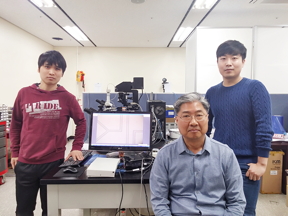
Prof. Wan Kyun Chung with PhD student Young Jin Heo, MS student Junsu Kang, and postdoctoral researcher Min Jun Kim in the Robotics Laboratory at POSTECH, Korea, have developed a novel control algorithm to resolve critical problems induced from a Proportional-Integral-Derivative (PID) controller by automatizing the technical tuning process. Their research was published in Scientific Reports.
POSTECH researchers develop a control algorithm for more accurate lab-on-a-chip devices
Pohang, Korea | Posted on April 6th, 2016Lab-on-a-chip designates devices that integrate various biochemical functions on a fingernail-sized chip to enable quick and compact biological analysis or medical diagnosis by processing a small volume of biological samples, such as a drop of blood. To operate various functions on a lab-on-a-chip device, the key technology is the precise and rapid manipulation of fluid on a micro-scale.
In microfluidic devices, very small and trivial variables can frequently cause a large amount of errors. Up until now, Proportional-Integral-Derivative (PID) controller has normally been used for the manipulation of fluids in microfluidic chips. To apply the PID controller, a tedious gain-tuning process is required but the gain-tuning is a difficult process for people who are unfamiliar with control theory. Especially, in the case of controlling multiple flows, the process is extremely convoluted and frustrating.
The developed control algorithm can improve accuracy and stability of flow regulation in a microfluidic network without requiring any tuning process. With this algorithm, microfluidic flows in multiple channels can be controlled in simultaneous and independent way. The team expects that this algorithm has the potential for many applications of lab-on-a-chip devices. For example, cell culture or biological analysis, which are conducted in biology laboratories, can be performed on a microfluidic chip. Physical and chemical responses can be analyzed in the subdivided levels.
###
This work was supported by the National Research Foundation of Korea (NRF) grant funded by the Korean government (MSIP).
####
For more information, please click here
Contacts:
Ms. YunMee Jung
82-542-792-417
Copyright © Pohang University of Science & Technology (POSTECH)
If you have a comment, please Contact us.Issuers of news releases, not 7th Wave, Inc. or Nanotechnology Now, are solely responsible for the accuracy of the content.
Bookmark:


| Related Links |
| Related News Press |
News and information
 Quantum computer improves AI predictions April 17th, 2026
Flexible sensor gains sensitivity under pressure April 17th, 2026
A reusable chip for particulate matter sensing April 17th, 2026
Detecting vibrational quantum beating in the predissociation dynamics of SF6 using time-resolved photoelectron spectroscopy April 17th, 2026
Microfluidics/Nanofluidics
Projecting light to dispense liquids: A new route to ultra-precise microdroplets January 30th, 2026
Implantable device shrinks pancreatic tumors: Taming pancreatic cancer with intratumoral immunotherapy April 14th, 2023
Researchers design new inks for 3D-printable wearable bioelectronics: Potential uses include printing electronic tattoos for medical tracking applications August 19th, 2022
Oregon State University research pushes closer to new therapy for pancreatic cancer May 6th, 2022
Software
Visualizing nanoscale structures in real time: Open-source software enables researchers to see materials in 3D while they're still on the electron microscope August 19th, 2022
Luisier wins SNSF Advanced Grant to develop simulation tools for nanoscale devices July 8th, 2022
Lab-on-a-chip
Micro-scale opto-thermo-mechanical actuation in the dry adhesive regime Peer-Reviewed Publication September 24th, 2021
Silicon-graphene hybrid plasmonic waveguide photodetectors beyond 1.55 μm March 13th, 2020
Govt.-Legislation/Regulation/Funding/Policy
Quantum computer improves AI predictions April 17th, 2026
Metasurfaces smooth light to boost magnetic sensing precision January 30th, 2026
New imaging approach transforms study of bacterial biofilms August 8th, 2025
Possible Futures
A fundamentally new therapeutic approach to cystic fibrosis: Nanobody repairs cellular defect April 17th, 2026
UC Irvine physicists discover method to reverse ‘quantum scrambling’ : The work addresses the problem of information loss in quantum computing system April 17th, 2026
Nanomedicine
A fundamentally new therapeutic approach to cystic fibrosis: Nanobody repairs cellular defect April 17th, 2026
New molecular technology targets tumors and simultaneously silences two ‘undruggable’ cancer genes August 8th, 2025
New imaging approach transforms study of bacterial biofilms August 8th, 2025
Electrifying results shed light on graphene foam as a potential material for lab grown cartilage June 6th, 2025
Discoveries
Quantum computer improves AI predictions April 17th, 2026
Flexible sensor gains sensitivity under pressure April 17th, 2026
A reusable chip for particulate matter sensing April 17th, 2026
Detecting vibrational quantum beating in the predissociation dynamics of SF6 using time-resolved photoelectron spectroscopy April 17th, 2026
Announcements
A fundamentally new therapeutic approach to cystic fibrosis: Nanobody repairs cellular defect April 17th, 2026
UC Irvine physicists discover method to reverse ‘quantum scrambling’ : The work addresses the problem of information loss in quantum computing system April 17th, 2026
Interviews/Book Reviews/Essays/Reports/Podcasts/Journals/White papers/Posters
A fundamentally new therapeutic approach to cystic fibrosis: Nanobody repairs cellular defect April 17th, 2026
UC Irvine physicists discover method to reverse ‘quantum scrambling’ : The work addresses the problem of information loss in quantum computing system April 17th, 2026
 |
||
 |
||
| The latest news from around the world, FREE | ||
 |
||
|
|
||
| Premium Products | ||
 |
||
|
Only the news you want to read!
Learn More |
||
 |
||
|
Full-service, expert consulting
Learn More |
||
|
|
||