Home > Press > Researchers use single molecule of DNA to create world's smallest diode: Study advances search for silicon chip replacement
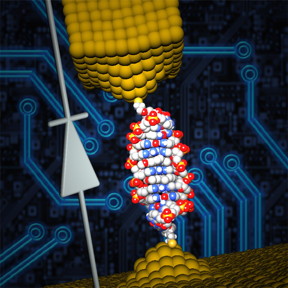 |
| The University of Georgia and Ben-Gurion University research team site-specifically inserted a small molecule named coralyne into the DNA and were able to create a single-molecule diode, which can be used as an active element in future nanoscale circuits. CREDIT: University of Georgia and Ben-Gurion University |
Abstract:
Researchers at the University of Georgia and at Ben-Gurion University in Israel have demonstrated for the first time that nanoscale electronic components can be made from single DNA molecules. Their study, published in the journal Nature Chemistry, represents a promising advance in the search for a replacement for the silicon chip.
Researchers use single molecule of DNA to create world's smallest diode: Study advances search for silicon chip replacement
Athens, GA | Posted on April 5th, 2016The finding may eventually lead to smaller, more powerful and more advanced electronic devices, according to the study's lead author, Bingqian Xu.
"For 50 years, we have been able to place more and more computing power onto smaller and smaller chips, but we are now pushing the physical limits of silicon," said Xu, an associate professor in the UGA College of Engineering and an adjunct professor in chemistry and physics. "If silicon-based chips become much smaller, their performance will become unstable and unpredictable."
To find a solution to this challenge, Xu turned to DNA. He says DNA's predictability, diversity and programmability make it a leading candidate for the design of functional electronic devices using single molecules.
In the Nature Chemistry paper, Xu and collaborators at Ben-Gurion University of the Negev describe using a single molecule of DNA to create the world's smallest diode. A diode is a component vital to electronic devices that allows current to flow in one direction but prevents its flow in the other direction.
Xu and a team of graduate research assistants at UGA isolated a specifically designed single duplex DNA of 11 base pairs and connected it to an electronic circuit only a few nanometers in size. After the measured current showed no special behavior, the team site-specifically intercalated a small molecule named coralyne into the DNA. They found the current flowing through the DNA was 15 times stronger for negative voltages than for positive voltages, a necessary feature of a diode.
"This finding is quite counterintuitive because the molecular structure is still seemingly symmetrical after coralyne intercalation," Xu said.
A theoretical model developed by Yanantan Dubi of Ben-Gurion University indicated the diode-like behavior of DNA originates from the bias voltage-induced breaking of spatial symmetry inside the DNA molecule after the coralyne is inserted.
"Our discovery can lead to progress in the design and construction of nanoscale electronic elements that are at least 1,000 times smaller than current components," Xu said.
The research team plans to continue its work, with the goal of constructing additional molecular devices and enhancing the performance of the molecular diode.
###
The research is supported by the National Science Foundation.
####
For more information, please click here
Contacts:
Stephanie Schupska
706-542-6927
Copyright © University of Georgia
If you have a comment, please Contact us.Issuers of news releases, not 7th Wave, Inc. or Nanotechnology Now, are solely responsible for the accuracy of the content.
Bookmark:


| Related Links |
| Related News Press |
News and information
 Quantum computer improves AI predictions April 17th, 2026
Flexible sensor gains sensitivity under pressure April 17th, 2026
A reusable chip for particulate matter sensing April 17th, 2026
Detecting vibrational quantum beating in the predissociation dynamics of SF6 using time-resolved photoelectron spectroscopy April 17th, 2026
Govt.-Legislation/Regulation/Funding/Policy
Quantum computer improves AI predictions April 17th, 2026
Metasurfaces smooth light to boost magnetic sensing precision January 30th, 2026
New imaging approach transforms study of bacterial biofilms August 8th, 2025
Possible Futures
A fundamentally new therapeutic approach to cystic fibrosis: Nanobody repairs cellular defect April 17th, 2026
UC Irvine physicists discover method to reverse ‘quantum scrambling’ : The work addresses the problem of information loss in quantum computing system April 17th, 2026
Chip Technology
A reusable chip for particulate matter sensing April 17th, 2026
Metasurfaces smooth light to boost magnetic sensing precision January 30th, 2026
Nanoelectronics
Lab to industry: InSe wafer-scale breakthrough for future electronics August 8th, 2025
Interdisciplinary: Rice team tackles the future of semiconductors Multiferroics could be the key to ultralow-energy computing October 6th, 2023
Key element for a scalable quantum computer: Physicists from Forschungszentrum Jülich and RWTH Aachen University demonstrate electron transport on a quantum chip September 23rd, 2022
Reduced power consumption in semiconductor devices September 23rd, 2022
Discoveries
Quantum computer improves AI predictions April 17th, 2026
Flexible sensor gains sensitivity under pressure April 17th, 2026
A reusable chip for particulate matter sensing April 17th, 2026
Detecting vibrational quantum beating in the predissociation dynamics of SF6 using time-resolved photoelectron spectroscopy April 17th, 2026
Announcements
A fundamentally new therapeutic approach to cystic fibrosis: Nanobody repairs cellular defect April 17th, 2026
UC Irvine physicists discover method to reverse ‘quantum scrambling’ : The work addresses the problem of information loss in quantum computing system April 17th, 2026
Interviews/Book Reviews/Essays/Reports/Podcasts/Journals/White papers/Posters
A fundamentally new therapeutic approach to cystic fibrosis: Nanobody repairs cellular defect April 17th, 2026
UC Irvine physicists discover method to reverse ‘quantum scrambling’ : The work addresses the problem of information loss in quantum computing system April 17th, 2026
Nanobiotechnology
A fundamentally new therapeutic approach to cystic fibrosis: Nanobody repairs cellular defect April 17th, 2026
New molecular technology targets tumors and simultaneously silences two ‘undruggable’ cancer genes August 8th, 2025
New imaging approach transforms study of bacterial biofilms August 8th, 2025
Electrifying results shed light on graphene foam as a potential material for lab grown cartilage June 6th, 2025
Research partnerships
Lab to industry: InSe wafer-scale breakthrough for future electronics August 8th, 2025
HKU physicists uncover hidden order in the quantum world through deconfined quantum critical points April 25th, 2025
 |
||
 |
||
| The latest news from around the world, FREE | ||
 |
||
|
|
||
| Premium Products | ||
 |
||
|
Only the news you want to read!
Learn More |
||
 |
||
|
Full-service, expert consulting
Learn More |
||
|
|
||