Home > Press > Researchers demonstrate a new way to characterize twisted light
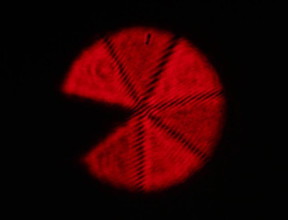 |
| To characterize twisted light the researchers looked at the images produced by the interference of a structured laser beam with a replica of that beam rotated by a given angle, including this "Pac-Man." CREDIT: Mohammad Mirhosseini |
Abstract:
Researchers at the University of Rochester have overcome experimental challenges to demonstrate a new way for getting a full picture of twisted light: characterizing the Wigner distribution.
Researchers demonstrate a new way to characterize twisted light
Rochester, NY | Posted on April 4th, 2016Twisted light has raised researchers' interest for its potential for quantum communication applications. The discrete nature of one of the defining parameters of twisted light, orbital angular momentum (OAM), makes it attractive for encoding quantum information. There is also no known fundamental limit to the maximum OAM value that can be coded into a photon, which could allow for quicker communication than with other systems.
But before any particular system can be used in quantum communication, researchers need to be able to measure it and describe it. Other methods to obtain the wavefunction, a property that describes a quantum system in full - such as quantum tomography or direct measurements - have been demonstrated in the past. However, in a Physical Review Letters paper published this week, the Rochester researchers state that their technique is particularly "suitable for quantum information applications involving a large number of OAM states."
The Wigner distribution is a mathematical construct that completely describes a system in terms of two conjugate variables, that is two variables linked by Heisenberg's Uncertainty Principle. Mohammad Mirhosseini, a postdoctoral associate in Professor of Optics Robert W. Boyd's group, and his collaborators at the Institute of Optics have now shown how the Wigner distribution can be obtained for twisted light. The work also represents the first characterization of the Wigner distribution that involves a discrete variable, as is the case with OAM.
"Apart from the potential uses in quantum communication, our work might offer a good way for describing atomic systems with quantized levels," said Mirhosseini. "The Wigner distribution of twisted light is a very complete way to understand the system: not only does it tell us about the relation between these two linked variables, but it also tells us about the system's behavior. We showed that the Wigner distribution for twisted light superpositions contains negative values, which reveals wave-like behavior."
Mirhosseini thinks their work could also show a possible path forward for other experiments.
"Measuring time in quantum systems is not as simple as using a watch - it can prove challenging," says Mirhosseini. "The conjugate variable of OAM, angle, is in many ways similar to phase, which is itself similar to time. So perhaps the lessons learned here can be applied, in other experiments, to systems where we need to measure time."
####
For more information, please click here
Contacts:
Leonor Sierra
585-276-6264
Copyright © University of Rochester
If you have a comment, please Contact us.Issuers of news releases, not 7th Wave, Inc. or Nanotechnology Now, are solely responsible for the accuracy of the content.
Bookmark:


| Related Links |
| Related News Press |
News and information
 Quantum computer improves AI predictions April 17th, 2026
Flexible sensor gains sensitivity under pressure April 17th, 2026
A reusable chip for particulate matter sensing April 17th, 2026
Detecting vibrational quantum beating in the predissociation dynamics of SF6 using time-resolved photoelectron spectroscopy April 17th, 2026
Quantum Physics
Detecting vibrational quantum beating in the predissociation dynamics of SF6 using time-resolved photoelectron spectroscopy April 17th, 2026
Beyond silicon: Electronics at the scale of a single molecule January 30th, 2026
ICFO researchers overcome long-standing bottleneck in single photon detection with twisted 2D materials August 8th, 2025
Wireless/telecommunications/RF/Antennas/Microwaves
Researchers develop molecular qubits that communicate at telecom frequencies October 3rd, 2025
HKUST researchers develop new integration technique for efficient coupling of III-V and silicon February 16th, 2024
Govt.-Legislation/Regulation/Funding/Policy
Quantum computer improves AI predictions April 17th, 2026
Metasurfaces smooth light to boost magnetic sensing precision January 30th, 2026
New imaging approach transforms study of bacterial biofilms August 8th, 2025
Discoveries
Quantum computer improves AI predictions April 17th, 2026
Flexible sensor gains sensitivity under pressure April 17th, 2026
A reusable chip for particulate matter sensing April 17th, 2026
Detecting vibrational quantum beating in the predissociation dynamics of SF6 using time-resolved photoelectron spectroscopy April 17th, 2026
Announcements
A fundamentally new therapeutic approach to cystic fibrosis: Nanobody repairs cellular defect April 17th, 2026
UC Irvine physicists discover method to reverse ‘quantum scrambling’ : The work addresses the problem of information loss in quantum computing system April 17th, 2026
Interviews/Book Reviews/Essays/Reports/Podcasts/Journals/White papers/Posters
A fundamentally new therapeutic approach to cystic fibrosis: Nanobody repairs cellular defect April 17th, 2026
UC Irvine physicists discover method to reverse ‘quantum scrambling’ : The work addresses the problem of information loss in quantum computing system April 17th, 2026
Grants/Sponsored Research/Awards/Scholarships/Gifts/Contests/Honors/Records
Quantum computer improves AI predictions April 17th, 2026
Detecting vibrational quantum beating in the predissociation dynamics of SF6 using time-resolved photoelectron spectroscopy April 17th, 2026
Metasurfaces smooth light to boost magnetic sensing precision January 30th, 2026
Photonics/Optics/Lasers
Metasurfaces smooth light to boost magnetic sensing precision January 30th, 2026
From sensors to smart systems: the rise of AI-driven photonic noses January 30th, 2026
 |
||
 |
||
| The latest news from around the world, FREE | ||
 |
||
|
|
||
| Premium Products | ||
 |
||
|
Only the news you want to read!
Learn More |
||
 |
||
|
Full-service, expert consulting
Learn More |
||
|
|
||