Home > Press > Smaller. Cheaper. Better. Iron nitride transformers developed at Sandia could boost energy storage options
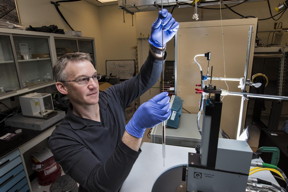 |
| Sandia National Laboratories researcher Todd Monson and his colleagues have demonstrated the fabrication of iron nitride transformers in power-conversion test beds.
Photo by Randy Montoya |
Abstract:
A Sandia-led team has developed a way to make a magnetic material that could lead to lighter and smaller, cheaper and better-performing high-frequency transformers, needed for more flexible energy storage systems and widespread adoption of renewable energy.
Smaller. Cheaper. Better. Iron nitride transformers developed at Sandia could boost energy storage options
Albuquerque, NM | Posted on March 28th, 2016The work is part of a larger, integrated portfolio of projects funded by Department of Energy's (DOE) Energy Storage Program in the Office of Electricity Delivery and Energy Reliability.
Transportable energy storage and power conversion systems, which can fit inside a single semi-trailer, could make it cost effective to rapidly install solar, wind and geothermal energy systems in even the most remote locations.
"Such modular systems could be deployed quickly to multiple sites with much less assembly and validation time," said Sandia researcher Todd Monson of Nanoscale Sciences Department, who led the team with Stan Atcitty of Sandia's Energy Storage Technology & Systems Department.
Sandia manufactures iron nitride (γ'-Fe4N) powders by ball-milling iron powders in liquid nitrogen and then ammonia. The iron nitride powders are then consolidated through a low-temperature field-assisted sintering technique (FAST) that forms a solid material from loose powders through the application of heat and sometimes pressure.
The FAST manufacturing method enables the creation of transformer cores from raw starting materials in minutes, without decomposing the required iron nitrides, as could happen at the higher temperatures used in conventional sintering. Previously, the γ' phase of iron nitride has only been synthesized in either thin-film form in high-vacuum environments or as inclusions in other materials, and never integrated into an actual device.
Monson said using this method could make transformers up to 10 times smaller than they are currently.
No machining required
"FAST enables the net-shaping of parts, meaning that iron nitride powders can be sintered directly into perfectly sized parts, such as transformer cores, which don't require any machining," Monson said.
Due to its magnetic properties, iron nitride transformers can be made much more compact and lighter than traditional transformers, with better power-handling capability and greater efficiency. They will require only air cooling, another important space saver. Iron nitride also could serve as a more robust, high-performance transformer core material across the nation's electrical grid.
So far, Monson and his colleagues have demonstrated the fabrication of iron nitride transformer cores with good physical and magnetic characteristics and now are refining their process and preparing to test the transformers in power-conversion test beds.
"Advanced magnetic materials are critical for next-generation power conversion systems that use high-frequency linked converters, and can complement Sandia efforts in ultra-wide bandgap device materials for improved power electronics systems. They can withstand higher frequencies and higher temperatures, which ultimately result in high power density designs," said Atcitty.
Monson, Atcitty and their team built on Sandia's expertise in power electronics and magnetic materials in strong collaborations with University of California, Irvine, and Arizona State University researchers, who helped with materials processing and systems-level modeling.
Team members from Sandia and UC Irvine have filed a patent application for the materials synthesis process.
"Power electronics represents a substantial cost factor in an effective energy storage system," said Imre Gyuk, Energy Storage program manager in the DOE's Office of Electricity Delivery and Energy Reliability.
###
####
About Sandia National Labratories
Sandia National Laboratories is a multi-program laboratory operated by Sandia Corporation, a wholly owned subsidiary of Lockheed Martin Corp., for the U.S. Department of Energy's National Nuclear Security Administration. With main facilities in Albuquerque, N.M., and Livermore, Calif., Sandia has major R&D responsibilities in national security, energy and environmental technologies and economic competitiveness.
For more information, please click here
Contacts:
Stephanie Holinka
505-284-9227
Copyright © Sandia National Labratories
If you have a comment, please Contact us.Issuers of news releases, not 7th Wave, Inc. or Nanotechnology Now, are solely responsible for the accuracy of the content.
Bookmark:


| Related Links |
 For more information about the program, see Sandia's Energy Storage Program website:
| Related News Press |
News and information
Quantum computer improves AI predictions April 17th, 2026
Flexible sensor gains sensitivity under pressure April 17th, 2026
A reusable chip for particulate matter sensing April 17th, 2026
Detecting vibrational quantum beating in the predissociation dynamics of SF6 using time-resolved photoelectron spectroscopy April 17th, 2026
Laboratories
Researchers develop molecular qubits that communicate at telecom frequencies October 3rd, 2025
A battery’s hopping ions remember where they’ve been: Seen in atomic detail, the seemingly smooth flow of ions through a battery’s electrolyte is surprisingly complicated February 16th, 2024
Govt.-Legislation/Regulation/Funding/Policy
Quantum computer improves AI predictions April 17th, 2026
Metasurfaces smooth light to boost magnetic sensing precision January 30th, 2026
New imaging approach transforms study of bacterial biofilms August 8th, 2025
Possible Futures
A fundamentally new therapeutic approach to cystic fibrosis: Nanobody repairs cellular defect April 17th, 2026
UC Irvine physicists discover method to reverse ‘quantum scrambling’ : The work addresses the problem of information loss in quantum computing system April 17th, 2026
Discoveries
Quantum computer improves AI predictions April 17th, 2026
Flexible sensor gains sensitivity under pressure April 17th, 2026
A reusable chip for particulate matter sensing April 17th, 2026
Detecting vibrational quantum beating in the predissociation dynamics of SF6 using time-resolved photoelectron spectroscopy April 17th, 2026
Announcements
A fundamentally new therapeutic approach to cystic fibrosis: Nanobody repairs cellular defect April 17th, 2026
UC Irvine physicists discover method to reverse ‘quantum scrambling’ : The work addresses the problem of information loss in quantum computing system April 17th, 2026
Patents/IP/Tech Transfer/Licensing
Getting drugs across the blood-brain barrier using nanoparticles March 3rd, 2023
Metasurfaces control polarized light at will: New research unlocks the hidden potential of metasurfaces August 13th, 2021
Arrowhead Pharmaceuticals Announces Closing of Agreement with Takeda November 27th, 2020
Energy
Sensors innovations for smart lithium-based batteries: advancements, opportunities, and potential challenges August 8th, 2025
Simple algorithm paired with standard imaging tool could predict failure in lithium metal batteries August 8th, 2025
Battery Technology/Capacitors/Generators/Piezoelectrics/Thermoelectrics/Energy storage
Decoding hydrogen‑bond network of electrolyte for cryogenic durable aqueous zinc‑ion batteries January 30th, 2026
COF scaffold membrane with gate‑lane nanostructure for efficient Li+/Mg2+ separation January 30th, 2026
MXene nanomaterials enter a new dimension Multilayer nanomaterial: MXene flakes created at Drexel University show new promise as 1D scrolls January 30th, 2026
Research partnerships
Lab to industry: InSe wafer-scale breakthrough for future electronics August 8th, 2025
HKU physicists uncover hidden order in the quantum world through deconfined quantum critical points April 25th, 2025
 |
||
 |
||
| The latest news from around the world, FREE | ||
 |
||
|
|
||
| Premium Products | ||
 |
||
|
Only the news you want to read!
Learn More |
||
 |
||
|
Full-service, expert consulting
Learn More |
||
|
|
||