Home > Press > Experimentation and largest-ever quantum simulation of a disordered system explain quantum many-particle problem
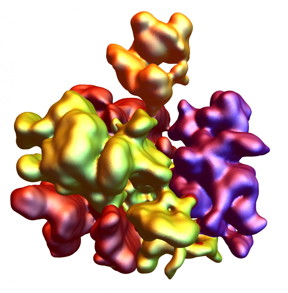 |
| Figure illustrates puddles of localized quasi-condensates found using a quantum Monte Carlo simulation of trapped atoms in a disordered lattice. Individual puddles, consisting of 10-20 particles each, are incoherent relative to each other. The Bose glass is composed of these puddle-like structures. CREDIT: Ushnish Ray, University of Illinois |
Abstract:
Using some of the largest supercomputers available, physics researchers from the University of Illinois at Urbana-Champaign have produced one of the largest simulations ever to help explain one of physics most daunting problems.
Experimentation and largest-ever quantum simulation of a disordered system explain quantum many-particle problem
Urbana, IL | Posted on March 15th, 2016"This result was a fantastic collaboration between theory and experiment," explained Physics Professor Brian DeMarco, whose group led the experimental phase of the study. "One of the grandest and most impactful frontiers of physics is the quantum many-particle problem. We do not understand very well what happens when many quantum particles come together and interact with each other. This problem spans some of the largest scales in the universe, like understanding the nuclear matter in neutron stars, to the smallest, such as electron transport in photosynthesis and the quarks and gluons inside a proton."
DeMarco's group experiments with atoms gases cooled to just billionths of a degree above absolute zero temperature in order to experimentally simulate models of materials such as high-temperature superconductors. In these experiments, the atoms play the role of electrons in a material, and the analog of material parameters (like disorder) are completely controlled and known and can be changed every 90-second experimental cycle. Measurements on the atoms are used to expose new physics and test theories.
"In most cases, we lack predictive power, because these problems are not readily computable -- a classical computer requires exponentially costly resources to simulate many quantum systems," added David Ceperley, a professor of physics whose team developed the companion simulation. "A key example of this problem with practical challenges lies with materials such as high-temperature superconductors. Even armed with the chemical composition and structure of these materials, it is almost impossible to predict today at what temperature they will super-conduct."
The different approaches to attacking a particularly important quantum many-particle problem by DeMarco's and Ceperley's groups came together in a new result published in Nature Physics. In their paper, "Probing the Bose glass-superfluid transition using quantum quenches of disorder," Carolyn Meldgin from DeMarco's group and Ushnish Ray from Ceperley's team share a new understanding of how disorder in a quantum material gives rise to an exotic quantum state called a Bose glass.
"A Bose glass is a strange and poorly understood insulator that can occur when disorder is added to a superfluid or superconductor," Meldgin said. In her experiments, Meldgin was able to use optical disorder to induce a Bose glass, and Ray exactly simulated the experiment using the Titan supercomputer.
In this work, Ceperley's group achieved the largest scale computer simulations possible of a disordered quantum many-particle system on the biggest supercomputers in existence. These computer simulations were able to simulate relatively large numbers of particles, such as the 30,000 atoms used in DeMarco's experiments.
Together, Meldgin and Ray were able to show something startling--that a dynamic probe in the experiment connects to the equilibrium computer simulations.
"In both cases, the same amount of disorder is required to turn a superfluid into a Bose-glass," Ray stated. "This result is critically important to our understanding of disordered quantum materials, which are ubiquitous, since disorder is difficult to avoid. It also has important implications for quantum annealers, like the D-Wave Systems device."
####
For more information, please click here
Contacts:
Brian DeMarco
217-244-9848
Copyright © University of Illinois College of Engineering
If you have a comment, please Contact us.Issuers of news releases, not 7th Wave, Inc. or Nanotechnology Now, are solely responsible for the accuracy of the content.
Bookmark:


| Related News Press |
News and information
 Quantum computer improves AI predictions April 17th, 2026
Flexible sensor gains sensitivity under pressure April 17th, 2026
A reusable chip for particulate matter sensing April 17th, 2026
Detecting vibrational quantum beating in the predissociation dynamics of SF6 using time-resolved photoelectron spectroscopy April 17th, 2026
Quantum Physics
Detecting vibrational quantum beating in the predissociation dynamics of SF6 using time-resolved photoelectron spectroscopy April 17th, 2026
Beyond silicon: Electronics at the scale of a single molecule January 30th, 2026
MXene nanomaterials enter a new dimension Multilayer nanomaterial: MXene flakes created at Drexel University show new promise as 1D scrolls January 30th, 2026
Physics
UC Irvine physicists discover method to reverse ‘quantum scrambling’ : The work addresses the problem of information loss in quantum computing system April 17th, 2026
Quantum Computing
Quantum computer improves AI predictions April 17th, 2026
UC Irvine physicists discover method to reverse ‘quantum scrambling’ : The work addresses the problem of information loss in quantum computing system April 17th, 2026
Researchers develop molecular qubits that communicate at telecom frequencies October 3rd, 2025
Discoveries
Quantum computer improves AI predictions April 17th, 2026
Flexible sensor gains sensitivity under pressure April 17th, 2026
A reusable chip for particulate matter sensing April 17th, 2026
Detecting vibrational quantum beating in the predissociation dynamics of SF6 using time-resolved photoelectron spectroscopy April 17th, 2026
Announcements
A fundamentally new therapeutic approach to cystic fibrosis: Nanobody repairs cellular defect April 17th, 2026
UC Irvine physicists discover method to reverse ‘quantum scrambling’ : The work addresses the problem of information loss in quantum computing system April 17th, 2026
Interviews/Book Reviews/Essays/Reports/Podcasts/Journals/White papers/Posters
A fundamentally new therapeutic approach to cystic fibrosis: Nanobody repairs cellular defect April 17th, 2026
UC Irvine physicists discover method to reverse ‘quantum scrambling’ : The work addresses the problem of information loss in quantum computing system April 17th, 2026
Events/Classes
Institute for Nanoscience hosts annual proposal planning meeting May 16th, 2025
A New Blue: Mysterious origin of the ribbontail ray’s electric blue spots revealed July 5th, 2024
Researchers demonstrate co-propagation of quantum and classical signals: Study shows that quantum encryption can be implemented in existing fiber networks January 20th, 2023
 |
||
 |
||
| The latest news from around the world, FREE | ||
 |
||
|
|
||
| Premium Products | ||
 |
||
|
Only the news you want to read!
Learn More |
||
 |
||
|
Full-service, expert consulting
Learn More |
||
|
|
||