Home > Press > Irregular silicon wafer breakage studied in real-time by direct and diffraction X-ray imaging
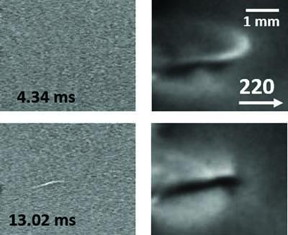 |
| On the left are the direct transmission images. On the right are the diffraction images. CREDIT: Rack et al. |
Abstract:
Fracture and breakage of single crystals, particularly of silicon wafers, are multi-scale problems: the crack tip starts propagating on an atomic scale with the breaking of chemical bonds, forms crack fronts through the crystal on the micrometre scale and ends macroscopically in catastrophic wafer shattering.
Irregular silicon wafer breakage studied in real-time by direct and diffraction X-ray imaging
Chester, UK | Posted on March 7th, 2016Total wafer breakage is a severe problem for the semiconductor industry not only during handling but also during temperature treatments, leading to million-dollar costs per annum in a device production line. Knowledge of the relevant dynamics governing perfect cleavage along the {111} or {110} faces, and of the deflection into higher indexed {hkl} faces of higher energy, is scarce due to the high velocity of the process. Imaging techniques are commonly limited to depicting only the state of a wafer before the crack and in the final state.
A group of researchers demonstrates, for the first time, in situ high-speed crack propagation under thermal stress, imaged simultaneously in direct transmission and diffraction X-ray imaging [Rack, Scheel and Danilewsky (2016). IUCrJ, 3, 108-114; doi:10.1107/S205225251502271X]. The scientists show how the propagating crack tip and the related strain field can be tracked in the phase-contrast and diffracted images, respectively. Movies with a time resolution of microseconds per frame reveal that the strain and crack tip do not propagate continuously or at a constant speed. Jumps in the crack tip position indicate pinning of the crack tip for about 1-2 ms followed by jumps faster than 2-6 m s-1, leading to a macroscopically observed average velocity of 0.028-0.055 m s-1. The results also give a proof of concept that the described X-ray technique is compatible with studying ultra-fast cracks up to the speed of sound.
Rack et al. comment, "We are only at the beginning of studying ultra-fast crack propagation in single-crystalline materials in real time".
####
For more information, please click here
Contacts:
Jonathan Agbenyega
44-124-434-2878
Copyright © International Union of Crystallography
If you have a comment, please Contact us.Issuers of news releases, not 7th Wave, Inc. or Nanotechnology Now, are solely responsible for the accuracy of the content.
Bookmark:


| Related Links |
| Related News Press |
News and information
 Quantum computer improves AI predictions April 17th, 2026
Flexible sensor gains sensitivity under pressure April 17th, 2026
A reusable chip for particulate matter sensing April 17th, 2026
Detecting vibrational quantum beating in the predissociation dynamics of SF6 using time-resolved photoelectron spectroscopy April 17th, 2026
Imaging
Chemistry
Projecting light to dispense liquids: A new route to ultra-precise microdroplets January 30th, 2026
From sensors to smart systems: the rise of AI-driven photonic noses January 30th, 2026
"Nanoreactor" cage uses visible light for catalytic and ultra-selective cross-cycloadditions October 3rd, 2025
Chip Technology
A reusable chip for particulate matter sensing April 17th, 2026
Metasurfaces smooth light to boost magnetic sensing precision January 30th, 2026
Discoveries
Quantum computer improves AI predictions April 17th, 2026
Flexible sensor gains sensitivity under pressure April 17th, 2026
A reusable chip for particulate matter sensing April 17th, 2026
Detecting vibrational quantum beating in the predissociation dynamics of SF6 using time-resolved photoelectron spectroscopy April 17th, 2026
Announcements
A fundamentally new therapeutic approach to cystic fibrosis: Nanobody repairs cellular defect April 17th, 2026
UC Irvine physicists discover method to reverse ‘quantum scrambling’ : The work addresses the problem of information loss in quantum computing system April 17th, 2026
Interviews/Book Reviews/Essays/Reports/Podcasts/Journals/White papers/Posters
A fundamentally new therapeutic approach to cystic fibrosis: Nanobody repairs cellular defect April 17th, 2026
UC Irvine physicists discover method to reverse ‘quantum scrambling’ : The work addresses the problem of information loss in quantum computing system April 17th, 2026
Tools
Metasurfaces smooth light to boost magnetic sensing precision January 30th, 2026
From sensors to smart systems: the rise of AI-driven photonic noses January 30th, 2026
Japan launches fully domestically produced quantum computer: Expo visitors to experience quantum computing firsthand August 8th, 2025
 |
||
 |
||
| The latest news from around the world, FREE | ||
 |
||
|
|
||
| Premium Products | ||
 |
||
|
Only the news you want to read!
Learn More |
||
 |
||
|
Full-service, expert consulting
Learn More |
||
|
|
||