Home > Press > Nanobiosensors and photofunctional materials designed at ICN2 recognized by the PIONER Awards
 |
Abstract:
The ceremony of the second edition of the PIONER Awards has been held today at the headquarters of the CERCA Institution in Barcelona. Five young people who have developed a doctoral thesis with industrial potential have awarded. Two of the awarded researchers developed their thesis in the Catalan Institute of Nanoscience and Nanotechnology (ICN2).
Nanobiosensors and photofunctional materials designed at ICN2 recognized by the PIONER Awards
Barcelona, Spain | Posted on December 21st, 2015Developing a doctoral thesis is one of the first major challenges of the research career. In these early stages it is very important that researchers are aware that their results may have not only a great scientific value, but also commercial and industrial implications. For this reason, promoted by the Research Centers of Catalonia (CERCA), the CERCA Institution promotes the PIONER Awards in order to distinguish those researchers who have developed a doctoral thesis with a clear commercial potential.
The ceremony of the second edition of the PIONER Awards was held today at the headquarters of the CERCA Institution (Via Laietana, 2; Barcelona). Five young people who have developed their doctoral thesis within a CERCA center received the award for having initiated or strengthened a technology or product with industrial interest. Two of these awards have recognized the work of doctors who developed their doctoral thesis in the Catalan Institute of Nanoscience and Nanotechnology (ICN2).
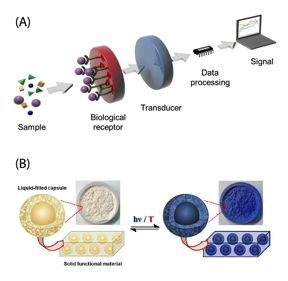
The first awarded ICN2 doctoral thesis focuses on the development of optical biosensors for diagnosis and therapeutic monitoring of various diseases, such as allergy, celiac disease or cancer. The author of the thesis, entitled "Nanoplasmonic Biosensors for Clinical Diagnosis at the Point of Care" is Dr Maria Aznar Soler, who worked under the direction of Dr M. Carmen Estevez and CSIC researcher Prof Laura M . Lechuga, Group Leader of the ICN2 NanoBioSensors and Bioanalytical Applications (NanoB2A) Group.
The second ICN2 thesis applies encapsulation technologies to design intelligent materials with photochromic and thermochromic properties. It is entitled "Encapsulation of stimuli-responsive molecules for the preparation of photofunctional materials" and has been written by Dr. Nuria Vazquez, under the direction of CSIC researcher Prof Daniel Ruiz, Group Leader of the ICN2 Nanostructured Functional Materials (NanosFun), and Prof. Jordi Hernando, from the Chemistry Department at the Autonomous University of Barcelona (UAB).
The rest of the winners are Dr Michal Drozdzal, from the Computer Vision Centre (CVC); Dr Alessandro Franci, from the International Center for Numerical Methods in Engineering (CIMNE); and Dr Benjamí Oller Salvia, from the Institute for Research in Biomedicine (IRB Barcelona). The fact that two of five awards have been awarded to researches developed at ICN2 evidences the commercial potential of the work developed at this center.
####
For more information, please click here
Contacts:
Alex Argemi
Phone: +34 93 737 26 07
Copyright © ICN2
If you have a comment, please Contact us.Issuers of news releases, not 7th Wave, Inc. or Nanotechnology Now, are solely responsible for the accuracy of the content.
Bookmark:


| Related News Press |
News and information
 Quantum computer improves AI predictions April 17th, 2026
Flexible sensor gains sensitivity under pressure April 17th, 2026
A reusable chip for particulate matter sensing April 17th, 2026
Detecting vibrational quantum beating in the predissociation dynamics of SF6 using time-resolved photoelectron spectroscopy April 17th, 2026
Sensors
Flexible sensor gains sensitivity under pressure April 17th, 2026
Tiny nanosheets, big leap: A new sensor detects ethanol at ultra-low levels January 30th, 2026
From sensors to smart systems: the rise of AI-driven photonic noses January 30th, 2026
Sensors innovations for smart lithium-based batteries: advancements, opportunities, and potential challenges August 8th, 2025
Discoveries
Quantum computer improves AI predictions April 17th, 2026
Flexible sensor gains sensitivity under pressure April 17th, 2026
A reusable chip for particulate matter sensing April 17th, 2026
Detecting vibrational quantum beating in the predissociation dynamics of SF6 using time-resolved photoelectron spectroscopy April 17th, 2026
Materials/Metamaterials/Magnetoresistance
First real-time observation of two-dimensional melting process: Researchers at Mainz University unveil new insights into magnetic vortex structures August 8th, 2025
Researchers unveil a groundbreaking clay-based solution to capture carbon dioxide and combat climate change June 6th, 2025
A 1960s idea inspires NBI researchers to study hitherto inaccessible quantum states June 6th, 2025
Institute for Nanoscience hosts annual proposal planning meeting May 16th, 2025
Announcements
A fundamentally new therapeutic approach to cystic fibrosis: Nanobody repairs cellular defect April 17th, 2026
UC Irvine physicists discover method to reverse ‘quantum scrambling’ : The work addresses the problem of information loss in quantum computing system April 17th, 2026
Interviews/Book Reviews/Essays/Reports/Podcasts/Journals/White papers/Posters
A fundamentally new therapeutic approach to cystic fibrosis: Nanobody repairs cellular defect April 17th, 2026
UC Irvine physicists discover method to reverse ‘quantum scrambling’ : The work addresses the problem of information loss in quantum computing system April 17th, 2026
Grants/Sponsored Research/Awards/Scholarships/Gifts/Contests/Honors/Records
Quantum computer improves AI predictions April 17th, 2026
Detecting vibrational quantum beating in the predissociation dynamics of SF6 using time-resolved photoelectron spectroscopy April 17th, 2026
Metasurfaces smooth light to boost magnetic sensing precision January 30th, 2026
Photonics/Optics/Lasers
Metasurfaces smooth light to boost magnetic sensing precision January 30th, 2026
From sensors to smart systems: the rise of AI-driven photonic noses January 30th, 2026
 |
||
 |
||
| The latest news from around the world, FREE | ||
 |
||
|
|
||
| Premium Products | ||
 |
||
|
Only the news you want to read!
Learn More |
||
 |
||
|
Full-service, expert consulting
Learn More |
||
|
|
||