Home > Press > Nanostructured metal coatings let the light through for electrical devices
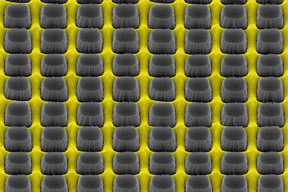 |
| An array of nanopillars etched by thin layer of grate-patterned metal creates a nonreflective yet conductive surface that could improve electronic device performance.
Image courtesy of Daniel Wasserman |
Abstract:
Light and electricity dance a complicated tango in devices like LEDs, solar cells and sensors. A new anti-reflection coating developed by engineers at the University of Illinois at Urbana Champaign, in collaboration with researchers at the University of Massachusetts at Lowell, lets light through without hampering the flow of electricity, a step that could increase efficiency in such devices.
Nanostructured metal coatings let the light through for electrical devices
Champaign, IL | Posted on December 8th, 2015The coating is a specially engraved, nanostructured thin film that allows more light through than a flat surface, yet also provides electrical access to the underlying material – a crucial combination for optoelectronics, devices that convert electricity to light or vice versa. The researchers, led by U. of I. electrical and computer engineering professor Daniel Wasserman, published their findings in the journal Advanced Materials.
“The ability to improve both electrical and optical access to a material is an important step towards higher-efficiency optoelectronic devices,” said Wasserman, a member of the Micro and Nano Technology Laboratory at Illinois.
At the interface between two materials, such as a semiconductor and air, some light is always reflected, Wasserman said. This limits the efficiency of optoelectronic devices. If light is emitted in a semiconductor, some fraction of this light will never escape the semiconductor material. Alternatively, for a sensor or solar cell, some fraction of light will never make it to the detector to be collected and turned into an electrical signal. Researchers use a model called Fresnel’s equations to describe the reflection and transmission at the interface between two materials.
“It has been long known that structuring the surface of a material can increase light transmission,” said study co-author Viktor Podolskiy, a professor at the University of Massachusetts at Lowell. “Among such structures, one of the more interesting is similar to structures found in nature, and is referred to as a ‘moth-eye’ pattern: tiny nanopillars which can ‘beat’ the Fresnel equations at certain wavelengths and angles.”
Although such pattered surfaces aid in light transmission, they hinder electrical transmission, creating a barrier to the underlying electrical material.
“In most cases, the addition of a conducting material to the surface results in absorption and reflection, both of which will degrade device performance,” Wasserman said.
The Illinois and Massachusetts team used a patented method of metal-assisted chemical etching, MacEtch, developed at Illinois by Xiuling Li, U. of I. professor of electrical and computer engineering and co-author of the new paper. The researchers used MacEtch to engrave a patterned metal film into a semiconductor to create an array of tiny nanopillars rising above the metal film. The combination of these “moth-eye” nanopillars and the metal film created a partially coated material that outperformed the untreated semiconductor.
“The nanopillars enhance the optical transmission while the metal film offers electrical contact. Remarkably, we can improve our optical transmission and electrical access simultaneously,” said Ryan Liu, a graduate researcher at Illinois and a co-lead author of the work along with Illinois graduate researcher Xiang Zhao and Massachusetts graduate researcher Christopher Roberts.
The researchers demonstrated that their technique, which results in metal covering roughly half of the surface, can transmit about 90 percent of light to or from the surface. For comparison, the bare, unpatterned surface with no metal can only transmit 70 percent of the light and has no electrical contact.
The researchers also demonstrated their ability to tune the material’s optical properties by adjusting the metal film’s dimensions and how deeply it etches into the semiconductor.
“We are looking to integrate these nanostructured films with optoelectronic devices to demonstrate that we can simultaneously improve both the optical and electronic properties of devices operating at wavelengths from the visible all the way to the far infrared,” Wasserman said.
The National Science Foundation and Lam Research supported this work.
####
For more information, please click here
Contacts:
Liz Ahlberg
Physical Sciences Editor
217-244-1073
Daniel Wasserman
217-333-9872
Copyright © University of Illinois at Urbana-Champaign
If you have a comment, please Contact us.Issuers of news releases, not 7th Wave, Inc. or Nanotechnology Now, are solely responsible for the accuracy of the content.
Bookmark:


| Related Links |
| Related News Press |
News and information
 Quantum computer improves AI predictions April 17th, 2026
Flexible sensor gains sensitivity under pressure April 17th, 2026
A reusable chip for particulate matter sensing April 17th, 2026
Detecting vibrational quantum beating in the predissociation dynamics of SF6 using time-resolved photoelectron spectroscopy April 17th, 2026
Thin films
Tiny nanosheets, big leap: A new sensor detects ethanol at ultra-low levels January 30th, 2026
Display technology/LEDs/SS Lighting/OLEDs
Spinel-type sulfide semiconductors to operate the next-generation LEDs and solar cells For solar-cell absorbers and green-LED source October 3rd, 2025
Efficient and stable hybrid perovskite-organic light-emitting diodes with external quantum efficiency exceeding 40 per cent July 5th, 2024
Govt.-Legislation/Regulation/Funding/Policy
Quantum computer improves AI predictions April 17th, 2026
Metasurfaces smooth light to boost magnetic sensing precision January 30th, 2026
New imaging approach transforms study of bacterial biofilms August 8th, 2025
Optical computing/Photonic computing
ICFO researchers overcome long-standing bottleneck in single photon detection with twisted 2D materials August 8th, 2025
Programmable electron-induced color router array May 14th, 2025
Sensors
Flexible sensor gains sensitivity under pressure April 17th, 2026
Tiny nanosheets, big leap: A new sensor detects ethanol at ultra-low levels January 30th, 2026
From sensors to smart systems: the rise of AI-driven photonic noses January 30th, 2026
Sensors innovations for smart lithium-based batteries: advancements, opportunities, and potential challenges August 8th, 2025
Discoveries
Quantum computer improves AI predictions April 17th, 2026
Flexible sensor gains sensitivity under pressure April 17th, 2026
A reusable chip for particulate matter sensing April 17th, 2026
Detecting vibrational quantum beating in the predissociation dynamics of SF6 using time-resolved photoelectron spectroscopy April 17th, 2026
Materials/Metamaterials/Magnetoresistance
First real-time observation of two-dimensional melting process: Researchers at Mainz University unveil new insights into magnetic vortex structures August 8th, 2025
Researchers unveil a groundbreaking clay-based solution to capture carbon dioxide and combat climate change June 6th, 2025
A 1960s idea inspires NBI researchers to study hitherto inaccessible quantum states June 6th, 2025
Institute for Nanoscience hosts annual proposal planning meeting May 16th, 2025
Announcements
A fundamentally new therapeutic approach to cystic fibrosis: Nanobody repairs cellular defect April 17th, 2026
UC Irvine physicists discover method to reverse ‘quantum scrambling’ : The work addresses the problem of information loss in quantum computing system April 17th, 2026
Interviews/Book Reviews/Essays/Reports/Podcasts/Journals/White papers/Posters
A fundamentally new therapeutic approach to cystic fibrosis: Nanobody repairs cellular defect April 17th, 2026
UC Irvine physicists discover method to reverse ‘quantum scrambling’ : The work addresses the problem of information loss in quantum computing system April 17th, 2026
Energy
Sensors innovations for smart lithium-based batteries: advancements, opportunities, and potential challenges August 8th, 2025
Simple algorithm paired with standard imaging tool could predict failure in lithium metal batteries August 8th, 2025
Grants/Sponsored Research/Awards/Scholarships/Gifts/Contests/Honors/Records
Quantum computer improves AI predictions April 17th, 2026
Detecting vibrational quantum beating in the predissociation dynamics of SF6 using time-resolved photoelectron spectroscopy April 17th, 2026
Metasurfaces smooth light to boost magnetic sensing precision January 30th, 2026
Photonics/Optics/Lasers
Metasurfaces smooth light to boost magnetic sensing precision January 30th, 2026
From sensors to smart systems: the rise of AI-driven photonic noses January 30th, 2026
Solar/Photovoltaic
Spinel-type sulfide semiconductors to operate the next-generation LEDs and solar cells For solar-cell absorbers and green-LED source October 3rd, 2025
KAIST researchers introduce new and improved, next-generation perovskite solar cell November 8th, 2024
Groundbreaking precision in single-molecule optoelectronics August 16th, 2024
Development of zinc oxide nanopagoda array photoelectrode: photoelectrochemical water-splitting hydrogen production January 12th, 2024
 |
||
 |
||
| The latest news from around the world, FREE | ||
 |
||
|
|
||
| Premium Products | ||
 |
||
|
Only the news you want to read!
Learn More |
||
 |
||
|
Full-service, expert consulting
Learn More |
||
|
|
||