Home > Press > Guided ultrasound plus nanoparticle chemotherapy cures tumors in mice
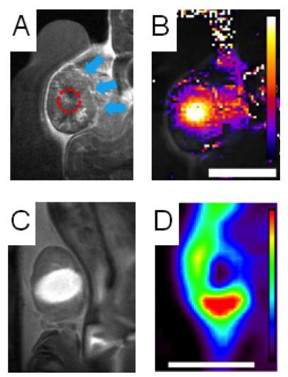 |
| Clockwise from top left: A tumor (blue arrows) is heated with ultrasound (red dashed line); heat map of tumor during treatment; PET scan shows nanoparticles in surviving tumor margin; bright contrast agent shows area damaged by heat. CREDIT: Andrew Wong/UC Davis |
Abstract:
Thermal ablation with magnetic resonance-guided focused ultrasound surgery (MRgFUS) is a noninvasive technique for treating fibroids and cancer. New research from UC Davis shows that combining the technique with chemotherapy can allow complete destruction of tumors in mice.
Guided ultrasound plus nanoparticle chemotherapy cures tumors in mice
Davis, CA | Posted on December 5th, 2015MRgFUS combines an ultrasound beam that heats and destroys tissue with a magnetic resonance imaging to guide the beam and monitor the effects of treatment. The effectiveness of the treatment can be limited by the need to spare normal tissue or critical structures on the tumor margins, as well as the need to eliminate micrometastases.
In a new paper in The Journal of Clinical Investigation, Katherine W. Ferrara, distinguished professor of biomedical engineering at UC Davis, and colleagues report on a strategy that can destroy an entire tumor without thermal destruction of the tumor margin. Her group demonstrated a dramatic increase in the concentration of anti-cancer chemotherapy within several types of MRgFUS thermal ablation-treated tumors.
"MRgFUS is already FDA approved for the treatment of uterine fibroids and palliation of bone metastases. We hope to expand the indication for MRgFUS by supplementing it with chemotherapy," said first author Andrew Wong, a graduate student with the UC Davis Physician Scientist Training Program.
Ferrara's previous research has shown that ultrasound-induced mild hyperthermia can enhance the accumulation of tiny nanoparticles carrying anti-cancer drugs, but the accumulation is dependent on the type of tumor. Her group hypothesized that combining thermal ablation and chemotherapy could improve efficacy across multiple types of tumors.
The team used a variety of techniques including combined positron emission tomography/computed tomography (PET-CT), magnetic resonance imaging, autoradiography, and fluorescence imaging to track nanoparticles loaded with the chemotherapy drug doxorubicin in a mouse model of breast cancer.
They found that as the ultrasound damaged the tumor and induced a local immune response, nanoparticles accumulated in the tumor and the local drug concentration increased 50-fold. The high drug concentrations continued over several weeks, increasing total exposure of the tumor to the drug.
Ferrara's research team found that the enhanced drug accumulation induced by MRgFUS resulted in improved survival and a consistent cure in their preclinical model of breast cancer, even when part of the tumor was left intact.
They also demonstrated that an effective cure could be achieved with a carefully designed protocol involving heat-activated nanoparticles, which, when gently heated by ultrasound, release their chemotherapeutic payload in the vasculature surrounding the tumor.
###
Additional members of the team included Brett Z. Fite, Yu Liu, Josquin Foiret, Azadeh Kheirolomoom, Jai W. Seo, Katherine D. Watson, Lisa M. Mahakian, Sarah Tam and Alexander D. Borowsky. The work was supported by grants from the National Institutes of Health.
####
For more information, please click here
Contacts:
Andy Fell
530-752-4533
Copyright © University of California, Davis
If you have a comment, please Contact us.Issuers of news releases, not 7th Wave, Inc. or Nanotechnology Now, are solely responsible for the accuracy of the content.
Bookmark:


| Related News Press |
News and information
 Quantum computer improves AI predictions April 17th, 2026
Flexible sensor gains sensitivity under pressure April 17th, 2026
A reusable chip for particulate matter sensing April 17th, 2026
Detecting vibrational quantum beating in the predissociation dynamics of SF6 using time-resolved photoelectron spectroscopy April 17th, 2026
Cancer
New molecular technology targets tumors and simultaneously silences two ‘undruggable’ cancer genes August 8th, 2025
Ben-Gurion University of the Negev researchers several steps closer to harnessing patient's own T-cells to fight off cancer June 6th, 2025
Self-propelled protein-based nanomotors for enhanced cancer therapy by inducing ferroptosis June 6th, 2025
Govt.-Legislation/Regulation/Funding/Policy
Quantum computer improves AI predictions April 17th, 2026
Metasurfaces smooth light to boost magnetic sensing precision January 30th, 2026
New imaging approach transforms study of bacterial biofilms August 8th, 2025
Possible Futures
A fundamentally new therapeutic approach to cystic fibrosis: Nanobody repairs cellular defect April 17th, 2026
UC Irvine physicists discover method to reverse ‘quantum scrambling’ : The work addresses the problem of information loss in quantum computing system April 17th, 2026
Nanomedicine
A fundamentally new therapeutic approach to cystic fibrosis: Nanobody repairs cellular defect April 17th, 2026
New molecular technology targets tumors and simultaneously silences two ‘undruggable’ cancer genes August 8th, 2025
New imaging approach transforms study of bacterial biofilms August 8th, 2025
Electrifying results shed light on graphene foam as a potential material for lab grown cartilage June 6th, 2025
Discoveries
Quantum computer improves AI predictions April 17th, 2026
Flexible sensor gains sensitivity under pressure April 17th, 2026
A reusable chip for particulate matter sensing April 17th, 2026
Detecting vibrational quantum beating in the predissociation dynamics of SF6 using time-resolved photoelectron spectroscopy April 17th, 2026
Announcements
A fundamentally new therapeutic approach to cystic fibrosis: Nanobody repairs cellular defect April 17th, 2026
UC Irvine physicists discover method to reverse ‘quantum scrambling’ : The work addresses the problem of information loss in quantum computing system April 17th, 2026
Interviews/Book Reviews/Essays/Reports/Podcasts/Journals/White papers/Posters
A fundamentally new therapeutic approach to cystic fibrosis: Nanobody repairs cellular defect April 17th, 2026
UC Irvine physicists discover method to reverse ‘quantum scrambling’ : The work addresses the problem of information loss in quantum computing system April 17th, 2026
Nanobiotechnology
A fundamentally new therapeutic approach to cystic fibrosis: Nanobody repairs cellular defect April 17th, 2026
New molecular technology targets tumors and simultaneously silences two ‘undruggable’ cancer genes August 8th, 2025
New imaging approach transforms study of bacterial biofilms August 8th, 2025
Electrifying results shed light on graphene foam as a potential material for lab grown cartilage June 6th, 2025
 |
||
 |
||
| The latest news from around the world, FREE | ||
 |
||
|
|
||
| Premium Products | ||
 |
||
|
Only the news you want to read!
Learn More |
||
 |
||
|
Full-service, expert consulting
Learn More |
||
|
|
||