Home > Press > New class of materials for organic electronics: Joint project details charge transport in polymeric carbon nitride for first time
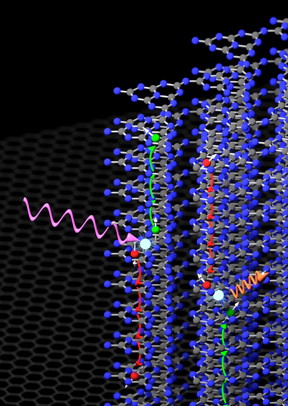 |
| Charge carriers in polymeric carbon nitrides always take paths perpendicular to the sheets, as Merschjann's group has now shown. Light creates an electron-hole pair. The opposite happens when an electron and hole meet under certain conditions (forming a singlet exciton) and emit light (fluorescence). CREDIT: C. Merschjann. |
Abstract:
Polymeric carbon nitrides are organic compounds synthesised to form a yellow powder of a myriad of nanocrystals. The crystalline structure resembles that of graphite because the carbon nitride groups are chemically bound only in layers, while just weak Van der Waals forces provide cohesion between these layers. It was already known that light is able to create an electron-hole pair in this class of materials. So there have already been numerous attempts to employ polymeric carbon nitrides as cost-effective photocatalysts for solar-powered water splitting. However, the efficiency levels so far have remained comparatively low.
New class of materials for organic electronics: Joint project details charge transport in polymeric carbon nitride for first time
Berlin, Germany | Posted on November 13th, 2015Light creates charge carriers
Now a team headed by Dr. Christoph Merschjann (HZB and Freie Universität Berlin) and Prof. Stefan Lochbrunner (University of Rostock) have for the first time precisely probed the processes occurring during light-induced charge separation. "The most interesting result has been that charges are basically only transported along one dimension during this process, perpendicular to the graphite-like layers", explains Merschjann. The light creates an electron-hole pair that subsequently migrates in opposing directions. Using femtosecond spectroscopy as well as other spectroscopic time-domain methods, the researchers were able to make the first quantitative mobility and lifetime measurements on the charge carriers. This revealed that the charge mobility attains values similar to those in conventional organic semiconductor materials. Moreover, the charge carriers are long-lived before recombining again.
New material for organic electronics
Polymeric carbon nitrides are not only non-toxic and cost-effective, they are also extremely durable because they are chemically very stable and can withstand temperatures of up to about 500 °C. Components made of these kinds of compounds might therefore be employed in environments that are unsuitable for today's organic electronics. Merschjann finds the prospect of growing these compounds on ordered substrates, such as graphene for example, especially interesting though. This is because graphene possesses extremely high in-plane conductivity, while carbon nitrides primarily conduct perpendicular to the sheets. "Carbon nitrides need not fear the competition with conventional organic semiconductor materials. On the contrary, completely new kinds of all-organic optoelectronic components might be built using their property of being essentially one-dimensional semiconductors", Merschjann hopes. He is currently working on making direct measurements of the charge carriers in a DFG-funded research project at Freie Universität Berlin.
###
The cooperation was initiated by the BMBF-Cluster-Projekct „Light2Hydrogen".
The results have been published in the renowned periodical Advanced Materials: Complementing Graphenes: 1D Interplanar Charge Transport in Polymeric Graphitic Carbon Nitrides
DOI: 10.1002/adma.201503448
####
For more information, please click here
Contacts:
Antonia Roetger
Copyright © Helmholtz-Zentrum Berlin für Materialien und Energie (HZB)
If you have a comment, please Contact us.Issuers of news releases, not 7th Wave, Inc. or Nanotechnology Now, are solely responsible for the accuracy of the content.
Bookmark:


| Related News Press |
News and information
 Quantum computer improves AI predictions April 17th, 2026
Flexible sensor gains sensitivity under pressure April 17th, 2026
A reusable chip for particulate matter sensing April 17th, 2026
Detecting vibrational quantum beating in the predissociation dynamics of SF6 using time-resolved photoelectron spectroscopy April 17th, 2026
Organic Electronics
Unveiling the power of hot carriers in plasmonic nanostructures August 16th, 2024
Efficient and stable hybrid perovskite-organic light-emitting diodes with external quantum efficiency exceeding 40 per cent July 5th, 2024
Optical computing/Photonic computing
ICFO researchers overcome long-standing bottleneck in single photon detection with twisted 2D materials August 8th, 2025
Programmable electron-induced color router array May 14th, 2025
Discoveries
Quantum computer improves AI predictions April 17th, 2026
Flexible sensor gains sensitivity under pressure April 17th, 2026
A reusable chip for particulate matter sensing April 17th, 2026
Detecting vibrational quantum beating in the predissociation dynamics of SF6 using time-resolved photoelectron spectroscopy April 17th, 2026
Announcements
A fundamentally new therapeutic approach to cystic fibrosis: Nanobody repairs cellular defect April 17th, 2026
UC Irvine physicists discover method to reverse ‘quantum scrambling’ : The work addresses the problem of information loss in quantum computing system April 17th, 2026
Interviews/Book Reviews/Essays/Reports/Podcasts/Journals/White papers/Posters
A fundamentally new therapeutic approach to cystic fibrosis: Nanobody repairs cellular defect April 17th, 2026
UC Irvine physicists discover method to reverse ‘quantum scrambling’ : The work addresses the problem of information loss in quantum computing system April 17th, 2026
Photonics/Optics/Lasers
Metasurfaces smooth light to boost magnetic sensing precision January 30th, 2026
From sensors to smart systems: the rise of AI-driven photonic noses January 30th, 2026
 |
||
 |
||
| The latest news from around the world, FREE | ||
 |
||
|
|
||
| Premium Products | ||
 |
||
|
Only the news you want to read!
Learn More |
||
 |
||
|
Full-service, expert consulting
Learn More |
||
|
|
||