Home > Press > Breakthrough in superconducting materials opens new path to fusion: New high-temperature superconducting materials are also compatible with high magnetic fields
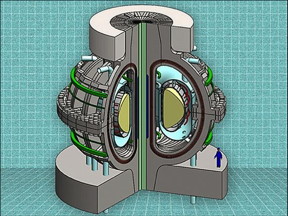 |
| Conceptual design of the ARC fusion reactor. About the same size as the currently operating JET tokamak in the United Kingdom, but with three times the magnetic field strength, ARC is sized to produce 500 MW of deuterium-tritium fueled fusion power.
CREDIT: Earl Marmar |
Abstract:
In fusion reactor designs, superconductors (which suffer no resistive power loss) are used to generate the magnetic fields that confine the 100 million degree C plasma. While increasing magnetic field strength offers potential ways to improve reactor performance, conventional low-temperature superconductors suffer dramatic drops in current carrying ability at high magnetic fields. Now, the emergence of high-temperature superconductors that can also operate at high magnetic fields opens a new, lower-cost path to fusion energy.
Breakthrough in superconducting materials opens new path to fusion: New high-temperature superconducting materials are also compatible with high magnetic fields
College Park, MD | Posted on November 13th, 2015A typical measure of fusion plasma performance is called "plasma beta," which is the ratio of plasma pressure to magnetic field pressure. Achieving a very high beta--generating the required plasma pressure with low magnetic field--could help reduce the cost of the superconducting magnets used in a fusion reactor. For this reason, many visions of fusion reactors try to maximize plasma beta at moderate magnetic field strengths. Operation at higher beta, however, pushes the plasma up against many performance limits, making plasma stability a tricky business.
But plasma beta is not the only consideration. Another ratio, the size of the confined plasma compared to the ion gyroradius, also determines overall energy confinement and dictates plasma performance. (The ion gyroradius is the helical path ions are forced to follow in the magnetic field.) Increasing magnetic field strength decreases the ion gyroradius, which allows a reduction in the size of the fusion device with no loss of performance. This approach also lowers beta and the plasma operates farther away from stability limits, in a "safe zone."
While scientists have explored both of these paths to improving performance, the recent development of the so-called "high-temperature superconductors" opens a window for much higher magnetic fields, as the critical currents do not degrade rapidly, even at magnetic field values of 30 Tesla or higher. So these should really be called high-temperature, high-magnetic-field superconductors.
For tokamak design, the field strength limits are primarily determined by the maximum allowable stresses in the structural components holding the magnet together, and not by the intrinsic limits of the superconductors.
Even the most aggressive tokamak designs with conventional superconductor technology are limited to about 6 Tesla on-axis toroidal magnetic fields. By nearly doubling magnetic field strength, to about 10 Tesla on-axis, conceptual designs indicate that a tokamak approximately the physical size of the world's largest currently operating tokamak, JET, would be capable of producing 500 MW of fusion power, and even net electricity (Figure 1). High-temperature, high-magnetic-field superconductors can also make it possible to incorporate jointed magnetic coils into the reactor design, dramatically improving flexibility, and ultimately, maintainability for reactor systems.
While several physics and technology challenges remain to be solved, the world-wide experience from tokamak experiments provides the basis to support a new path of exploration into compact, power producing reactors using the newly available high-temperature, high-magnetic-field superconducting technology.
Abstracts: JT2.00001 Considerations of the high magnetic field tokamak path on the approach to fusion energy
Session Session JT2: Tutorial: Considerations of the High Magnetic Field Tokamak Path on the Approach to Fusion Energy
2:00 PM-3:00 PM, Tuesday, November 17, 2015
Room: Chatham Ballroom C
####
For more information, please click here
Contacts:
Saralyn Stewart
512-694-2320
Earl Marmar
(617) 253-5455
Copyright © American Physical Society
If you have a comment, please Contact us.Issuers of news releases, not 7th Wave, Inc. or Nanotechnology Now, are solely responsible for the accuracy of the content.
Bookmark:


| Related News Press |
News and information
 Quantum computer improves AI predictions April 17th, 2026
Flexible sensor gains sensitivity under pressure April 17th, 2026
A reusable chip for particulate matter sensing April 17th, 2026
Detecting vibrational quantum beating in the predissociation dynamics of SF6 using time-resolved photoelectron spectroscopy April 17th, 2026
Superconductivity
MXene nanomaterials enter a new dimension Multilayer nanomaterial: MXene flakes created at Drexel University show new promise as 1D scrolls January 30th, 2026
Discoveries
Quantum computer improves AI predictions April 17th, 2026
Flexible sensor gains sensitivity under pressure April 17th, 2026
A reusable chip for particulate matter sensing April 17th, 2026
Detecting vibrational quantum beating in the predissociation dynamics of SF6 using time-resolved photoelectron spectroscopy April 17th, 2026
Materials/Metamaterials/Magnetoresistance
First real-time observation of two-dimensional melting process: Researchers at Mainz University unveil new insights into magnetic vortex structures August 8th, 2025
Researchers unveil a groundbreaking clay-based solution to capture carbon dioxide and combat climate change June 6th, 2025
A 1960s idea inspires NBI researchers to study hitherto inaccessible quantum states June 6th, 2025
Institute for Nanoscience hosts annual proposal planning meeting May 16th, 2025
Announcements
A fundamentally new therapeutic approach to cystic fibrosis: Nanobody repairs cellular defect April 17th, 2026
UC Irvine physicists discover method to reverse ‘quantum scrambling’ : The work addresses the problem of information loss in quantum computing system April 17th, 2026
Interviews/Book Reviews/Essays/Reports/Podcasts/Journals/White papers/Posters
A fundamentally new therapeutic approach to cystic fibrosis: Nanobody repairs cellular defect April 17th, 2026
UC Irvine physicists discover method to reverse ‘quantum scrambling’ : The work addresses the problem of information loss in quantum computing system April 17th, 2026
Energy
Sensors innovations for smart lithium-based batteries: advancements, opportunities, and potential challenges August 8th, 2025
Simple algorithm paired with standard imaging tool could predict failure in lithium metal batteries August 8th, 2025
Events/Classes
Institute for Nanoscience hosts annual proposal planning meeting May 16th, 2025
A New Blue: Mysterious origin of the ribbontail ray’s electric blue spots revealed July 5th, 2024
Researchers demonstrate co-propagation of quantum and classical signals: Study shows that quantum encryption can be implemented in existing fiber networks January 20th, 2023
 |
||
 |
||
| The latest news from around the world, FREE | ||
 |
||
|
|
||
| Premium Products | ||
 |
||
|
Only the news you want to read!
Learn More |
||
 |
||
|
Full-service, expert consulting
Learn More |
||
|
|
||