Home > Press > Electrochemical etching down to one-monolayer towards high-Tc superconductivity: A new route for exploration of nontrivial physical phenomena at two-dimensional materials
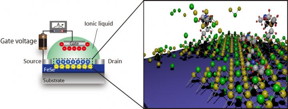 |
| (Left) Device structure of electric-double-layer transistor with FeSe channel deposited on oxide substrate. (Right) One-monolayer FeSe is realized by electrochemical etching where Fe and Se ions are dissolved into ionic liquid. CREDIT: Junichi Shiogai |
Abstract:
Iron selenide (FeSe) is an attracting superconducting material since the superconducting transition temperature (Tc) is enhanced from 8 K in bulk form toward 65 K in one-monolayer form.
Electrochemical etching down to one-monolayer towards high-Tc superconductivity: A new route for exploration of nontrivial physical phenomena at two-dimensional materials
Sendai, Japan | Posted on November 4th, 2015However, systematic thickness dependence of electrical measurement has been difficult to address.
A team of researchers at Tohoku University's Institute for Materials Research (IMR), has realized layer-by-layer etching in superconducting FeSe films down to approximately one-monolayer about 0.6 nm using classical electrochemical reaction in electric-double-layer transistor configuration.
As the thickness of the films becomes thin, the superconducting transition temperature (Tc) is increased from bulk value (8 K) to about 40 K. In addition, the research group unveils that by combining with an electrostatic charging effect, the high-Tc transition can be induced in 10-nm thick condition (20 monolayers), which had been limited in one/two-monolayers so far.
The development of this etching technique will pave the way for the exploration of nontrivial physical phenomena in atomically thin two-dimensional films. This had previously been difficult to address by conventional methods.
This work was published in Nature Physics online on Nov 2, 2015.
###
Publication Information
Authors: J. Shiogai, Y. Ito, T. Mitsuhashi, T. Nojima and A. Tsukazaki
Title: Electric-field-induced superconductivity in electrochemically etched ultrathin FeSe films on SrTiO3 and MgO
Journal: Nature Physics
####
For more information, please click here
Contacts:
Junichi Shiogai
Copyright © Tohoku University
If you have a comment, please Contact us.Issuers of news releases, not 7th Wave, Inc. or Nanotechnology Now, are solely responsible for the accuracy of the content.
Bookmark:


| Related News Press |
News and information
 Quantum computer improves AI predictions April 17th, 2026
Flexible sensor gains sensitivity under pressure April 17th, 2026
A reusable chip for particulate matter sensing April 17th, 2026
Detecting vibrational quantum beating in the predissociation dynamics of SF6 using time-resolved photoelectron spectroscopy April 17th, 2026
Superconductivity
MXene nanomaterials enter a new dimension Multilayer nanomaterial: MXene flakes created at Drexel University show new promise as 1D scrolls January 30th, 2026
Physics
UC Irvine physicists discover method to reverse ‘quantum scrambling’ : The work addresses the problem of information loss in quantum computing system April 17th, 2026
Thin films
Tiny nanosheets, big leap: A new sensor detects ethanol at ultra-low levels January 30th, 2026
Discoveries
Quantum computer improves AI predictions April 17th, 2026
Flexible sensor gains sensitivity under pressure April 17th, 2026
A reusable chip for particulate matter sensing April 17th, 2026
Detecting vibrational quantum beating in the predissociation dynamics of SF6 using time-resolved photoelectron spectroscopy April 17th, 2026
Announcements
A fundamentally new therapeutic approach to cystic fibrosis: Nanobody repairs cellular defect April 17th, 2026
UC Irvine physicists discover method to reverse ‘quantum scrambling’ : The work addresses the problem of information loss in quantum computing system April 17th, 2026
Interviews/Book Reviews/Essays/Reports/Podcasts/Journals/White papers/Posters
A fundamentally new therapeutic approach to cystic fibrosis: Nanobody repairs cellular defect April 17th, 2026
UC Irvine physicists discover method to reverse ‘quantum scrambling’ : The work addresses the problem of information loss in quantum computing system April 17th, 2026
 |
||
 |
||
| The latest news from around the world, FREE | ||
 |
||
|
|
||
| Premium Products | ||
 |
||
|
Only the news you want to read!
Learn More |
||
 |
||
|
Full-service, expert consulting
Learn More |
||
|
|
||