Home > Press > Horizontal magnetic tunneling in a field-effect device integrated on Silicon
 |
Abstract:
The choice for energy-efficient technologies is not a matter of price choice but it is slowly turning into a matter of heat. A work recently published in Nature’s Scientific Reports suggests devices fabricated directly on Silicon with magnetic tunnel junctions governed by electric pulses, which means without current and minimizing the problem of overheating.
Horizontal magnetic tunneling in a field-effect device integrated on Silicon
Barcelona, Spain | Posted on October 3rd, 2015Large data servers and computer clusters are in such need of cooling that even their geographical location is a major engineering decision. Indeed, Reuters reported the decision of big companies of setting its European core systems up to store large amounts of data in Sweden just to “take advantage of the climate in Lulea, among the coldest in Sweden, to cool tens of thousands of servers”. [1] This problem has even bigger planetary consequences, as data storage centers are already singled out among the biggest contributors to global warming [2]. Every contribution in the direction of reducing calories is strongly welcome in the present scenario of escalating data traffic and information processing.
A team of scientist across Europe, comprising Dr. Ignasi Fina, from the ICN2 Oxide Nanoelectronics Group, Dr. Xavier Martí, from IGS Research and ICN2 collaborator, and Prof. Marin Alexe from the University of Warwick (UK) and coworkers from Germany and Czech Republic, has recently contributed their grain of salt to this hot topic. Dr. Ignasi Fina is the first author of an article recently published in Nature’s Scientific Reports [3], with Dr. Xavier Martí and Prof. Marin Alexe as the last ones.
Data storage technologies are split between the ones which write with electrical current discharges and the ones which write using voltage pulses with no need of electrical current flow. The latter, which include ferroelectric memories, a field in which the ON group led by Gustau Catalan is very active, are currently confined to ultra-low power applications and found their niche market in several contact-less transport memory cards or the automotive sector where the need for energy-efficient solutions is unavoidable. However, the media are realizing slowly but surely that the choice for energy-efficient technologies is not a matter of price-point choice but it is slowly turning into a matter of heat – without choice.
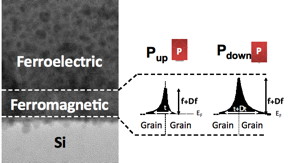
During the last years, a flurry of research has been focused on multiferroic materials, trying to merge record-breaking information areal densities achieved by magnetic electrical-current based technologies with an energy-efficient electric-pulse based approach. Most of the research on this field has been carried out on perfect single-crystalline structures where theory met experiments with success. However, the growth of perfect structures requires growth techniques that hinder their scalability. By circumventing the need for structural perfection, the work recently published at Scientific Reports delivers a self-assembled in-plane array of magnetic tunnel junctions governed by voltage pulses. Of particular relevance, the devices have been fabricated directly on Silicon, on step further for the integration of the devices into realistic prototypes.
[1] www.reuters.com/article/2011/10/27/us-facebook-sweden-idUSTRE79Q2HR20111027
[2] www.economist.com/node/14297036
[3] Ignasi Fina, Geanina Apachitei, Daniele Preziosi, Hakan Deniz, Dominik Kriegner, Xavier Marti & Marin Alexe. In-plane tunnelling field-effect transistor integrated on Silicon. Scientific Reports 5, Article number: 14367 (2015) doi:10.1038/srep14367
www.nature.com/articles/srep14367
####
For more information, please click here
Contacts:
Àlex Argemí
Phone: +34937372607
Fax: 937372607
Copyright © ICN2
If you have a comment, please Contact us.Issuers of news releases, not 7th Wave, Inc. or Nanotechnology Now, are solely responsible for the accuracy of the content.
Bookmark:


| Related News Press |
News and information
 Quantum computer improves AI predictions April 17th, 2026
Flexible sensor gains sensitivity under pressure April 17th, 2026
A reusable chip for particulate matter sensing April 17th, 2026
Detecting vibrational quantum beating in the predissociation dynamics of SF6 using time-resolved photoelectron spectroscopy April 17th, 2026
Magnetism/Magnons
Metasurfaces smooth light to boost magnetic sensing precision January 30th, 2026
Researchers develop molecular qubits that communicate at telecom frequencies October 3rd, 2025
First real-time observation of two-dimensional melting process: Researchers at Mainz University unveil new insights into magnetic vortex structures August 8th, 2025
Magnetism in new exotic material opens the way for robust quantum computers June 4th, 2025
Chip Technology
A reusable chip for particulate matter sensing April 17th, 2026
Metasurfaces smooth light to boost magnetic sensing precision January 30th, 2026
Memory Technology
Researchers tackle the memory bottleneck stalling quantum computing October 3rd, 2025
First real-time observation of two-dimensional melting process: Researchers at Mainz University unveil new insights into magnetic vortex structures August 8th, 2025
Utilizing palladium for addressing contact issues of buried oxide thin film transistors April 5th, 2024
Discoveries
Quantum computer improves AI predictions April 17th, 2026
Flexible sensor gains sensitivity under pressure April 17th, 2026
A reusable chip for particulate matter sensing April 17th, 2026
Detecting vibrational quantum beating in the predissociation dynamics of SF6 using time-resolved photoelectron spectroscopy April 17th, 2026
Materials/Metamaterials/Magnetoresistance
First real-time observation of two-dimensional melting process: Researchers at Mainz University unveil new insights into magnetic vortex structures August 8th, 2025
Researchers unveil a groundbreaking clay-based solution to capture carbon dioxide and combat climate change June 6th, 2025
A 1960s idea inspires NBI researchers to study hitherto inaccessible quantum states June 6th, 2025
Institute for Nanoscience hosts annual proposal planning meeting May 16th, 2025
Announcements
A fundamentally new therapeutic approach to cystic fibrosis: Nanobody repairs cellular defect April 17th, 2026
UC Irvine physicists discover method to reverse ‘quantum scrambling’ : The work addresses the problem of information loss in quantum computing system April 17th, 2026
Interviews/Book Reviews/Essays/Reports/Podcasts/Journals/White papers/Posters
A fundamentally new therapeutic approach to cystic fibrosis: Nanobody repairs cellular defect April 17th, 2026
UC Irvine physicists discover method to reverse ‘quantum scrambling’ : The work addresses the problem of information loss in quantum computing system April 17th, 2026
 |
||
 |
||
| The latest news from around the world, FREE | ||
 |
||
|
|
||
| Premium Products | ||
 |
||
|
Only the news you want to read!
Learn More |
||
 |
||
|
Full-service, expert consulting
Learn More |
||
|
|
||