Home > Press > Semiconductor nanoparticles show high luminescence in a polymer matrix: Highly luminescent semiconductor nanoparticles immobilized in a polymer matrix using environmentally benign supercritical CO2
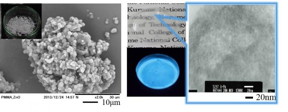 |
| Polymer-ZnO nanoparticle QDs by dispersion polymerization in supercritical CO2 are shown.
COPYRIGHT (C) 2015 TOYOHASHI UNIVERSITY OF TECHNOLOGY. ALL RIGHTS RESERVED. |
Abstract:
Semiconductor nanocrystals known as quantum dots (QDs) are increasingly being used as photoluminescent materials in bio-imaging, photonics, and optoelectronic applications. However, these QDs must have stable photoluminescence properties to be used in these applications. Photoluminescence stability of QDs is achieved by chemically modifying the surface of the QDs.
Semiconductor nanoparticles show high luminescence in a polymer matrix: Highly luminescent semiconductor nanoparticles immobilized in a polymer matrix using environmentally benign supercritical CO2
Toyohashi, Japan | Posted on October 1st, 2015However, chemical modification of the surface typically requires large amounts of organic solvents that are harmful to the environment. To solve this problem, many researchers have attempted to synthesize polymer-nanoparticle composites by using supercritical fluid (SCF)-based technology. Supercritical CO2 has emerged as the most extensively studied SCF medium, because it is readily available, inexpensive, nonflammable, and environmentally benign.
Toyohashi Tech researchers in cooperation with researchers at the National Institute of Technology, Kurume College have investigated the formation of nanostructured material using supercritical CO2. They have demonstrated the formation of composite nanoparticles of luminescent ZnO QDs and polymer by dispersion polymerization in supercritical CO2. As a result of the supercritical-CO2-assisted surface modification of QDs, the QDs were well dispersed in the polymer matrix and showed high luminescence.
"Unfortunately, the photoluminescence properties of pristine luminescent QDs were quenched in supercritical CO2. The surface structure of the QDs was destroyed by supercritical CO2.", explains associate professor Kiyoshi Matsuyama at the National Institute of Technology, Kurume College, "We found that the quenching of ZnO QDs could be prevented by coating with silica to obtain PMMA-ZnO composite QDs with high luminescence using a supercritical-CO2-assisted surface modification with polymer."
Our research shows that the supercritical-fluid-assisted process provides an environmentally benign route for producing stabilized luminescent materials.
####
For more information, please click here
Contacts:
Michiteru Kitazaki
Copyright © Toyohashi University of Technology
If you have a comment, please Contact us.Issuers of news releases, not 7th Wave, Inc. or Nanotechnology Now, are solely responsible for the accuracy of the content.
Bookmark:


| Related Links |
 Related studies are featured in the September 2015 issue of TUT Research:
| Related News Press |
News and information
Quantum computer improves AI predictions April 17th, 2026
Flexible sensor gains sensitivity under pressure April 17th, 2026
A reusable chip for particulate matter sensing April 17th, 2026
Detecting vibrational quantum beating in the predissociation dynamics of SF6 using time-resolved photoelectron spectroscopy April 17th, 2026
Imaging
Simple algorithm paired with standard imaging tool could predict failure in lithium metal batteries August 8th, 2025
Discoveries
Quantum computer improves AI predictions April 17th, 2026
Flexible sensor gains sensitivity under pressure April 17th, 2026
A reusable chip for particulate matter sensing April 17th, 2026
Detecting vibrational quantum beating in the predissociation dynamics of SF6 using time-resolved photoelectron spectroscopy April 17th, 2026
Materials/Metamaterials/Magnetoresistance
First real-time observation of two-dimensional melting process: Researchers at Mainz University unveil new insights into magnetic vortex structures August 8th, 2025
Researchers unveil a groundbreaking clay-based solution to capture carbon dioxide and combat climate change June 6th, 2025
A 1960s idea inspires NBI researchers to study hitherto inaccessible quantum states June 6th, 2025
Institute for Nanoscience hosts annual proposal planning meeting May 16th, 2025
Announcements
A fundamentally new therapeutic approach to cystic fibrosis: Nanobody repairs cellular defect April 17th, 2026
UC Irvine physicists discover method to reverse ‘quantum scrambling’ : The work addresses the problem of information loss in quantum computing system April 17th, 2026
Interviews/Book Reviews/Essays/Reports/Podcasts/Journals/White papers/Posters
A fundamentally new therapeutic approach to cystic fibrosis: Nanobody repairs cellular defect April 17th, 2026
UC Irvine physicists discover method to reverse ‘quantum scrambling’ : The work addresses the problem of information loss in quantum computing system April 17th, 2026
Quantum Dots/Rods
A new kind of magnetism November 17th, 2023
IOP Publishing celebrates World Quantum Day with the announcement of a special quantum collection and the winners of two prestigious quantum awards April 14th, 2023
Qubits on strong stimulants: Researchers find ways to improve the storage time of quantum information in a spin rich material January 27th, 2023
NIST’s grid of quantum islands could reveal secrets for powerful technologies November 18th, 2022
Photonics/Optics/Lasers
Metasurfaces smooth light to boost magnetic sensing precision January 30th, 2026
From sensors to smart systems: the rise of AI-driven photonic noses January 30th, 2026
 |
||
 |
||
| The latest news from around the world, FREE | ||
 |
||
|
|
||
| Premium Products | ||
 |
||
|
Only the news you want to read!
Learn More |
||
 |
||
|
Full-service, expert consulting
Learn More |
||
|
|
||