Home > Press > New material science research may advance tech tools
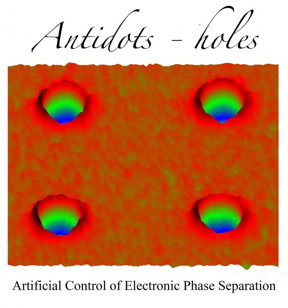 |
| LSU researchers created holes, or antidots, in thin films of manganite, which is used to build magnetic hard discs in computers. It was discovered that the edges of the antidots were magnetic. CREDIT: Ward Plummer, Louisiana State University |
Abstract:
Hard, complex materials with many components are used to fabricate some of today's most advanced technology tools. However, little is still known about how the properties of these materials change under specific temperatures, magnetic fields and pressures. Researchers from LSU, Fudan University, the University of Florida and the Collaborative Innovation Center of Advanced Microstructures in Nanjing, China, conducted research on materials that separate into different regions through a process called electronic phase separation, which is poorly understood. Their research advances the understanding of how these materials can be manipulated without having to discover new materials, change the chemical concentration or apply external magnetic fields. Their research was published in the Proceedings of the National Academy of Sciences.
New material science research may advance tech tools
Baton Rouge, LA | Posted on August 31st, 2015The researchers manipulated a steel gray mineral called manganite, which is used to build magnetic hard discs in computers. They created holes, or antidots, in thin films of manganite. It was discovered that the edges of the antidots were magnetic.
"The discovery of the magnetic edge states on the antidots made this work possible. Nobody had ever seen this before," said LSU Physics Professor Ward Plummer, a co-author on the study.
The magnetic phase state at the edges of the antidots raised the metal-to-insulator phase transition temperature of the manganite film. The researchers were able to replicate this through simulations.
"People have really tried to increase the temperature and reduce the operating field or tried to change the substrate or chemical composition. But we find this new approach with antidots to be quite useful," said Jian Shen, head of the Department of Physics at Fudan University and a co-author on the paper.
"What you really would like to do is get this temperature above room temperature, so you can switch the material by using a magnetic field," Plummer said.
###
This study is part of an on-going collaboration between Plummer and Shen. They began to work together on manganite systems with higher temperatures and lower magnetic fields in 1998 at Oak Ridge National Laboratory. This project continues with funding from the Department of Energy.
####
For more information, please click here
Contacts:
Alison Satake
225-578-3870
Copyright © Louisiana State University
If you have a comment, please Contact us.Issuers of news releases, not 7th Wave, Inc. or Nanotechnology Now, are solely responsible for the accuracy of the content.
Bookmark:


| Related News Press |
News and information
 Quantum computer improves AI predictions April 17th, 2026
Flexible sensor gains sensitivity under pressure April 17th, 2026
A reusable chip for particulate matter sensing April 17th, 2026
Detecting vibrational quantum beating in the predissociation dynamics of SF6 using time-resolved photoelectron spectroscopy April 17th, 2026
Magnetism/Magnons
Metasurfaces smooth light to boost magnetic sensing precision January 30th, 2026
Researchers develop molecular qubits that communicate at telecom frequencies October 3rd, 2025
First real-time observation of two-dimensional melting process: Researchers at Mainz University unveil new insights into magnetic vortex structures August 8th, 2025
Magnetism in new exotic material opens the way for robust quantum computers June 4th, 2025
Thin films
Tiny nanosheets, big leap: A new sensor detects ethanol at ultra-low levels January 30th, 2026
Laboratories
Researchers develop molecular qubits that communicate at telecom frequencies October 3rd, 2025
Govt.-Legislation/Regulation/Funding/Policy
Quantum computer improves AI predictions April 17th, 2026
Metasurfaces smooth light to boost magnetic sensing precision January 30th, 2026
New imaging approach transforms study of bacterial biofilms August 8th, 2025
Memory Technology
Researchers tackle the memory bottleneck stalling quantum computing October 3rd, 2025
First real-time observation of two-dimensional melting process: Researchers at Mainz University unveil new insights into magnetic vortex structures August 8th, 2025
Utilizing palladium for addressing contact issues of buried oxide thin film transistors April 5th, 2024
Discoveries
Quantum computer improves AI predictions April 17th, 2026
Flexible sensor gains sensitivity under pressure April 17th, 2026
A reusable chip for particulate matter sensing April 17th, 2026
Detecting vibrational quantum beating in the predissociation dynamics of SF6 using time-resolved photoelectron spectroscopy April 17th, 2026
Materials/Metamaterials/Magnetoresistance
First real-time observation of two-dimensional melting process: Researchers at Mainz University unveil new insights into magnetic vortex structures August 8th, 2025
Researchers unveil a groundbreaking clay-based solution to capture carbon dioxide and combat climate change June 6th, 2025
A 1960s idea inspires NBI researchers to study hitherto inaccessible quantum states June 6th, 2025
Institute for Nanoscience hosts annual proposal planning meeting May 16th, 2025
Announcements
A fundamentally new therapeutic approach to cystic fibrosis: Nanobody repairs cellular defect April 17th, 2026
UC Irvine physicists discover method to reverse ‘quantum scrambling’ : The work addresses the problem of information loss in quantum computing system April 17th, 2026
Interviews/Book Reviews/Essays/Reports/Podcasts/Journals/White papers/Posters
A fundamentally new therapeutic approach to cystic fibrosis: Nanobody repairs cellular defect April 17th, 2026
UC Irvine physicists discover method to reverse ‘quantum scrambling’ : The work addresses the problem of information loss in quantum computing system April 17th, 2026
 |
||
 |
||
| The latest news from around the world, FREE | ||
 |
||
|
|
||
| Premium Products | ||
 |
||
|
Only the news you want to read!
Learn More |
||
 |
||
|
Full-service, expert consulting
Learn More |
||
|
|
||