Home > Press > Controlling phase changes in solids: Controlling phase changes in solids
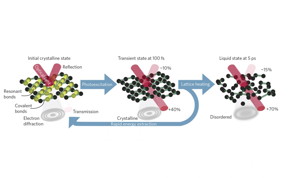 |
| Schematic of the ultrafast transformation pathway. CREDIT: ICFO/Fritz-Haber-Inst. MPG/SUTD |
Abstract:
Rewritable CDs, DVDs and Blu-Ray discs owe their existence to phase-change materials, those materials that change their internal order when heated and whose structures can be switched back and forth between their crystalline and amorphous phases. Phase-change materials have even more exciting applications on the horizon, but our limited ability to precisely control their phase changes is a hurdle to the development of new technology.
Controlling phase changes in solids: Controlling phase changes in solids
Barcelona, Spain | Posted on July 29th, 2015One of the most popular and useful phase-change materials is GST, which consists of germanium, antimony, and tellurium. This material is particularly useful because it alternates between its crystalline and amorphous phases more quickly than any other material yet studied. These phase changes result from changes in the bonds between atoms, which also modify the electronic and optical properties of GST as well as its lattice structure. Specifically, resonant bonds, in which electrons participate in several neighboring bonds, influence the material's electro-optical properties, while covalent bonds, in which electrons are shared between two atoms, influence its lattice structure. Most techniques that use GST simultaneously change both the electro-optical and structural properties. This is actually a considerable drawback since in the process of repeating structural transitions, such as heating and cooling the material, the lifetime of any device based on this material is drastically reduced.
In a study recently published in Nature Materials, researchers from the ICFO groups led by Prof. Simon Wall and ICREA Prof. at ICFO Valerio Pruneri, in collaboration with the Firtz-Haber-Institut der Max-Planck-Gesellschaft, have demonstrated how the material and electro-optical properties of GST change over fractions of a trillionth of a second as the phase of the material changes. Laser light was successfully used to alter the bonds controlling the electro-optical properties without meaningfully altering the bonds controlling the lattice. This new configuration allowed the rapid, reversible changes in the electro-optical properties that are important in device applications without reducing the lifetime of the device by changing its lattice structure. Moreover, the change in the electro-optical properties of GST measured in this study is more than ten times greater than that previously achieved by silicon materials used for the same purpose. This finding suggests that GST may be a good substitute for these commonly used silicon materials.
The results of this study may be expected to have far-reaching implications for the development of new technologies, including flexible displays, logic circuits, optical circuits, and universal memory for data storage. These results also indicate the potential of GST for other applications requiring materials with large changes in optical properties that can be achieved rapidly and with high precision.
####
For more information, please click here
Contacts:
Alina Hirschmann
34-935-542-246
Copyright © ICFO-The Institute of Photonic Sciences
If you have a comment, please Contact us.Issuers of news releases, not 7th Wave, Inc. or Nanotechnology Now, are solely responsible for the accuracy of the content.
Bookmark:


| Related News Press |
News and information
 Quantum computer improves AI predictions April 17th, 2026
Flexible sensor gains sensitivity under pressure April 17th, 2026
A reusable chip for particulate matter sensing April 17th, 2026
Detecting vibrational quantum beating in the predissociation dynamics of SF6 using time-resolved photoelectron spectroscopy April 17th, 2026
Flexible Electronics
Flexible sensor gains sensitivity under pressure April 17th, 2026
Flexible electronics integrated with paper-thin structure for use in space January 17th, 2025
Display technology/LEDs/SS Lighting/OLEDs
Spinel-type sulfide semiconductors to operate the next-generation LEDs and solar cells For solar-cell absorbers and green-LED source October 3rd, 2025
Memory Technology
Researchers tackle the memory bottleneck stalling quantum computing October 3rd, 2025
First real-time observation of two-dimensional melting process: Researchers at Mainz University unveil new insights into magnetic vortex structures August 8th, 2025
Utilizing palladium for addressing contact issues of buried oxide thin film transistors April 5th, 2024
Discoveries
Quantum computer improves AI predictions April 17th, 2026
Flexible sensor gains sensitivity under pressure April 17th, 2026
A reusable chip for particulate matter sensing April 17th, 2026
Detecting vibrational quantum beating in the predissociation dynamics of SF6 using time-resolved photoelectron spectroscopy April 17th, 2026
Materials/Metamaterials/Magnetoresistance
First real-time observation of two-dimensional melting process: Researchers at Mainz University unveil new insights into magnetic vortex structures August 8th, 2025
Researchers unveil a groundbreaking clay-based solution to capture carbon dioxide and combat climate change June 6th, 2025
A 1960s idea inspires NBI researchers to study hitherto inaccessible quantum states June 6th, 2025
Institute for Nanoscience hosts annual proposal planning meeting May 16th, 2025
Announcements
A fundamentally new therapeutic approach to cystic fibrosis: Nanobody repairs cellular defect April 17th, 2026
UC Irvine physicists discover method to reverse ‘quantum scrambling’ : The work addresses the problem of information loss in quantum computing system April 17th, 2026
Interviews/Book Reviews/Essays/Reports/Podcasts/Journals/White papers/Posters
A fundamentally new therapeutic approach to cystic fibrosis: Nanobody repairs cellular defect April 17th, 2026
UC Irvine physicists discover method to reverse ‘quantum scrambling’ : The work addresses the problem of information loss in quantum computing system April 17th, 2026
Photonics/Optics/Lasers
Metasurfaces smooth light to boost magnetic sensing precision January 30th, 2026
From sensors to smart systems: the rise of AI-driven photonic noses January 30th, 2026
 |
||
 |
||
| The latest news from around the world, FREE | ||
 |
||
|
|
||
| Premium Products | ||
 |
||
|
Only the news you want to read!
Learn More |
||
 |
||
|
Full-service, expert consulting
Learn More |
||
|
|
||