Home > Press > Transition from 3 to 2 dimensions increases conduction, MIPT scientists discover
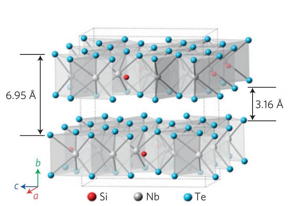 |
| This is the crystal structure of Nb3SiTe6. CREDIT: © J. Hu et al/ Nature Physics |
Abstract:
Scientists from the MIPT Department of Molecular and Chemical Physics have for the first time described the behavior of electrons in a previously unstudied analogue of graphene, two-dimensional niobium telluride, and, in the process, uncovered the nature of two-dimensionality effects on conducting properties. These findings will help in the creation of future flat and flexible electronic devices.
Transition from 3 to 2 dimensions increases conduction, MIPT scientists discover
Moscow, Russia | Posted on July 6th, 2015In recent decades, physicists have been actively studying so-called two-dimensional materials. Andrei Geim and Konstantin Novoselov received the Nobel Prize for their research on graphene, the most well-known among them. The properties of such materials, which can be described as "sheets" with a thickness of a few atoms, strongly differ from their three-dimensional analogues. For example, graphene is transparent, conducts current better than copper and has good thermal conductivity. Scientists believe that other types of two-dimensional materials may possess even more exotic properties.
A group of scientists from Russia and the USA, including Pavel Sorokin and Liubov Antipina from MIPT, recently conducted research on the properties of the crystals of one such material,Nb3SiTe6, a compound of niobium telluride. In their structure, the crystals resemble sandwiches with a thickness of three atoms (around 4 angstroms): a layer of tellurium, a layer of niobium mixed with silicon atoms and then another layer of tellurium. This substance belongs to a class of materials known as dichalcogenides, which many scientists view as promising two-dimensional semiconductors.
The scientists synthesized Nb3SiTe6 crystals in a laboratory at Tulane University (New Orleans). They then separated them into two-dimensional layers, taking samples for further analysis by transmission electron microscopy, X-ray crystal analysis and other methods. The goal of the researchers was to investigate electron-phonon interaction changes in two-dimensional substances.
Quasi particles, quanta of crystal lattice oscillations, are called phonons. Physicists introduced the concept of phonons because it helped simplify the description of processes in crystals, and tracking of electron-phonon interaction is fundamentally important for description of the different conducting properties in matter.
"We developed a theory that predicts that electron-phonon interaction is suppressed due to dimensional effects in two-dimensional material. In other words, these materials obstruct the flow of electrons to a lesser extent," says Pavel Sorokin, a co-author of the study, doctor of physical and mathematical sciences, and lecturer at the MIPT Section of the Physics and Chemistry of Nanostructures (DMCP).
American colleagues confirmed this predictioninrelatedexperiments. "They conducted measurements where the same effectwas observed. Our calculations allowed the ruling out of other explanations; we managed to prove that changes in electron-phonon interaction occur specifically because of the two-dimensionality of the membrane," Sorokin adds.
Full details of the research discussed above can be found in an article published in the journal Nature Physics (DOI:10.1038/NPHYS3321).
####
For more information, please click here
Contacts:
Stanislav Goryachev
7-964-501-2307
Copyright © Moscow Institute of Physics and Technology
If you have a comment, please Contact us.Issuers of news releases, not 7th Wave, Inc. or Nanotechnology Now, are solely responsible for the accuracy of the content.
Bookmark:


| Related News Press |
News and information
 Quantum computer improves AI predictions April 17th, 2026
Flexible sensor gains sensitivity under pressure April 17th, 2026
A reusable chip for particulate matter sensing April 17th, 2026
Detecting vibrational quantum beating in the predissociation dynamics of SF6 using time-resolved photoelectron spectroscopy April 17th, 2026
Physics
UC Irvine physicists discover method to reverse ‘quantum scrambling’ : The work addresses the problem of information loss in quantum computing system April 17th, 2026
Quantum computers simulate fundamental physics: shedding light on the building blocks of nature June 6th, 2025
A 1960s idea inspires NBI researchers to study hitherto inaccessible quantum states June 6th, 2025
Magnetism in new exotic material opens the way for robust quantum computers June 4th, 2025
Graphene/ Graphite
Electrifying results shed light on graphene foam as a potential material for lab grown cartilage June 6th, 2025
Chip Technology
A reusable chip for particulate matter sensing April 17th, 2026
Metasurfaces smooth light to boost magnetic sensing precision January 30th, 2026
Nanoelectronics
Lab to industry: InSe wafer-scale breakthrough for future electronics August 8th, 2025
Interdisciplinary: Rice team tackles the future of semiconductors Multiferroics could be the key to ultralow-energy computing October 6th, 2023
Key element for a scalable quantum computer: Physicists from Forschungszentrum Jülich and RWTH Aachen University demonstrate electron transport on a quantum chip September 23rd, 2022
Reduced power consumption in semiconductor devices September 23rd, 2022
Discoveries
Quantum computer improves AI predictions April 17th, 2026
Flexible sensor gains sensitivity under pressure April 17th, 2026
A reusable chip for particulate matter sensing April 17th, 2026
Detecting vibrational quantum beating in the predissociation dynamics of SF6 using time-resolved photoelectron spectroscopy April 17th, 2026
Announcements
A fundamentally new therapeutic approach to cystic fibrosis: Nanobody repairs cellular defect April 17th, 2026
UC Irvine physicists discover method to reverse ‘quantum scrambling’ : The work addresses the problem of information loss in quantum computing system April 17th, 2026
Interviews/Book Reviews/Essays/Reports/Podcasts/Journals/White papers/Posters
A fundamentally new therapeutic approach to cystic fibrosis: Nanobody repairs cellular defect April 17th, 2026
UC Irvine physicists discover method to reverse ‘quantum scrambling’ : The work addresses the problem of information loss in quantum computing system April 17th, 2026
 |
||
 |
||
| The latest news from around the world, FREE | ||
 |
||
|
|
||
| Premium Products | ||
 |
||
|
Only the news you want to read!
Learn More |
||
 |
||
|
Full-service, expert consulting
Learn More |
||
|
|
||