Home > Press > Binghamton engineer creates origami battery
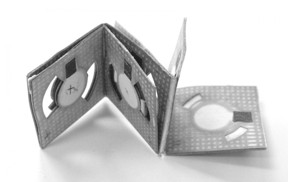 |
| Origami batteries like this one, developed by Binghamton University researcher Seokheun Choi, could one day power biosensors for use in remote locations. CREDIT: Jonathan Cohen, Binghamton University photographer |
Abstract:
Origami, the Japanese art of paper folding, can be used to create beautiful birds, frogs and other small sculptures. Now a Binghamton University engineer says the technique can be applied to building batteries, too.
Binghamton engineer creates origami battery
Binghamton, UK | Posted on June 10th, 2015Seokheun "Sean" Choi developed an inexpensive, bacteria-powered battery made from paper, he writes in the July edition of the journal Nano Energy.
The battery generates power from microbial respiration, delivering enough energy to run a paper-based biosensor with nothing more than a drop of bacteria-containing liquid. "Dirty water has a lot of organic matter," Choi says. "Any type of organic material can be the source of bacteria for the bacterial metabolism."
The method should be especially useful to anyone working in remote areas with limited resources. Indeed, because paper is inexpensive and readily available, many experts working on disease control and prevention have seized upon it as a key material in creating diagnostic tools for the developing world.
"Paper is cheap and it's biodegradable," Choi says. "And we don't need external pumps or syringes because paper can suck up a solution using capillary force."
While paper-based biosensors have shown promise in this area, the existing technology must be paired with hand-held devices for analysis. Choi says he envisions a self-powered system in which a paper-based battery would create enough energy -- we're talking microwatts -- to run the biosensor. Creating such a system is the goal of a new three-year grant of nearly $300,000 he received from the National Science Foundation.
Choi's battery, which folds into a square the size of a matchbook, uses an inexpensive air-breathing cathode created with nickel sprayed onto one side of ordinary office paper. The anode is screen printed with carbon paints, creating a hydrophilic zone with wax boundaries.
Total cost of this potentially game-changing device? Five cents.
Choi, who joined Binghamton's faculty less than three years ago as an assistant professor of electrical and computer engineering, earned a doctorate from Arizona State University after doing undergraduate work and a master's degree in South Korea. Choi, who holds two U.S. patents, initially collaborated on the paper battery with Hankeun Lee, a former Binghamton undergraduate and co-author of the new journal article.
Choi recalls an actual "lightbulb moment" while working on an earlier iteration of the paper-based batteries, before he tried the origami approach. "I connected four of the devices in series, and I lit up this small LED," he says. "At that moment, I knew I had done it!"
####
For more information, please click here
Contacts:
Ryan Yarosh
607-777-2174
Copyright © Binghamton University
If you have a comment, please Contact us.Issuers of news releases, not 7th Wave, Inc. or Nanotechnology Now, are solely responsible for the accuracy of the content.
Bookmark:


| Related Links |
 For a direct link to the journal article:
| Related News Press |
News and information
Quantum computer improves AI predictions April 17th, 2026
Flexible sensor gains sensitivity under pressure April 17th, 2026
A reusable chip for particulate matter sensing April 17th, 2026
Detecting vibrational quantum beating in the predissociation dynamics of SF6 using time-resolved photoelectron spectroscopy April 17th, 2026
Sensors
Flexible sensor gains sensitivity under pressure April 17th, 2026
Tiny nanosheets, big leap: A new sensor detects ethanol at ultra-low levels January 30th, 2026
From sensors to smart systems: the rise of AI-driven photonic noses January 30th, 2026
Sensors innovations for smart lithium-based batteries: advancements, opportunities, and potential challenges August 8th, 2025
Discoveries
Quantum computer improves AI predictions April 17th, 2026
Flexible sensor gains sensitivity under pressure April 17th, 2026
A reusable chip for particulate matter sensing April 17th, 2026
Detecting vibrational quantum beating in the predissociation dynamics of SF6 using time-resolved photoelectron spectroscopy April 17th, 2026
Announcements
A fundamentally new therapeutic approach to cystic fibrosis: Nanobody repairs cellular defect April 17th, 2026
UC Irvine physicists discover method to reverse ‘quantum scrambling’ : The work addresses the problem of information loss in quantum computing system April 17th, 2026
Interviews/Book Reviews/Essays/Reports/Podcasts/Journals/White papers/Posters
A fundamentally new therapeutic approach to cystic fibrosis: Nanobody repairs cellular defect April 17th, 2026
UC Irvine physicists discover method to reverse ‘quantum scrambling’ : The work addresses the problem of information loss in quantum computing system April 17th, 2026
Patents/IP/Tech Transfer/Licensing
Getting drugs across the blood-brain barrier using nanoparticles March 3rd, 2023
Metasurfaces control polarized light at will: New research unlocks the hidden potential of metasurfaces August 13th, 2021
Arrowhead Pharmaceuticals Announces Closing of Agreement with Takeda November 27th, 2020
Battery Technology/Capacitors/Generators/Piezoelectrics/Thermoelectrics/Energy storage
Decoding hydrogen‑bond network of electrolyte for cryogenic durable aqueous zinc‑ion batteries January 30th, 2026
COF scaffold membrane with gate‑lane nanostructure for efficient Li+/Mg2+ separation January 30th, 2026
MXene nanomaterials enter a new dimension Multilayer nanomaterial: MXene flakes created at Drexel University show new promise as 1D scrolls January 30th, 2026
 |
||
 |
||
| The latest news from around the world, FREE | ||
 |
||
|
|
||
| Premium Products | ||
 |
||
|
Only the news you want to read!
Learn More |
||
 |
||
|
Full-service, expert consulting
Learn More |
||
|
|
||