Home > Press > UCLA researchers create new method that targets tumors with the same effectiveness but a significant reduction in both side effects and cost
 |
| Pancreatic cancer treatment image |
Abstract:
Scientists at UCLA's California NanoSystems Institute and Jonsson Comprehensive Cancer Center have combined their nanotechnology expertise to create a new treatment that may solve some of the problems of using chemotherapy to treat pancreatic cancer.
UCLA researchers create new method that targets tumors with the same effectiveness but a significant reduction in both side effects and cost
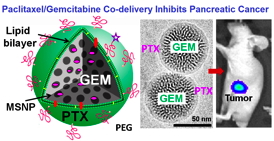
Los Angeles, CA | Posted on March 23rd, 2015The study, published online in the journal ACS Nano, describes successful experiments to combine two drugs within a specially designed mesoporous silica nanoparticle that looks like a glass bubble. The drugs work together to shrink human pancreas tumors in mice as successfully as the current standard treatment, but at one twelfth the dosage. This lower dosage could reduce both the cost of treatment and the side effects that people suffer from the current method.
The study was led by Dr. Huan Meng, assistant adjunct professor of medicine, and Dr. Andre Nel, distinguished professor of medicine, both at the Jonsson Cancer Center.
Pancreatic cancer, a devastating disease with a five-year survival rate of 5 percent, is difficult to detect early and symptoms do not usually appear until the disease is advanced. As a result, many people are not diagnosed until their tumors are beyond the effective limits of surgery, leaving chemotherapy as the only viable treatment option. The chemotherapy drug most often used for pancreas cancer is gemcitabine, but its impact is often limited.
Recent research has found that combining gemcitabine with another drug called paclitaxel can improve the overall treatment effect. In the current method, Abraxane — a nano complex containing paclitaxel — and gemcitabine are given separately, which works to a degree, but because the drugs may stay in the body for different lengths of time, the combined beneficial effect is not fully synchronized.
"The beauty of the silica nanoparticle technology is that gemcitabine and paclitaxel are placed together in one special lipid-coated nanoparticle at the exact ratio that makes them synergistic with one another when co-delivered at the cancer site, giving us the best possible outcome by using a single drug carrier," Meng said. "This enables us to reduce the dose and maintain the combinatorial effect."
After the scientists constructed the silica nanoparticles, they suspended them in blood serum and injected them into mice that had human pancreas tumors growing under their skin. Other mice with tumors were given injections of saline solution (a placebo with no effect), gemcitabine (the treatment standard), and gemcitabine and Abraxane (an FDA-approved combination shown to improve pancreas cancer survival in humans).
In the mice that received the two drugs inside the nanoparticle, pancreas tumors shrank dramatically compared with those in the other mice.
Similar comparisons were made with mouse models, in which the human tumors were surgically implanted into the mice's abdomens in order to more closely emulate the natural point of origin of pancreatic tumors and provide a better parallel to the tumors in humans. In these experiments, the tumors in the mice receiving silica nanoparticles shrank more than the comparative controls. Also, metastasis, or tumor spread, to nearby organs was eradicated in these mice.
"Instead of just a laboratory proof-of-principle study of any cancer, we specifically attacked pancreatic cancer with a custom-designed nanocarrier," said Nel, who is also associate director for research of the California NanoSystems Institute. "In our platform, the drugs are truly synergistic because we have control over drug mixing, allowing us to incorporate optimal ratios in our particles, making the relevance of our models very high and our results very strong."
Meng said the silica nanocarrier must still be refined for use in humans. The researchers hope to test the platform in human clinical trials within the next five years.
The research was supported by the U.S. Public Health Service and the National Science Foundation.
####
For more information, please click here
Contacts:
Shaun Mason, CNSI
310-794-5346
Copyright © UCLA
If you have a comment, please Contact us.Issuers of news releases, not 7th Wave, Inc. or Nanotechnology Now, are solely responsible for the accuracy of the content.
Bookmark:


| Related News Press |
News and information
 Quantum computer improves AI predictions April 17th, 2026
Flexible sensor gains sensitivity under pressure April 17th, 2026
A reusable chip for particulate matter sensing April 17th, 2026
Detecting vibrational quantum beating in the predissociation dynamics of SF6 using time-resolved photoelectron spectroscopy April 17th, 2026
Cancer
New molecular technology targets tumors and simultaneously silences two ‘undruggable’ cancer genes August 8th, 2025
Ben-Gurion University of the Negev researchers several steps closer to harnessing patient's own T-cells to fight off cancer June 6th, 2025
Self-propelled protein-based nanomotors for enhanced cancer therapy by inducing ferroptosis June 6th, 2025
Govt.-Legislation/Regulation/Funding/Policy
Quantum computer improves AI predictions April 17th, 2026
Metasurfaces smooth light to boost magnetic sensing precision January 30th, 2026
New imaging approach transforms study of bacterial biofilms August 8th, 2025
Nanomedicine
A fundamentally new therapeutic approach to cystic fibrosis: Nanobody repairs cellular defect April 17th, 2026
New molecular technology targets tumors and simultaneously silences two ‘undruggable’ cancer genes August 8th, 2025
New imaging approach transforms study of bacterial biofilms August 8th, 2025
Electrifying results shed light on graphene foam as a potential material for lab grown cartilage June 6th, 2025
Discoveries
Quantum computer improves AI predictions April 17th, 2026
Flexible sensor gains sensitivity under pressure April 17th, 2026
A reusable chip for particulate matter sensing April 17th, 2026
Detecting vibrational quantum beating in the predissociation dynamics of SF6 using time-resolved photoelectron spectroscopy April 17th, 2026
Announcements
A fundamentally new therapeutic approach to cystic fibrosis: Nanobody repairs cellular defect April 17th, 2026
UC Irvine physicists discover method to reverse ‘quantum scrambling’ : The work addresses the problem of information loss in quantum computing system April 17th, 2026
Interviews/Book Reviews/Essays/Reports/Podcasts/Journals/White papers/Posters
A fundamentally new therapeutic approach to cystic fibrosis: Nanobody repairs cellular defect April 17th, 2026
UC Irvine physicists discover method to reverse ‘quantum scrambling’ : The work addresses the problem of information loss in quantum computing system April 17th, 2026
 |
||
 |
||
| The latest news from around the world, FREE | ||
 |
||
|
|
||
| Premium Products | ||
 |
||
|
Only the news you want to read!
Learn More |
||
 |
||
|
Full-service, expert consulting
Learn More |
||
|
|
||