Home > Press > NC State researchers create 'nanofiber gusher': Report method of fabricating larger amounts of nanofibers in liquid
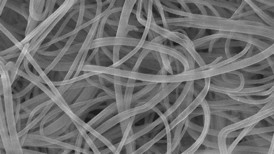 |
| NC State researchers use shearing method to create polymer nanofibers in liquid.
CREDIT: Photo courtesy of Orlin Velev, NC State University. |
Abstract:
"Scalable Liquid Shear-Driven Fabrication of Polymer Nanofibers"
Authors: Stoyan Smoukov, Tian Tian, Eunkyoung Shim and Orlin Velev, North Carolina State University; Narendiran Vitchuli, Sumit Gangwal, Miles Wright and Pete Geisen, Xanofi Inc.; Manuel Marquez, Ynano Llc.; and Jeffrey Fowler, Syngenta Co.
Published: March 18, 2015, online in Advanced Materials
DOI: 10.1002/adma.201404616
Abstract: A simple process for batch or continuous formation of polymer nanofibers and other nanomaterials in the bulk of a sheared fluid medium is introduced. The process could be of high value to commercial nanotechnology as it can be easily scaled up to the fabrication of staple nanofibers at rates that could exceed tens of kilograms per hour.
NC State researchers create 'nanofiber gusher': Report method of fabricating larger amounts of nanofibers in liquid
Raleigh, NC | Posted on March 19th, 2015Creating large amounts of polymer nanofibers dispersed in liquid is a challenge that has vexed researchers for years. But engineers and researchers at North Carolina State University and one of its start-up companies have now reported a method that can produce unprecedented amounts of polymer nanofibers, which have potential applications in filtration, batteries and cell scaffolding.
In a paper published online in Advanced Materials, the NC State researchers and colleagues from industry, including NC State start-up company Xanofi, describe the method that allows them to fabricate polymer nanofibers on a massive scale.
The method - fine-tuned after nearly a decade of increasing success in producing micro- and nanoparticles of different shapes - works as simply as dropping liquid solution of a polymer in a beaker containing a spinning cylinder. Glycerin - a common and safe liquid that has many uses - is used to shear the polymer solution inside the beaker along with an antisolvent like water. When you take out the rotating cylinder, says Dr. Orlin Velev, Invista Professor of Chemical and Biomolecular Engineering at NC State and the corresponding author of the paper describing the research, you find a mat of nanofibers wrapped around it.
When they first started investigating the liquid shearing process, the researchers created polymer microrods, which could have various useful applications in foams and consumer products. "However, while investigating the shear process we came up with something strange. We discovered that these rods were really just pieces of 'broken' fibers," Velev said. "We didn't quite have the conditions set perfectly at that time. If you get the conditions right, the fibers don't break."
NC State patented the liquid shear process in 2006 and in a series of subsequent patents while Velev and his colleagues continued to work to perfect the process and its outcome. First, they created microfibers and nanoribbons as they investigated the process. "Microfibers, nanorods and nanoribbons are interesting and potentially useful, but you really want nanofibers," Velev said. "We achieved this during the scaling up and commercialization of the technology."
Velev engaged with NC State's Office of Technology Transfer and the university's TEC (The Entrepreneurship Collaborative) program to commercialize the discoveries. They worked with the experienced entrepreneur Miles Wright to start a company called Xanofi to advance the quest for nanofibers and the most efficient way to make mass quantities of them.
"We can now create kilograms of nanofibers per hour using this simple continuous flow process, which when scaled up becomes a 'nanofiber gusher,'" Velev said. "Depending on the concentrations of liquids, polymers and antisolvents, you can create multiple types of nanomaterials of different shapes and sizes."
"Large quantities are paramount in nanomanufacturing, so anything scalable is important," said Wright, the CEO of Xanofi and a co-author on the paper. "When we produce the nanofibers via continuous flow, we get exactly the same nanofibers you would get if you were producing small quantities of them. The fabrication of these materials in liquid is advantageous because you can create truly three-dimensional nanofiber substrates with very, very high overall surface area. This leads to many enhanced products ranging from filters to cell scaffolds, printable bioinks, battery separators, plus many more."
###
The research was funded by the National Science Foundation's Accelerating Innovation Research program. NC State's researchers Stoyan Smoukov, Tian Tian and Eunkyoung Shim co-authored the paper, as did Narendiran Vitchuli, Sumit Gangwal, Miles Wright and Pete Geisen from Xanofi Inc.; Manuel Marquez from Ynano Llc.; and Jeffrey Fowler from Syngenta Co.
####
For more information, please click here
Contacts:
Dr. Orlin Velev
919-513-4318
Copyright © North Carolina State University
If you have a comment, please Contact us.Issuers of news releases, not 7th Wave, Inc. or Nanotechnology Now, are solely responsible for the accuracy of the content.
Bookmark:


| Related News Press |
News and information
 Quantum computer improves AI predictions April 17th, 2026
Flexible sensor gains sensitivity under pressure April 17th, 2026
A reusable chip for particulate matter sensing April 17th, 2026
Detecting vibrational quantum beating in the predissociation dynamics of SF6 using time-resolved photoelectron spectroscopy April 17th, 2026
Nanomedicine
A fundamentally new therapeutic approach to cystic fibrosis: Nanobody repairs cellular defect April 17th, 2026
New molecular technology targets tumors and simultaneously silences two ‘undruggable’ cancer genes August 8th, 2025
New imaging approach transforms study of bacterial biofilms August 8th, 2025
Electrifying results shed light on graphene foam as a potential material for lab grown cartilage June 6th, 2025
Materials/Metamaterials/Magnetoresistance
First real-time observation of two-dimensional melting process: Researchers at Mainz University unveil new insights into magnetic vortex structures August 8th, 2025
Researchers unveil a groundbreaking clay-based solution to capture carbon dioxide and combat climate change June 6th, 2025
A 1960s idea inspires NBI researchers to study hitherto inaccessible quantum states June 6th, 2025
Institute for Nanoscience hosts annual proposal planning meeting May 16th, 2025
Announcements
A fundamentally new therapeutic approach to cystic fibrosis: Nanobody repairs cellular defect April 17th, 2026
UC Irvine physicists discover method to reverse ‘quantum scrambling’ : The work addresses the problem of information loss in quantum computing system April 17th, 2026
Interviews/Book Reviews/Essays/Reports/Podcasts/Journals/White papers/Posters
A fundamentally new therapeutic approach to cystic fibrosis: Nanobody repairs cellular defect April 17th, 2026
UC Irvine physicists discover method to reverse ‘quantum scrambling’ : The work addresses the problem of information loss in quantum computing system April 17th, 2026
Battery Technology/Capacitors/Generators/Piezoelectrics/Thermoelectrics/Energy storage
Decoding hydrogen‑bond network of electrolyte for cryogenic durable aqueous zinc‑ion batteries January 30th, 2026
COF scaffold membrane with gate‑lane nanostructure for efficient Li+/Mg2+ separation January 30th, 2026
MXene nanomaterials enter a new dimension Multilayer nanomaterial: MXene flakes created at Drexel University show new promise as 1D scrolls January 30th, 2026
Printing/Lithography/Inkjet/Inks/Bio-printing/Dyes
Presenting: Ultrasound-based printing of 3D materials—potentially inside the body December 8th, 2023
Simple ballpoint pen can write custom LEDs August 11th, 2023
Disposable electronics on a simple sheet of paper October 7th, 2022
 |
||
 |
||
| The latest news from around the world, FREE | ||
 |
||
|
|
||
| Premium Products | ||
 |
||
|
Only the news you want to read!
Learn More |
||
 |
||
|
Full-service, expert consulting
Learn More |
||
|
|
||