Home > Press > Researchers developed a cost-effective and efficient rival for platinum
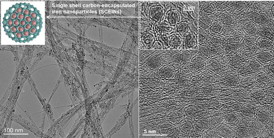 |
| This image shows single shell carbon-encapsulated iron nanoparticles. CREDIT: Aalto University |
Abstract:
Researchers succeeded in creating an electrocatalyst that is needed for storing electric energy made of carbon and iron.
Researchers developed a cost-effective and efficient rival for platinum
Aalto, Finland | Posted on February 18th, 2015A challenge that comes with the increased use of renewable energy is how to store electric energy.
Platinum has traditionally been used as the electrocatalyst in electrolysers that store electric energy as chemical compounds. However, platinum is a rare and expensive metal. Now Aalto University researchers have succeeded in developing a substitute to it that is cheap and effective.
"We developed an electrocatalyst that is made of iron and carbon. Now the same efficiency that was achieved with platinum can be obtained with a less expensive material. Nearly 40 per cent of the material costs of energy storage with an electrolyser come from the electrocatalyst", says senior scientist Tanja Kallio.
The findings have just been published in the scientific journal Angewandte Chemie on 12 February 2015.
Losses decrease
The manufacturing process has been developed in cooperation with a research group led by Professor Esko Kauppinen from Aalto University School of Science. The carbon nanotube the group developed conducts electricity extremely well and serves as the support, while the now added only single carbon layer covered iron functions as the catalyst. The manufacturing process has a single stage.
In the manufacturing phase, the iron is covered with graphene.
"The method has been altered to make the electro catalyst very active. By active, we refer to the small amount of energy needed to store electric energy as hydrogen. This reduces the losses caused by chemical storage and the process is economically viable."
###
The research was conducted at the Aalto University School of Chemical Technology in groups led by Professor Kari Laasonen and Dr. Tanja Kallio in cooperation with Professor Esko Kauppinen. The research has been funded by the Aalto University AEF Programme (Aalto Energy Efficiency Research Programme).
####
For more information, please click here
Contacts:
Senior scientist Tanja Kallio
tel. +358 50 5637 567
Professor Kari Laasonen
tel. +358 40 5570044
Copyright © Aalto University
If you have a comment, please Contact us.Issuers of news releases, not 7th Wave, Inc. or Nanotechnology Now, are solely responsible for the accuracy of the content.
Bookmark:


| Related Links |
| Related News Press |
News and information
 Quantum computer improves AI predictions April 17th, 2026
Flexible sensor gains sensitivity under pressure April 17th, 2026
A reusable chip for particulate matter sensing April 17th, 2026
Detecting vibrational quantum beating in the predissociation dynamics of SF6 using time-resolved photoelectron spectroscopy April 17th, 2026
Graphene/ Graphite
Electrifying results shed light on graphene foam as a potential material for lab grown cartilage June 6th, 2025
Breakthrough in proton barrier films using pore-free graphene oxide: Kumamoto University researchers achieve new milestone in advanced coating technologies September 13th, 2024
Discoveries
Quantum computer improves AI predictions April 17th, 2026
Flexible sensor gains sensitivity under pressure April 17th, 2026
A reusable chip for particulate matter sensing April 17th, 2026
Detecting vibrational quantum beating in the predissociation dynamics of SF6 using time-resolved photoelectron spectroscopy April 17th, 2026
Materials/Metamaterials/Magnetoresistance
First real-time observation of two-dimensional melting process: Researchers at Mainz University unveil new insights into magnetic vortex structures August 8th, 2025
Researchers unveil a groundbreaking clay-based solution to capture carbon dioxide and combat climate change June 6th, 2025
A 1960s idea inspires NBI researchers to study hitherto inaccessible quantum states June 6th, 2025
Institute for Nanoscience hosts annual proposal planning meeting May 16th, 2025
Announcements
A fundamentally new therapeutic approach to cystic fibrosis: Nanobody repairs cellular defect April 17th, 2026
UC Irvine physicists discover method to reverse ‘quantum scrambling’ : The work addresses the problem of information loss in quantum computing system April 17th, 2026
Interviews/Book Reviews/Essays/Reports/Podcasts/Journals/White papers/Posters
A fundamentally new therapeutic approach to cystic fibrosis: Nanobody repairs cellular defect April 17th, 2026
UC Irvine physicists discover method to reverse ‘quantum scrambling’ : The work addresses the problem of information loss in quantum computing system April 17th, 2026
Energy
Sensors innovations for smart lithium-based batteries: advancements, opportunities, and potential challenges August 8th, 2025
Simple algorithm paired with standard imaging tool could predict failure in lithium metal batteries August 8th, 2025
Automotive/Transportation
Decoding hydrogen‑bond network of electrolyte for cryogenic durable aqueous zinc‑ion batteries January 30th, 2026
Sensors innovations for smart lithium-based batteries: advancements, opportunities, and potential challenges August 8th, 2025
Simple algorithm paired with standard imaging tool could predict failure in lithium metal batteries August 8th, 2025
Battery Technology/Capacitors/Generators/Piezoelectrics/Thermoelectrics/Energy storage
Decoding hydrogen‑bond network of electrolyte for cryogenic durable aqueous zinc‑ion batteries January 30th, 2026
COF scaffold membrane with gate‑lane nanostructure for efficient Li+/Mg2+ separation January 30th, 2026
MXene nanomaterials enter a new dimension Multilayer nanomaterial: MXene flakes created at Drexel University show new promise as 1D scrolls January 30th, 2026
 |
||
 |
||
| The latest news from around the world, FREE | ||
 |
||
|
|
||
| Premium Products | ||
 |
||
|
Only the news you want to read!
Learn More |
||
 |
||
|
Full-service, expert consulting
Learn More |
||
|
|
||