Home > Press > Rediscovering spontaneous light emission: Berkeley researchers develop optical antenna for LEDs
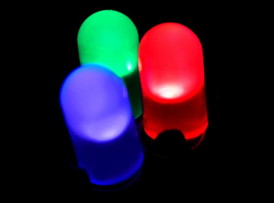 |
| Spontaneous light emissions from LEDs can be substantially enhanced when coupled to the right optical antenna, making them comparable to the stimulated emissions from lasers. CREDIT:(Image from Wikipedia) |
Abstract:
Berkeley Lab researchers have developed a nano-sized optical antenna that can greatly enhance the spontaneous emission of light from atoms, molecules and semiconductor quantum dots. This advance opens the door to light-emitting diodes (LEDs) that can replace lasers for short-range optical communications, including optical interconnects for microchips, plus a host of other potential applications.
Rediscovering spontaneous light emission: Berkeley researchers develop optical antenna for LEDs
Berkeley, CA | Posted on February 3rd, 2015"Since the invention of the laser, spontaneous light emission has been looked down upon in favor of stimulated light emission," says Eli Yablonovitch, an electrical engineer with Berkeley Lab's Materials Sciences Division. "However, with the right optical antenna, spontaneous emissions can actually be faster than stimulated emissions."
Yablonovitch, who also holds a faculty appointment with the University of California (UC) Berkeley where he directs the NSF Center for Energy Efficient Electronics Science (E3S), and is a member of the Kavli Energy NanoSciences Institute at Berkeley (Kavli ENSI), led a team that used an external antenna made from gold to effectively boost the spontaneous light emission of a nanorod made from Indium Gallium Arsenide Phosphide (InGaAsP) by 115 times. This is approaching the 200-fold increase that is considered the landmark in speed difference between stimulated and spontaneous emissions. When a 200-fold increase is reached, spontaneous emission rates will exceed those of stimulated emissions.
"With optical antennas, we believe that spontaneous emission rate enhancements of better than 2,500 times are possible while still maintaining light emission efficiency greater than 50-percent," Yablonovitch says. "Replacing wires on microchips with antenna enhanced LEDs would allow for faster interconnectivity and greater computational power."
The results of this study are reported in the Proceedings of the National Academy of Sciences (PNAS) in a paper titled "Optical antenna enhanced spontaneous emission." Yablonovitch and UC Berkeley's Ming Wua are the corresponding authors. Co-authors are Michael Eggleston, Kevin Messer and Liming Zhang.
In the world of high technology lasers are ubiquitous, the reigning workhorse for high-speed optical communications. Lasers, however, have downsides for communications over short distances, i.e., one meter or less - they consume too much power and typically take up too much space. LEDs would be a much more efficient alternative but have been limited by their spontaneous emission rates.
"Spontaneous emission from molecular-sized radiators is slowed by many orders of magnitude because molecules are too small to act as their own antennas," Yablonovitch says. "The key to speeding up these spontaneous emissions is to couple the radiating molecule to a half-wavelength antenna. Even though we've had antennas in radio for 120 years, somehow we've overlooked antennas in optics. Sometimes the great discoveries are looking right at us and waiting."
For their optical antenna, Yablonovitch and his colleagues used an arch antenna configuration. The surface of a square-shaped InGaAsP nanorod was coated with a layer of titanium dioxide to provide isolation between the nanorod and a gold wire that was deposited perpendicularly over the nanorod to create the antenna. The InGaAsP semiconductor that served as the spontaneous light-emitting material is a material already in wide use for infrared laser communication and photo-detectors.
In addition to short distance communication applications, LEDs equipped with optical antennas could also find important use in photodetectors. Optical antennas could also be applied to imaging, bio-sensing and data storage applications.
###
This research was supported by E3S, the U.S. Air Force Office of Scientific Research, and the U.S. Department of Energy's Office of Science.
####
About DOE/Lawrence Berkeley National Laboratory
Lawrence Berkeley National Laboratory addresses the world's most urgent scientific challenges by advancing sustainable energy, protecting human health, creating new materials, and revealing the origin and fate of the universe. Founded in 1931, Berkeley Lab's scientific expertise has been recognized with 13 Nobel prizes. The University of California manages Berkeley Lab for the U.S. Department of Energy's Office of Science.
For more information, please click here
Contacts:
Lynn Yarris
510-486-5375
Copyright © DOE/Lawrence Berkeley National Laboratory
If you have a comment, please Contact us.Issuers of news releases, not 7th Wave, Inc. or Nanotechnology Now, are solely responsible for the accuracy of the content.
Bookmark:


| Related Links |
| Related News Press |
News and information
 Quantum computer improves AI predictions April 17th, 2026
Flexible sensor gains sensitivity under pressure April 17th, 2026
A reusable chip for particulate matter sensing April 17th, 2026
Detecting vibrational quantum beating in the predissociation dynamics of SF6 using time-resolved photoelectron spectroscopy April 17th, 2026
Display technology/LEDs/SS Lighting/OLEDs
Spinel-type sulfide semiconductors to operate the next-generation LEDs and solar cells For solar-cell absorbers and green-LED source October 3rd, 2025
Wireless/telecommunications/RF/Antennas/Microwaves
Researchers develop molecular qubits that communicate at telecom frequencies October 3rd, 2025
Laboratories
Researchers develop molecular qubits that communicate at telecom frequencies October 3rd, 2025
Govt.-Legislation/Regulation/Funding/Policy
Quantum computer improves AI predictions April 17th, 2026
Metasurfaces smooth light to boost magnetic sensing precision January 30th, 2026
New imaging approach transforms study of bacterial biofilms August 8th, 2025
Chip Technology
A reusable chip for particulate matter sensing April 17th, 2026
Metasurfaces smooth light to boost magnetic sensing precision January 30th, 2026
Discoveries
Quantum computer improves AI predictions April 17th, 2026
Flexible sensor gains sensitivity under pressure April 17th, 2026
A reusable chip for particulate matter sensing April 17th, 2026
Detecting vibrational quantum beating in the predissociation dynamics of SF6 using time-resolved photoelectron spectroscopy April 17th, 2026
Announcements
A fundamentally new therapeutic approach to cystic fibrosis: Nanobody repairs cellular defect April 17th, 2026
UC Irvine physicists discover method to reverse ‘quantum scrambling’ : The work addresses the problem of information loss in quantum computing system April 17th, 2026
Interviews/Book Reviews/Essays/Reports/Podcasts/Journals/White papers/Posters
A fundamentally new therapeutic approach to cystic fibrosis: Nanobody repairs cellular defect April 17th, 2026
UC Irvine physicists discover method to reverse ‘quantum scrambling’ : The work addresses the problem of information loss in quantum computing system April 17th, 2026
Military
Quantum engineers ‘squeeze’ laser frequency combs to make more sensitive gas sensors January 17th, 2025
Chainmail-like material could be the future of armor: First 2D mechanically interlocked polymer exhibits exceptional flexibility and strength January 17th, 2025
Single atoms show their true color July 5th, 2024
NRL charters Navy’s quantum inertial navigation path to reduce drift April 5th, 2024
Quantum Dots/Rods
A new kind of magnetism November 17th, 2023
IOP Publishing celebrates World Quantum Day with the announcement of a special quantum collection and the winners of two prestigious quantum awards April 14th, 2023
Qubits on strong stimulants: Researchers find ways to improve the storage time of quantum information in a spin rich material January 27th, 2023
NIST’s grid of quantum islands could reveal secrets for powerful technologies November 18th, 2022
Photonics/Optics/Lasers
Metasurfaces smooth light to boost magnetic sensing precision January 30th, 2026
From sensors to smart systems: the rise of AI-driven photonic noses January 30th, 2026
 |
||
 |
||
| The latest news from around the world, FREE | ||
 |
||
|
|
||
| Premium Products | ||
 |
||
|
Only the news you want to read!
Learn More |
||
 |
||
|
Full-service, expert consulting
Learn More |
||
|
|
||