Home > Press > Regulatory and scientific complexity of generic nanodrugs could delay savings for patients
 |
Abstract:
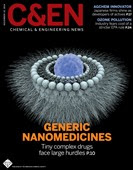
Nanomedicine is offering patients a growing arsenal of therapeutic drugs for a variety of diseases but often at a cost of thousands of dollars a month. Generics could substantially reduce the price tag for patients -- if only there were a well-defined way to make and regulate them. An article in Chemical & Engineering News (C&EN), the weekly newsmagazine of the American Chemical Society, details the challenges on the road to generic nanodrugs.
Regulatory and scientific complexity of generic nanodrugs could delay savings for patients
Washington, DC | Posted on November 12th, 2014Matt Davenport, a C&EN contributing editor, points out that in small-molecule therapeutics -- aspirin, for example -- the active ingredient is the primary concern of regulators. For these drugs, making generic versions is a relatively straightforward process. Nanomedicine, on the other hand, is far more complicated. It often involves packaging an active ingredient inside engineered delivery systems made out of materials such as lipids, polymers or carbohydrates. Even slight changes to a nanodrug's structure can result in a different toxicity level.
To date, the Food and Drug Administration (FDA) has approved dozens of nanodrugs although it has no formal regulatory definition for what a nanodrug is. Such a definition would be a first step toward clearer regulations.
The agency currently examines each nano therapeutic on a case-by-case basis and offers guidance to drug makers that is nonbinding for now. Still, in 2013, the FDA signed off on what many consider to be the first generic therapeutic in this category, but no one is sure when the next approval might come.
####
About American Chemical Society
The American Chemical Society is a nonprofit organization chartered by the U.S. Congress. With more than 161,000 members, ACS is the world's largest scientific society and a global leader in providing access to chemistry-related research through its multiple databases, peer-reviewed journals and scientific conferences. Its main offices are in Washington, D.C., and Columbus, Ohio.
For more information, please click here
Contacts:
Michael Bernstein
202-872-6042
Copyright © American Chemical Society
If you have a comment, please Contact us.Issuers of news releases, not 7th Wave, Inc. or Nanotechnology Now, are solely responsible for the accuracy of the content.
Bookmark:


| Related Links |
| Related News Press |
News and information
 Quantum computer improves AI predictions April 17th, 2026
Flexible sensor gains sensitivity under pressure April 17th, 2026
A reusable chip for particulate matter sensing April 17th, 2026
Detecting vibrational quantum beating in the predissociation dynamics of SF6 using time-resolved photoelectron spectroscopy April 17th, 2026
Cancer
New molecular technology targets tumors and simultaneously silences two ‘undruggable’ cancer genes August 8th, 2025
Ben-Gurion University of the Negev researchers several steps closer to harnessing patient's own T-cells to fight off cancer June 6th, 2025
Self-propelled protein-based nanomotors for enhanced cancer therapy by inducing ferroptosis June 6th, 2025
Govt.-Legislation/Regulation/Funding/Policy
Quantum computer improves AI predictions April 17th, 2026
Metasurfaces smooth light to boost magnetic sensing precision January 30th, 2026
New imaging approach transforms study of bacterial biofilms August 8th, 2025
Nanomedicine
A fundamentally new therapeutic approach to cystic fibrosis: Nanobody repairs cellular defect April 17th, 2026
New molecular technology targets tumors and simultaneously silences two ‘undruggable’ cancer genes August 8th, 2025
New imaging approach transforms study of bacterial biofilms August 8th, 2025
Electrifying results shed light on graphene foam as a potential material for lab grown cartilage June 6th, 2025
Announcements
A fundamentally new therapeutic approach to cystic fibrosis: Nanobody repairs cellular defect April 17th, 2026
UC Irvine physicists discover method to reverse ‘quantum scrambling’ : The work addresses the problem of information loss in quantum computing system April 17th, 2026
Interviews/Book Reviews/Essays/Reports/Podcasts/Journals/White papers/Posters
A fundamentally new therapeutic approach to cystic fibrosis: Nanobody repairs cellular defect April 17th, 2026
UC Irvine physicists discover method to reverse ‘quantum scrambling’ : The work addresses the problem of information loss in quantum computing system April 17th, 2026
 |
||
 |
||
| The latest news from around the world, FREE | ||
 |
||
|
|
||
| Premium Products | ||
 |
||
|
Only the news you want to read!
Learn More |
||
 |
||
|
Full-service, expert consulting
Learn More |
||
|
|
||