Home > Press > Special UO microscope captures defects in nanotubes: University of Oregon chemists provide a detailed view of traps that disrupt energy flow, possibly pointing toward improved charge-carrying devices
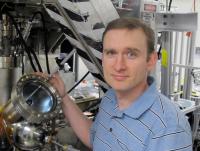 |
| George Nazin, a professor of physical chemistry at the University of Oregon, has uncovered traps, or defects, that disrupt electronic waves in nanotubes. The work was done with a scanning tunneling microscope fitted with a closed-cycle cryostat.
Credit: University of Oregon |
Abstract:
University of Oregon chemists have devised a way to see the internal structures of electronic waves trapped in carbon nanotubes by external electrostatic charges.
Special UO microscope captures defects in nanotubes: University of Oregon chemists provide a detailed view of traps that disrupt energy flow, possibly pointing toward improved charge-carrying devices
Eugene, OR | Posted on October 21st, 2014Carbon nanotubes have been touted as exceptional materials with unique properties that allow for extremely efficient charge and energy transport, with the potential to open the way for new, more efficient types of electronic and photovoltaic devices. However, these traps, or defects, in ultra-thin nanotubes can compromise their effectiveness.
Using a specially built microscope capable of imaging matter at the atomic scale, the researchers were able to visualize traps, which can adversely affect the flow of electrons and elementary energy packets called excitons.
The study, said George V. Nazin, a professor of physical chemistry, modeled the behavior often observed in carbon nanotube-based electronic devices, where electronic traps are induced by stochastic external charges in the immediate vicinity of the nanotubes. The external charges attract and trap electrons propagating through nanotubes.
"Our visualization should be useful for the development of a more accurate picture of electron propagation through nanotubes in real-world applications, where nanotubes are always subjected to external perturbations that potentially may lead to the creation of these traps," he said.
The research, detailed in a paper in the Journal of Physical Chemistry Letters, was done with an ultra-high vacuum scanning tunneling microscope coupled to a closed-cycle cryostat -- a novel device built for use in Nazin's lab. The cryostat allowed Nazin and his co-authors Dmitry A. Kislitsyn and Jason D. Hackley, both doctoral students, to lower the temperature to 20 Kelvin to freeze all nanoscale motion, and visualize the internal structures of nanoscale objects.
The device captured the internal structure of electronic waves trapped in short sections, just several nanometers long, of nanotubes partially suspended above an atomically flat gold surface. The properties of the waves, to a large extent, Nazin said, determine electron transmission through such electronic traps. The propagating electrons have to be in resonance with the localized waves for efficient electronic transmission to occur.
"Amazingly, by finely tuning the energies of propagating electrons, we found that, in addition to these resonance transmission channels, other resonances also are possible, with energies matching those of specific vibrations in carbon nanotubes," he said. "These new transmission channels correspond to 'vibronic' resonances, where trapped electronic waves excite vibrations of carbon atoms forming the electronic trap."
The microscope the team used is detailed separately in a freely available paper (High-stability cryogenic scanning tunneling microscope based on a closed-cycle cryostat) placed online Oct. 7 by the journal Review of Scientific Instruments.
###
The National Science Foundation (grant DMR-0960211) and a grant from the Oregon Nanoscience and Microtechnologies Institute (ONAMI) supported the construction of the microscope used in the project.
Nazin's co-authors on the paper detailing the microscope are Hackley, Kislitsyn, former UO doctoral student Daniel K. Beaman, now at Intel Corp. in Hillsboro, Oregon, and Stefan Ulrich of RHK Technologies Inc. in Troy, Michigan.
####
For more information, please click here
Contacts:
Jim Barlow
541-346-3481
Source:
George Nazin
assistant professor
physical chemistry
541-346-2017
Copyright © University of Oregon
If you have a comment, please Contact us.Issuers of news releases, not 7th Wave, Inc. or Nanotechnology Now, are solely responsible for the accuracy of the content.
Bookmark:


| Related Links |
 Department of Chemistry and Biochemistry:
| Related News Press |
News and information
Quantum computer improves AI predictions April 17th, 2026
Flexible sensor gains sensitivity under pressure April 17th, 2026
A reusable chip for particulate matter sensing April 17th, 2026
Detecting vibrational quantum beating in the predissociation dynamics of SF6 using time-resolved photoelectron spectroscopy April 17th, 2026
Imaging
Simple algorithm paired with standard imaging tool could predict failure in lithium metal batteries August 8th, 2025
Govt.-Legislation/Regulation/Funding/Policy
Quantum computer improves AI predictions April 17th, 2026
Metasurfaces smooth light to boost magnetic sensing precision January 30th, 2026
New imaging approach transforms study of bacterial biofilms August 8th, 2025
Nanotubes/Buckyballs/Fullerenes/Nanorods/Nanostrings/Nanosheets
Tiny nanosheets, big leap: A new sensor detects ethanol at ultra-low levels January 30th, 2026
Enhancing power factor of p- and n-type single-walled carbon nanotubes April 25th, 2025
Chainmail-like material could be the future of armor: First 2D mechanically interlocked polymer exhibits exceptional flexibility and strength January 17th, 2025
Innovative biomimetic superhydrophobic coating combines repair and buffering properties for superior anti-erosion December 13th, 2024
Discoveries
Quantum computer improves AI predictions April 17th, 2026
Flexible sensor gains sensitivity under pressure April 17th, 2026
A reusable chip for particulate matter sensing April 17th, 2026
Detecting vibrational quantum beating in the predissociation dynamics of SF6 using time-resolved photoelectron spectroscopy April 17th, 2026
Announcements
A fundamentally new therapeutic approach to cystic fibrosis: Nanobody repairs cellular defect April 17th, 2026
UC Irvine physicists discover method to reverse ‘quantum scrambling’ : The work addresses the problem of information loss in quantum computing system April 17th, 2026
Interviews/Book Reviews/Essays/Reports/Podcasts/Journals/White papers/Posters
A fundamentally new therapeutic approach to cystic fibrosis: Nanobody repairs cellular defect April 17th, 2026
UC Irvine physicists discover method to reverse ‘quantum scrambling’ : The work addresses the problem of information loss in quantum computing system April 17th, 2026
Tools
Metasurfaces smooth light to boost magnetic sensing precision January 30th, 2026
From sensors to smart systems: the rise of AI-driven photonic noses January 30th, 2026
Japan launches fully domestically produced quantum computer: Expo visitors to experience quantum computing firsthand August 8th, 2025
Grants/Sponsored Research/Awards/Scholarships/Gifts/Contests/Honors/Records
Quantum computer improves AI predictions April 17th, 2026
Detecting vibrational quantum beating in the predissociation dynamics of SF6 using time-resolved photoelectron spectroscopy April 17th, 2026
Metasurfaces smooth light to boost magnetic sensing precision January 30th, 2026
 |
||
 |
||
| The latest news from around the world, FREE | ||
 |
||
|
|
||
| Premium Products | ||
 |
||
|
Only the news you want to read!
Learn More |
||
 |
||
|
Full-service, expert consulting
Learn More |
||
|
|
||