Home > Press > Nanoparticles Break the Symmetry of Light
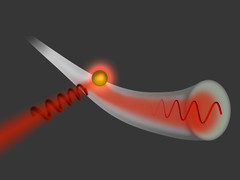 |
| Light hits a gold particle, which then emits light into a glass fibre - into only one direction. |
Abstract:
Nanoparticles can emit light into ultra-thin glass fibres. Physicists at the Vienna University of Technology have now managed to select the direction of the light using an unusual kind of coupling between spin and the direction of propagation.
Nanoparticles Break the Symmetry of Light
Vienna, Austria | Posted on October 6th, 2014How can a beam of light tell the difference between left and right? At the Vienna University of Technology (TU Wien) tiny particles have been coupled to a glass fibre. The particles emit light into the fibre in such a way that it does not travel in both directions, as one would expect. Instead, the light can be directed either to the left or to the right. This has become possible by employing a remarkable physical effect - the spin-orbit coupling of light. This new kind of optical switch has the potential to revolutionize nanophotonics. The researchers have now published their work in the journal "Science".
Gold Nanoparticles on Glass Fibres
When a particle absorbs and emits light, this light is not just emitted into one direction. "A particle in free space will always emit as much light into one particular direction as it emits into the opposite direction", says Professor Arno Rauschenbeutel (TU Wien). His team has now succeeded in breaking this symmetry of emission using gold nanoparticles coupled to ultra-thin glass fibres. The incident laser light determines whether the light emitted by the particle travels left or right in the glass fibre.
Bicycles and Airplane Propellers
This is only possible because light has an intrinsic angular momentum, the spin. Similar to a pendulum which can swing in one particular plane or move in circles, a light wave can have different directions of oscillation. If it has a well-defined vibrational direction, it is called a "polarized wave". "A simple plane wave has the same polarization everywhere", says Arno Rauschenbeutel, "but when the intensity of the light changes locally, the polarization changes too."
Usually, the light oscillates in a plane perpendicular to its direction of propagation. If the oscillation is circular, this is similar to the motion of an airplane propeller. Its rotational axis - corresponding to the spin - points into the direction of propagation. But light moving through ultra-thin glass fibres has very special properties. Its intensity is very high inside the glass fibre, but it rapidly decreases outside the fibre. "This leads to an additional field component in the direction of the glass fibre", says Arno Rauschenbeutel. The rotational plane of the light wave pivots by 90 degrees. "Then, the direction of propagation is perpendicular to the spin, just like a bicycle, moving into a direction which is perpendicular to the axes of the wheels."
By checking the wheels' direction of rotation - clockwise or counter-clockwise - we can tell whether a bicycle moves right or left when looking at it from the side. It is exactly the same with the beams of light in the ultra-thin glass fibre. The sense of rotation of the light field is coupled to the direction of motion. This kind of coupling is a direct consequence of the glass fibre geometry and the laws of electrodynamics. The effect is called "spin-orbit-coupling of light".
Coupling Rotation and the Direction of Motion
When a particle that is coupled to the glass fibre is irradiated with a laser in such a way that it emits light of a particular sense of rotation, the emitted light will thus propagate into just one particular direction inside the glass fibre - either to the left or to the right. This effect has now been demonstrated using a single gold nanoparticle on a glass fibre. The fibre is 250 times thinner than a human hair; the diameter of the gold particle is even four times less. Both the diameter of the fibre and the particle are even smaller than the wavelength of the emitted light.
"This new technology should be easily made available in commercial applications. Already now, the whole experiment fits into a shoebox", says Arno Rauschenbeutel. "The method could be applied to integrated optical circuits. Such systems may one day replace the electronic circuits we are using today."
####
For more information, please click here
Contacts:
Florian Aigner
43-158-801-41027
Further information
Prof. Arno Rauschenbeutel
Atominstitut
Vienna Center for Quantum Science and Technology
Technische Universität Wien
Stadionallee 2, 1020 Wien
T: +43-(1)-58801-141761
Copyright © Vienna University of Technology
If you have a comment, please Contact us.Issuers of news releases, not 7th Wave, Inc. or Nanotechnology Now, are solely responsible for the accuracy of the content.
Bookmark:


| Related Links |
| Related News Press |
News and information
 Quantum computer improves AI predictions April 17th, 2026
Flexible sensor gains sensitivity under pressure April 17th, 2026
A reusable chip for particulate matter sensing April 17th, 2026
Detecting vibrational quantum beating in the predissociation dynamics of SF6 using time-resolved photoelectron spectroscopy April 17th, 2026
Physics
UC Irvine physicists discover method to reverse ‘quantum scrambling’ : The work addresses the problem of information loss in quantum computing system April 17th, 2026
Quantum computers simulate fundamental physics: shedding light on the building blocks of nature June 6th, 2025
Chip Technology
A reusable chip for particulate matter sensing April 17th, 2026
Metasurfaces smooth light to boost magnetic sensing precision January 30th, 2026
Optical computing/Photonic computing
ICFO researchers overcome long-standing bottleneck in single photon detection with twisted 2D materials August 8th, 2025
Programmable electron-induced color router array May 14th, 2025
Discoveries
Quantum computer improves AI predictions April 17th, 2026
Flexible sensor gains sensitivity under pressure April 17th, 2026
A reusable chip for particulate matter sensing April 17th, 2026
Detecting vibrational quantum beating in the predissociation dynamics of SF6 using time-resolved photoelectron spectroscopy April 17th, 2026
Announcements
A fundamentally new therapeutic approach to cystic fibrosis: Nanobody repairs cellular defect April 17th, 2026
UC Irvine physicists discover method to reverse ‘quantum scrambling’ : The work addresses the problem of information loss in quantum computing system April 17th, 2026
Interviews/Book Reviews/Essays/Reports/Podcasts/Journals/White papers/Posters
A fundamentally new therapeutic approach to cystic fibrosis: Nanobody repairs cellular defect April 17th, 2026
UC Irvine physicists discover method to reverse ‘quantum scrambling’ : The work addresses the problem of information loss in quantum computing system April 17th, 2026
Photonics/Optics/Lasers
Metasurfaces smooth light to boost magnetic sensing precision January 30th, 2026
From sensors to smart systems: the rise of AI-driven photonic noses January 30th, 2026
 |
||
 |
||
| The latest news from around the world, FREE | ||
 |
||
|
|
||
| Premium Products | ||
 |
||
|
Only the news you want to read!
Learn More |
||
 |
||
|
Full-service, expert consulting
Learn More |
||
|
|
||