Home > Press > Ultrafast remote switching of light emission
 |
| Image: Yan Liang (L2Molecule.com) |
Abstract:
Researchers from Eindhoven University of Technology can now for the first time remotely control a miniature light source at timescales of 200 trillionth of a second. They published the results on 14 September 2014 in the online journal Nature Nanotechnology.
Ultrafast remote switching of light emission
Eindhoven, the Netherlands | Posted on October 2nd, 2014Physicists from the Photonics and Semiconductor Nanophysics group at Eindhoven, under the leadership of prof. Andrea Fiore, have developed a way of remotely controlling the nanoscale light sources at an extremely short timescale. These light sources are needed to be able to transmit quantum information.
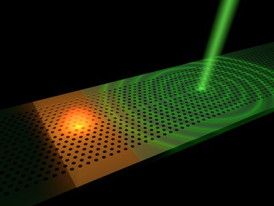
The researchers etched a photonic crystal around several quantum dots in a semiconductor layer. Quantum dots are small structures that spontaneously emit light as a consequence of atomic processes. If a short laser pulse is fired at the photonic crystal, its refractive index is modified and the quantum dot experiences a change in the electromagnetic field around it. This change can speed up or slow down the emission of light by the dot. As soon as the refractive index recovers its usual value, the dot emits light again in the normal manner.
Ultrashort light flash
Using this technique the spontaneous emission of light by the dot can be switched on and off at will. The most striking feature of this method is that the duration of the light flash can be made considerably shorter than the natural lifetime of such a dot as a light source. In the current article the researchers describe an experiment in which the light pulse was 200 picoseconds (trillionths of a second) long. Based on the underlying theory, the researchers expect to be able to make these light pulses another factor of ten shorter. Furthermore, the researchers demonstrated that the emission of the light source could be controlled using a laser pulse at a relatively large distance from the source.
Quantum information
This result is important for the transmission of quantum information, for example. This requires light sources that can emit individual photons (light particles). Being able to control time-dependent properties of these photons is important for the exchange of quantum information between different parties. The method now proposed for the remote control of the light source makes this possible without influencing the other properties of the emitted photons.
The researchers used the facilities to make the special structure that holds a quantum dot in a photonic crystal. The research was funded by NanoNextNL, STW and FOM.
####
For more information, please click here
Contacts:
Andrea Fiore
31-402-472-118
Copyright © Eindhoven University of Technology
If you have a comment, please Contact us.Issuers of news releases, not 7th Wave, Inc. or Nanotechnology Now, are solely responsible for the accuracy of the content.
Bookmark:


| Related Links |
 Ultrafast nonlocal control of spontaneous emission.
| Related News Press |
News and information
Quantum computer improves AI predictions April 17th, 2026
Flexible sensor gains sensitivity under pressure April 17th, 2026
A reusable chip for particulate matter sensing April 17th, 2026
Detecting vibrational quantum beating in the predissociation dynamics of SF6 using time-resolved photoelectron spectroscopy April 17th, 2026
Physics
UC Irvine physicists discover method to reverse ‘quantum scrambling’ : The work addresses the problem of information loss in quantum computing system April 17th, 2026
Quantum computers simulate fundamental physics: shedding light on the building blocks of nature June 6th, 2025
Chip Technology
A reusable chip for particulate matter sensing April 17th, 2026
Metasurfaces smooth light to boost magnetic sensing precision January 30th, 2026
Quantum Computing
Quantum computer improves AI predictions April 17th, 2026
UC Irvine physicists discover method to reverse ‘quantum scrambling’ : The work addresses the problem of information loss in quantum computing system April 17th, 2026
Researchers develop molecular qubits that communicate at telecom frequencies October 3rd, 2025
Discoveries
Quantum computer improves AI predictions April 17th, 2026
Flexible sensor gains sensitivity under pressure April 17th, 2026
A reusable chip for particulate matter sensing April 17th, 2026
Detecting vibrational quantum beating in the predissociation dynamics of SF6 using time-resolved photoelectron spectroscopy April 17th, 2026
Announcements
A fundamentally new therapeutic approach to cystic fibrosis: Nanobody repairs cellular defect April 17th, 2026
UC Irvine physicists discover method to reverse ‘quantum scrambling’ : The work addresses the problem of information loss in quantum computing system April 17th, 2026
Interviews/Book Reviews/Essays/Reports/Podcasts/Journals/White papers/Posters
A fundamentally new therapeutic approach to cystic fibrosis: Nanobody repairs cellular defect April 17th, 2026
UC Irvine physicists discover method to reverse ‘quantum scrambling’ : The work addresses the problem of information loss in quantum computing system April 17th, 2026
Quantum Dots/Rods
A new kind of magnetism November 17th, 2023
IOP Publishing celebrates World Quantum Day with the announcement of a special quantum collection and the winners of two prestigious quantum awards April 14th, 2023
Qubits on strong stimulants: Researchers find ways to improve the storage time of quantum information in a spin rich material January 27th, 2023
NIST’s grid of quantum islands could reveal secrets for powerful technologies November 18th, 2022
Photonics/Optics/Lasers
Metasurfaces smooth light to boost magnetic sensing precision January 30th, 2026
From sensors to smart systems: the rise of AI-driven photonic noses January 30th, 2026
 |
||
 |
||
| The latest news from around the world, FREE | ||
 |
||
|
|
||
| Premium Products | ||
 |
||
|
Only the news you want to read!
Learn More |
||
 |
||
|
Full-service, expert consulting
Learn More |
||
|
|
||