Home > Press > 'Stealth' nanoparticles could improve cancer vaccines
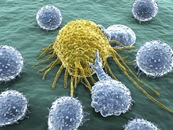 |
| Getting immune cells (blue) to kill cancer cells (yellow) could require a stealthy approach. Credit: selvanegra/iStock/Thinkstock |
Abstract:
Cancer vaccines have recently emerged as a promising approach for killing tumor cells before they spread. But so far, most clinical candidates haven't worked that well. Now, scientists have developed a new way to deliver vaccines that successfully stifled tumor growth when tested in laboratory mice. And the key, they report in the journal ACS Nano, is in the vaccine's unique stealthy nanoparticles.
'Stealth' nanoparticles could improve cancer vaccines
Washington, DC | Posted on October 1st, 2014Hiroshi Shiku, Naozumi Harada and colleagues explain that most cancer vaccine candidates are designed to flag down immune cells, called macrophages and dendritic cells, that signal "killer" T cells to attack tumors. The problem is that approaches based on targeting these generally circulating immune cells have not been very successful. But recent research has suggested that a subset of macrophages only found deep inside lymph nodes could play a major role in slowing cancer. But how could one get a vaccine to these special immune cells without first being gobbled up by the macrophages and dendritic cells circulating in the body? Shiku's team wanted to see if stealthy nanoparticles they had developed and clinically tested in patients might hold the answer.
The researchers injected the nanoparticles into mice. They found that the particles, which have no electric charge or surface molecules that would attract the attention of circulating immune cells, were able to enter the mice's lymph nodes. But once inside the lymph nodes' core, the special kind of macrophage engulfed the particles. When molecules for signaling killer T cells were put inside the nanoparticles, they hindered tumor growth far better than existing vaccines.
###
The authors acknowledge funding from a Grant-in-Aid for Scientific Research (KAKENHI) and the Exploratory Research for Advanced Technology (ERATO).
####
About American Chemical Society
The American Chemical Society is a nonprofit organization chartered by the U.S. Congress. With more than 161,000 members, ACS is the world's largest scientific society and a global leader in providing access to chemistry-related research through its multiple databases, peer-reviewed journals and scientific conferences. Its main offices are in Washington, D.C., and Columbus, Ohio.
For more information, please click here
Contacts:
Michael Bernstein
202-872-6042
Naozumi Harada, Ph.D.
Mie University Graduate School of Medicine
Mie 514-8507
and ImmunoFrontier, Inc.
Tokyo 101-0021
Japan
or
Hiroshi Shiku, M.D.
Department of Immuno-Gene Therapy
Mie University Graduate School of Medicine
Mie 514-8507
Japan
Email:
Copyright © American Chemical Society
If you have a comment, please Contact us.Issuers of news releases, not 7th Wave, Inc. or Nanotechnology Now, are solely responsible for the accuracy of the content.
Bookmark:


| Related Links |
| Related News Press |
News and information
 Quantum computer improves AI predictions April 17th, 2026
Flexible sensor gains sensitivity under pressure April 17th, 2026
A reusable chip for particulate matter sensing April 17th, 2026
Detecting vibrational quantum beating in the predissociation dynamics of SF6 using time-resolved photoelectron spectroscopy April 17th, 2026
Govt.-Legislation/Regulation/Funding/Policy
Quantum computer improves AI predictions April 17th, 2026
Metasurfaces smooth light to boost magnetic sensing precision January 30th, 2026
New imaging approach transforms study of bacterial biofilms August 8th, 2025
Nanomedicine
A fundamentally new therapeutic approach to cystic fibrosis: Nanobody repairs cellular defect April 17th, 2026
New molecular technology targets tumors and simultaneously silences two ‘undruggable’ cancer genes August 8th, 2025
New imaging approach transforms study of bacterial biofilms August 8th, 2025
Electrifying results shed light on graphene foam as a potential material for lab grown cartilage June 6th, 2025
Discoveries
Quantum computer improves AI predictions April 17th, 2026
Flexible sensor gains sensitivity under pressure April 17th, 2026
A reusable chip for particulate matter sensing April 17th, 2026
Detecting vibrational quantum beating in the predissociation dynamics of SF6 using time-resolved photoelectron spectroscopy April 17th, 2026
Announcements
A fundamentally new therapeutic approach to cystic fibrosis: Nanobody repairs cellular defect April 17th, 2026
UC Irvine physicists discover method to reverse ‘quantum scrambling’ : The work addresses the problem of information loss in quantum computing system April 17th, 2026
Interviews/Book Reviews/Essays/Reports/Podcasts/Journals/White papers/Posters
A fundamentally new therapeutic approach to cystic fibrosis: Nanobody repairs cellular defect April 17th, 2026
UC Irvine physicists discover method to reverse ‘quantum scrambling’ : The work addresses the problem of information loss in quantum computing system April 17th, 2026
Alliances/Trade associations/Partnerships/Distributorships
Chicago Quantum Exchange welcomes six new partners highlighting quantum technology solutions, from Chicago and beyond September 23rd, 2022
University of Illinois Chicago joins Brookhaven Lab's Quantum Center June 10th, 2022
Research partnerships
Lab to industry: InSe wafer-scale breakthrough for future electronics August 8th, 2025
HKU physicists uncover hidden order in the quantum world through deconfined quantum critical points April 25th, 2025
 |
||
 |
||
| The latest news from around the world, FREE | ||
 |
||
|
|
||
| Premium Products | ||
 |
||
|
Only the news you want to read!
Learn More |
||
 |
||
|
Full-service, expert consulting
Learn More |
||
|
|
||