Home > Press > New Topical Hemostatic Agent: Neutral Self-Assembling Peptide Hydrogel
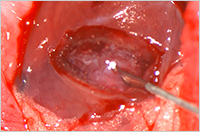 |
| Hemostasis in a rat liver laceration model. Incision was made on the left hepatic lobe. Bleeding decreased immediately following application of the 1.5% (w/v) SPG-178 hydrogel to the bleeding surface. Because SPG-178 hydrogel is transparent, the bleeding surface was visible. |
Abstract:
Self-assembling peptide is characterized by a stable β-sheet structure and known to undergo self-assembly into nanofibers that could further form a hydrogel. Self-assembling peptide hydrogels have already been employed for tissue engineering, drug delivery systems, and wound healing. In addition, self-assembling peptide hydrogels are effective as topical hemostatic agents. However, their low pH raises the possibility of harmful effects on living tissues.
New Topical Hemostatic Agent: Neutral Self-Assembling Peptide Hydrogel
Okinawa, Japan | Posted on September 30th, 2014Now, Seiji Komatsu and colleagues at Okayama University have demonstrated the efficacy of SPG-178 hydrogel, a neutral self-assembling peptide hydrogel as a topical hemostatic agent.
First, they measured the bleeding duration of incisions made on rat livers after application of SPG-178 (1.0% w/v), SPG-178 (1.5% w/v), RADA16 (1.0% w/v), and saline. Second, they observed the bleeding surfaces by transmission electron microscopy immediately after hemostasis. Third, they measured the elastic and viscous responses (G′ and G′′, respectively) of the hydrogels using a rheometer.
Their results showed that the duration of bleeding was significantly shorter in the SPG-178 group than in the RADA16 group and that there were no significant differences in transmission electron microscopy findings between the groups. The greater the G′ value of a hydrogel, the shorter was the bleeding duration.
SPG-178 hydrogel is effective and has several advantages over other hydrogels: it is non-biological, transparent, non-adherent and neutral, and can be sterilized by autoclaving. The researchers are confident that SPG-178 hydrogel is applicable in many surgical procedures.
Reference:
・Authors: Seiji Komatsu, Yusuke Nagai, Keiji Naruse, Yoshihiro Kimata.
・Title of original paper: The Neutral Self-Assembling Peptide Hydrogel SPG-178 as a Topical Hemostatic Agent.
・Journal, volume, pages and year: PLOS ONE 9, e102778 (2014).
・Journal website: ousar.lib.okayama-u.ac.jp/metadata/52799
・Digital Object Identifier (DOI): 10.1371/journal.pone.0102778
・Journal website: dx.plos.org/10.1371/journal.pone.0102778.
・Affiliations:
Department of Plastic and Reconstructive Surgery, Okayama University.
Department of Cardiovascular Physiology, Okayama University.
Department of Plastic and Reconstructive Surgery, Okayama Saiseikai General Hospital.
Menicon Co., Ltd.
####
About Okinawa University
Okayama University is one of the largest comprehensive universities in Japan with roots going back to the Medical Training Place sponsored by the Lord of Okayama and established in 1870. Now with 1,300 faculty and 14,000 students, the University offers courses in specialties ranging from medicine and pharmacy to humanities and physical sciences. Okayama University is located in the heart of Japan approximately 3 hours west of Tokyo by Shinkansen.
For more information, please click here
Contacts:
Okayama University
1-1-1 Tsushima-naka , Kita-ku ,
Okayama-shi 700-8530, Japan
Planning and Public Information Division
Copyright © Okinawa University
If you have a comment, please Contact us.Issuers of news releases, not 7th Wave, Inc. or Nanotechnology Now, are solely responsible for the accuracy of the content.
Bookmark:


| Related Links |
| Related News Press |
News and information
 Quantum computer improves AI predictions April 17th, 2026
Flexible sensor gains sensitivity under pressure April 17th, 2026
A reusable chip for particulate matter sensing April 17th, 2026
Detecting vibrational quantum beating in the predissociation dynamics of SF6 using time-resolved photoelectron spectroscopy April 17th, 2026
Self Assembly
Diamond glitter: A play of colors with artificial DNA crystals May 17th, 2024
Liquid crystal templated chiral nanomaterials October 14th, 2022
Nanoclusters self-organize into centimeter-scale hierarchical assemblies April 22nd, 2022
Atom by atom: building precise smaller nanoparticles with templates March 4th, 2022
Nanomedicine
A fundamentally new therapeutic approach to cystic fibrosis: Nanobody repairs cellular defect April 17th, 2026
New molecular technology targets tumors and simultaneously silences two ‘undruggable’ cancer genes August 8th, 2025
New imaging approach transforms study of bacterial biofilms August 8th, 2025
Electrifying results shed light on graphene foam as a potential material for lab grown cartilage June 6th, 2025
Discoveries
Quantum computer improves AI predictions April 17th, 2026
Flexible sensor gains sensitivity under pressure April 17th, 2026
A reusable chip for particulate matter sensing April 17th, 2026
Detecting vibrational quantum beating in the predissociation dynamics of SF6 using time-resolved photoelectron spectroscopy April 17th, 2026
Announcements
A fundamentally new therapeutic approach to cystic fibrosis: Nanobody repairs cellular defect April 17th, 2026
UC Irvine physicists discover method to reverse ‘quantum scrambling’ : The work addresses the problem of information loss in quantum computing system April 17th, 2026
Interviews/Book Reviews/Essays/Reports/Podcasts/Journals/White papers/Posters
A fundamentally new therapeutic approach to cystic fibrosis: Nanobody repairs cellular defect April 17th, 2026
UC Irvine physicists discover method to reverse ‘quantum scrambling’ : The work addresses the problem of information loss in quantum computing system April 17th, 2026
 |
||
 |
||
| The latest news from around the world, FREE | ||
 |
||
|
|
||
| Premium Products | ||
 |
||
|
Only the news you want to read!
Learn More |
||
 |
||
|
Full-service, expert consulting
Learn More |
||
|
|
||