Home > Press > 'Pixel' engineered electronics have growth potential: Rice, Oak Ridge, Vanderbilt, Penn scientists lead creation of atom-scale semiconducting composites
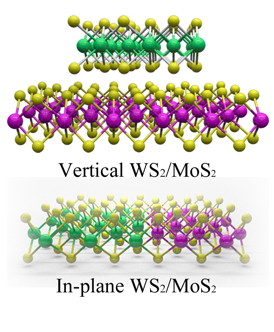 |
| Stacked (top) and in-plane nanomaterials self-assemble in two ways, depending on the temperature at which they're grown, according to Rice University researchers who led the project. The semiconducting materials show promise for a new generation of "pixel" electronics. In the illustration, green spheres are tungsten, purple are molybdenum and yellow are sulfur. Credit: Ajayan Group/Rice University |
Abstract:
A little change in temperature makes a big difference for growing a new generation of hybrid atomic-layer structures, according to scientists at Rice University, Oak Ridge National Laboratory, Vanderbilt University and Pennsylvania State University.
'Pixel' engineered electronics have growth potential: Rice, Oak Ridge, Vanderbilt, Penn scientists lead creation of atom-scale semiconducting composites
Houston, TX | Posted on September 29th, 2014Rice scientists led the first single-step growth of self-assembled hybrid layers made of two elements that can either be side by side and one-atom thick or stacked atop each other. The structure's final form can be tuned by changing the growth temperature.
The discovery reported online this week in Nature Materials could lead to what Rice materials scientist Pulickel Ajayan calls "pixel engineering": atomically thin semiconductors with no limit to their potential for use in optoelectronic devices.
The researchers led by Ajayan and Wu Zhou, a materials scientist at Oak Ridge, discovered the interesting new composites when they combined the growth of two-dimensional molybdenum disulfide and tungsten disulfide through chemical vapor deposition. In this process, specific gases are heated in a furnace, where their atoms gather in an orderly fashion around a catalyst to form the crystalline material.
High-temperature growth - about 850 degrees Celsius (1,563 degrees Fahrenheit) - yielded vertically stacked bilayers, with tungsten on top. At lower temperatures, about 650 degrees C (1,202 degrees F), the crystal lattices preferred to grow side by side. The interfaces in either material are sharp and clean, as seen under a scanning electron microscope and in spectroscopic studies.
"With the advent of 2-D layered materials, people are trying to build artificial structures using graphene and now dichalcogenides as building blocks," Ajayan said. Because graphene is atomically thin and flat and dichalcogenides like molybdenum disulfide are not quite that flat, there is some incompatibility when these are grown together -- but two dichalcogenides with different compositions could be compatible. "We show that depending on the conditions, we can combine two dichalcogenides to grow either in-plane hybrid or in stacks."
The monolayer composites have small but stable band gaps, while the stacked composite layers show modified electronic properties such as enhanced photoluminescence, which will be useful for electronics that rely on optical signals.
"What's even more interesting is that the layered structure has a particular lock-in stacking order," Zhou said. "When you stack 2-D materials by transferring layers, there's no way to control their orientation to one another. That impacts their electronic properties. In this paper, we demonstrate that in a certain window, we can get a particular stacking order during growth, with a particular orientation."
The new materials could be used for vertically stacked field-effect transistors as well as electronic devices only a few atoms thick, he said.
"We should be able to tweak certain regions to control certain functions, like light or terahertz emission," said Robert Vajtai of Rice, a co-author of the study. "The whole idea, really, is to create domains with different electronic characters within a single layer."
"Our goal is to build fully functional electronic devices on a single plane, or maybe a few layers," added Mauricio Terrones, a co-author from Penn State. "What we've accomplished means that pretty much any architecture for devices is now possible on a single atomic layer. And that's remarkable."
Co-authors are graduate students Yongji Gong, Gang Shi, Sidong Lei and Gonglan Ye and postdoctoral researcher Xiaolong Zou; Jun Lou, an associate professor and associate department chair of materials science and nanoengineering; and Boris Yakobson, the Karl F. Hasselmann Professor of Materials Science and NanoEngineering and a professor of chemistry, all of Rice; Junhao Lin and Sokrates Pantelides of Oak Ridge and Vanderbilt University; Xingli Wang, Beng Kang Tay and Zheng Liu of Nanyang Technological University, Singapore; graduate student Zhong Lin of Pennsylvania State University; and Humberto Terrones, the Rayleigh Endowed Chair Professor of Physics at Rensselaer Polytechnic Institute.
Vajtai is a faculty fellow at Rice. Mauricio Terrones is a professor of physics, chemistry, materials science and engineering at Penn State. Ajayan is Rice's Benjamin M. and Mary Greenwood Anderson Professor in Mechanical Engineering and Materials Science and of chemistry and chair of the Department of Materials Science and NanoEngineering.
The Army Research Office, the Department of Energy, the National Science Foundation, the Microelectronics Advanced Research Corp., the Defense Advanced Research Projects Agency, the U.S. Office of Naval Research and the Ministry of Education Academic Research Fund and Silicon Technologies Center of Excellence, Singapore, supported the research.
####
About Rice University
Located on a 300-acre forested campus in Houston, Rice University is consistently ranked among the nation's top 20 universities by U.S. News & World Report. Rice has highly respected schools of Architecture, Business, Continuing Studies, Engineering, Humanities, Music, Natural Sciences and Social Sciences and is home to the Baker Institute for Public Policy. With 3,920 undergraduates and 2,567 graduate students, Rice's undergraduate student-to-faculty ratio is just over 6-to-1. Its residential college system builds close-knit communities and lifelong friendships, just one reason why Rice is highly ranked for best quality of life by the Princeton Review and for best value among private universities by Kiplinger's Personal Finance.
Follow Rice News and Media Relations via Twitter @RiceUNews
For more information, please click here
Contacts:
David Ruth
713-348-6327
Mike Williams
713-348-6728
Copyright © Rice University
If you have a comment, please Contact us.Issuers of news releases, not 7th Wave, Inc. or Nanotechnology Now, are solely responsible for the accuracy of the content.
Bookmark:


| Related Links |
 The STEM Group at Oak Ridge National Laboratory (Zhou):
Rice Department of Materials Science and NanoEngineering:
| Related News Press |
News and information
Quantum computer improves AI predictions April 17th, 2026
Flexible sensor gains sensitivity under pressure April 17th, 2026
A reusable chip for particulate matter sensing April 17th, 2026
Detecting vibrational quantum beating in the predissociation dynamics of SF6 using time-resolved photoelectron spectroscopy April 17th, 2026
Flexible Electronics
Flexible sensor gains sensitivity under pressure April 17th, 2026
Flexible electronics integrated with paper-thin structure for use in space January 17th, 2025
Beyond wires: Bubble technology powers next-generation electronics:New laser-based bubble printing technique creates ultra-flexible liquid metal circuits November 8th, 2024
Laboratories
Researchers develop molecular qubits that communicate at telecom frequencies October 3rd, 2025
Govt.-Legislation/Regulation/Funding/Policy
Quantum computer improves AI predictions April 17th, 2026
Metasurfaces smooth light to boost magnetic sensing precision January 30th, 2026
New imaging approach transforms study of bacterial biofilms August 8th, 2025
Chip Technology
A reusable chip for particulate matter sensing April 17th, 2026
Metasurfaces smooth light to boost magnetic sensing precision January 30th, 2026
Optical computing/Photonic computing
ICFO researchers overcome long-standing bottleneck in single photon detection with twisted 2D materials August 8th, 2025
Programmable electron-induced color router array May 14th, 2025
Discoveries
Quantum computer improves AI predictions April 17th, 2026
Flexible sensor gains sensitivity under pressure April 17th, 2026
A reusable chip for particulate matter sensing April 17th, 2026
Detecting vibrational quantum beating in the predissociation dynamics of SF6 using time-resolved photoelectron spectroscopy April 17th, 2026
Announcements
A fundamentally new therapeutic approach to cystic fibrosis: Nanobody repairs cellular defect April 17th, 2026
UC Irvine physicists discover method to reverse ‘quantum scrambling’ : The work addresses the problem of information loss in quantum computing system April 17th, 2026
Interviews/Book Reviews/Essays/Reports/Podcasts/Journals/White papers/Posters
A fundamentally new therapeutic approach to cystic fibrosis: Nanobody repairs cellular defect April 17th, 2026
UC Irvine physicists discover method to reverse ‘quantum scrambling’ : The work addresses the problem of information loss in quantum computing system April 17th, 2026
Military
Quantum engineers ‘squeeze’ laser frequency combs to make more sensitive gas sensors January 17th, 2025
Chainmail-like material could be the future of armor: First 2D mechanically interlocked polymer exhibits exceptional flexibility and strength January 17th, 2025
Single atoms show their true color July 5th, 2024
NRL charters Navy’s quantum inertial navigation path to reduce drift April 5th, 2024
Photonics/Optics/Lasers
Metasurfaces smooth light to boost magnetic sensing precision January 30th, 2026
From sensors to smart systems: the rise of AI-driven photonic noses January 30th, 2026
Research partnerships
Lab to industry: InSe wafer-scale breakthrough for future electronics August 8th, 2025
HKU physicists uncover hidden order in the quantum world through deconfined quantum critical points April 25th, 2025
 |
||
 |
||
| The latest news from around the world, FREE | ||
 |
||
|
|
||
| Premium Products | ||
 |
||
|
Only the news you want to read!
Learn More |
||
 |
||
|
Full-service, expert consulting
Learn More |
||
|
|
||