Home > Press > Scientists refine formula for nanotube types: Rice University theorists determine factors that give tubes their chiral angles
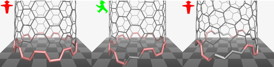 |
| This graphic shows the difference between an armchair nanotube, left, with a fast-growing near-armchair nanotube, center, which has a single kink at its base. At right, a nanotube with multiple kinks is not as likely to grow under given conditions, according to a new formula for nanotube growth by theoretical physicists at Rice University. Credit: Evgeni Penev/Rice University |
Abstract:
Many a great idea springs from talks over a cup of coffee. But it's rare and wonderful when a revelation comes from the cup itself.
Scientists refine formula for nanotube types: Rice University theorists determine factors that give tubes their chiral angles
Houston, TX | Posted on September 17th, 2014Rice University theoretical physicist Boris Yakobson, acting upon sudden inspiration at a meeting last year in Arlington, Va., obtained a couple of spare coffee cups from a server and a pair of scissors and proceeded to lay out - science fair-style - an idea that could have far-reaching implications for the nanotechnology industry.
As reflected in a new paper in Nature Communications, Yakobson and his Rice colleagues, postdoctoral researcher Vasilii Artyukhov and research scientist Evgeni Penev, had come up with the seed (or perhaps, bean) of a simple formula that describes why nanotubes have chirality. Chirality is the property that describes the angle of the carbon atom hexagons that make up a nanotube's walls.
The researchers said the knowledge may ultimately allow chemists to control the chirality of entire batches of nanotubes as the tubes are grown.
Carbon nanotubes are sheets of graphene, the single-atom thick form of carbon, rolled into a cylinder. Certain types, called armchair nanotubes -- so-called for the way their edges line up -- have excellent conductivity and may be the key to lossless power transmission cables. Turn the hexagons 30 degrees and the nanotubes become what are called zigzag type, a semiconducting variant that has great value for electronic applications.
Zigzags, armchairs and all the nanotubes in between are defined by their chirality. Their electronic, chemical and optical properties change with every degree between zero and 30 that the hexagons are tilted.
Nanotubes grow in batches of many types, and nobody has yet found an efficient way to obtain tubes of a single type in industrial quantities. The best hope for new technologies using nanotubes is to figure out how to grow single-chirality batches.
That, it turns out, may be a matter of balancing two opposing forces: the energy of the catalyst-nanotube contact and the speed at which atoms attach themselves as they force the nanotube to grow from the bottom up.
Yakobson and his colleagues were most intrigued by the fact that, over the last decade, nanotube growth in several laboratories has revealed a strong preference toward near-armchair versions with minimum chirality. As grown, these nanotubes tilt at the base while still attached to the metal catalyst. "They're leaning towers of carbon," Yakobson said, although that would have made Pisa jealous because nanotubes can be thousands of times higher than they are wide. Plus, they spin as they grow instead of standing still.
"From a theory standpoint, it was really a puzzle," Penev said. "Why do they grow chiral, and what can control this type of chirality?"
Yakobson and his Rice group specialize in theoretical analysis of energy at the atomic level. When the professor, with cup and scissors in hand, cut a notch into the container, it all began to make sense.
"When we looked very carefully at the thermodynamics and kinetics of the atomic interface between the catalyst and the body of the growing carbon lattice, we discovered there is a balance between the energy of the contact and the speed by which carbon atoms can be inserted," he said.
The researchers described energy and speed as "antagonistic trends," as the energetic preference leans toward a flat-bottom nanotube that hugs the catalyst and results in either armchair or zigzag "achiral" tubes, while the need for speed leads to chiral tubes.
The best balance was achieved when the nanotubes showed a single kink at the base, like one tooth on a saw, and left the needed amount of room for atoms to attach themselves and force the tube to spiral upwards.
"The critical detail is that carbon is easier to insert at the interface between the catalyst and nanotube body if there is a loose spot," Artyukhov said. "This loose spot is always due to the kink in the foundation, so to speak."
Consequently, while calculating the growth distribution of nanotubes in a batch, the researchers found the most abundant nanotubes are those that are very close to armchair type, especially when growth takes place at lower temperatures and with a solid catalyst. Higher temperatures and a liquid catalyst tend to produce a wider array of chiral nanotubes. Both results can be explained by the formula, according to the paper.
"In fact, one of the most satisfying things about this work is that all this complexity can be packed into a very simple mathematical equation," Yakobson said. "I would never have expected that."
The Office of Naval Research, the Air Force Office of Scientific Research and the National Science Foundation (NSF) supported the research. The researchers used the NSF-supported Data Analysis and Visualization Cyberinfrastructure supercomputer administered by Rice's Ken Kennedy Institute for Information Technology, as well as NSF's XSEDE and the Department of Energy's National Energy Research Scientific Computing Center supercomputers.
Yakobson is Rice's Karl F. Hasselmann Professor of Materials Science and NanoEngineering, a professor of chemistry and a member of Rice's Richard E. Smalley Institute for Nanoscale Science and Technology.
####
About Rice University
Located on a 300-acre forested campus in Houston, Rice University is consistently ranked among the nation's top 20 universities by U.S. News & World Report. Rice has highly respected schools of Architecture, Business, Continuing Studies, Engineering, Humanities, Music, Natural Sciences and Social Sciences and is home to the Baker Institute for Public Policy. With 3,920 undergraduates and 2,567 graduate students, Rice's undergraduate student-to-faculty ratio is just over 6-to-1. Its residential college system builds close-knit communities and lifelong friendships, just one reason why Rice is highly ranked for best quality of life by the Princeton Review and for best value among private universities by Kiplinger's Personal Finance.
Follow Rice News and Media Relations via Twitter @RiceUNews
For more information, please click here
Contacts:
David Ruth
713-348-6327
Jade Boyd
713-348-6778
Copyright © Rice University
If you have a comment, please Contact us.Issuers of news releases, not 7th Wave, Inc. or Nanotechnology Now, are solely responsible for the accuracy of the content.
Bookmark:


| Related Links |
 Rice University Materials Science and NanoEngineering:
| Related News Press |
News and information
Quantum computer improves AI predictions April 17th, 2026
Flexible sensor gains sensitivity under pressure April 17th, 2026
A reusable chip for particulate matter sensing April 17th, 2026
Detecting vibrational quantum beating in the predissociation dynamics of SF6 using time-resolved photoelectron spectroscopy April 17th, 2026
Videos/Movies
ICFO researchers overcome long-standing bottleneck in single photon detection with twisted 2D materials August 8th, 2025
New X-ray imaging technique to study the transient phases of quantum materials December 29th, 2022
Solvent study solves solar cell durability puzzle: Rice-led project could make perovskite cells ready for prime time September 23rd, 2022
Scientists prepare for the world’s smallest race: Nanocar Race II March 18th, 2022
Govt.-Legislation/Regulation/Funding/Policy
Quantum computer improves AI predictions April 17th, 2026
Metasurfaces smooth light to boost magnetic sensing precision January 30th, 2026
New imaging approach transforms study of bacterial biofilms August 8th, 2025
Nanotubes/Buckyballs/Fullerenes/Nanorods/Nanostrings/Nanosheets
Tiny nanosheets, big leap: A new sensor detects ethanol at ultra-low levels January 30th, 2026
Enhancing power factor of p- and n-type single-walled carbon nanotubes April 25th, 2025
Chainmail-like material could be the future of armor: First 2D mechanically interlocked polymer exhibits exceptional flexibility and strength January 17th, 2025
Innovative biomimetic superhydrophobic coating combines repair and buffering properties for superior anti-erosion December 13th, 2024
Discoveries
Quantum computer improves AI predictions April 17th, 2026
Flexible sensor gains sensitivity under pressure April 17th, 2026
A reusable chip for particulate matter sensing April 17th, 2026
Detecting vibrational quantum beating in the predissociation dynamics of SF6 using time-resolved photoelectron spectroscopy April 17th, 2026
Announcements
A fundamentally new therapeutic approach to cystic fibrosis: Nanobody repairs cellular defect April 17th, 2026
UC Irvine physicists discover method to reverse ‘quantum scrambling’ : The work addresses the problem of information loss in quantum computing system April 17th, 2026
Interviews/Book Reviews/Essays/Reports/Podcasts/Journals/White papers/Posters
A fundamentally new therapeutic approach to cystic fibrosis: Nanobody repairs cellular defect April 17th, 2026
UC Irvine physicists discover method to reverse ‘quantum scrambling’ : The work addresses the problem of information loss in quantum computing system April 17th, 2026
Military
Quantum engineers ‘squeeze’ laser frequency combs to make more sensitive gas sensors January 17th, 2025
Chainmail-like material could be the future of armor: First 2D mechanically interlocked polymer exhibits exceptional flexibility and strength January 17th, 2025
Single atoms show their true color July 5th, 2024
NRL charters Navy’s quantum inertial navigation path to reduce drift April 5th, 2024
 |
||
 |
||
| The latest news from around the world, FREE | ||
 |
||
|
|
||
| Premium Products | ||
 |
||
|
Only the news you want to read!
Learn More |
||
 |
||
|
Full-service, expert consulting
Learn More |
||
|
|
||