Home > Press > ‘Small’ transformation yields big changes
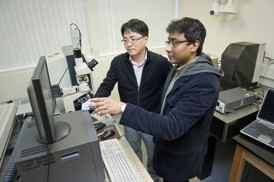 |
| In this file photo, Swastik Kar (right), and Yung Joon Jung use a Raman Spectrometer to characterize the assembly of a carbon nanotube. Photo by Mary Knox Merrill |
Abstract:
An interdisciplinary team of researchers led by Northeastern University has developed a novel method for controllably constructing precise inter-nanotube junctions and a variety of nanocarbon structures in carbon nanotube arrays. The method, the researchers say, is facile and easily scalable, which will allow them to tailor the physical properties of nanotube networks for use in applications ranging from electronic devices to CNT-reinforced composite materials found in everything from cars to sports equipment.
‘Small’ transformation yields big changes
Boston, MA | Posted on September 16th, 2014Their findings were published on Monday in the journal Nature Communications. The paper—titled "Sculpting carbon bonds for allotropic transformation through solid-state re-engineering of -sp2 carbon"—was co-authored by postdocs, students, and leading CNT researchers from Northeastern University, the Massachusetts Institute of Technology, and the Korea Advanced Institute of Science and Technology whose expertise runs from physics and mechanical engineering to materials science and electrical engineering.
The chief architect of the team's novel method for re-engineering carbon bonds was Hyunyoung Jung, the paper's lead author and a postdoctoral fellow in the lab of co-author Yung Joon Jung, a nano-manufacturing expert and an associate professor of mechanical and industrial engineering.
Hyunyoung found that applying controlled, alternating voltage pulses across single-walled carbon nanotube networks transformed them into larger-diameter single-walled CNTs; multi-walled CNTs of different morphologies; or multi-layered graphene nanorribbons.
The new reconstruction method—unlike previous attempts to meld nanotubes—eschews harsh chemicals and extremely high temperatures, making the solid-state engineering technique eminently conducive to scalability. What's more, the new method produces molecular junctions whose electrical and thermal conductivities are far superior compared to the junction-free assembled CNT network.
Their robust physical properties, the researchers say, make these inter-nanotube junctions perfect for reinforcing composite materials that require mechanical toughness, including tennis racquets, golf clubs, cars, and even airplanes, where carbon fibers are currently being used. "Using these materials for mechanical components could lighten cars or other mechanical structures without sacrificing strength," Yung Joon explained.
The researchers described the utility of their groundbreaking work through the use of a metaphor in which carbon nanotubes were wall-building bricks. Fashion a wall by stacking single bricks atop each other, they said, and watch the wall come tumbling down. But build a wall by placing cement between the bricks and marvel at the indomitable strength of the larger, single unit.
"We have filled in the gaps with cement," said co-author Swastik Kar, an assistant professor of physics at Northeastern, in keeping with the metaphor. "We started with single-walled carbon nanotubes," he added, "and then used this pioneering method to bring them together."
In addition to Kar, Hyunyoung, and Yung Joon, the paper's Northeastern co-authors comprised Younglae Kim, an ex-graduate student, and Sanghyung Hong, a doctoral candidate in Yung Joon Jung's lab. "Professor Kar's and our groups have had a very strong collaboration for many years," Yung Joon said. "This research brings together experts from a number of disciplines to not only produce a high-impact paper but also to generate intellectual property."
The team's research was supported by the National Science Foundation and the Ministry of Industry in the Republic of Korea.
####
For more information, please click here
Contacts:
John O'Neill
617-373-5460
Copyright © Northeastern University
If you have a comment, please Contact us.Issuers of news releases, not 7th Wave, Inc. or Nanotechnology Now, are solely responsible for the accuracy of the content.
Bookmark:


| Related News Press |
News and information
 Quantum computer improves AI predictions April 17th, 2026
Flexible sensor gains sensitivity under pressure April 17th, 2026
A reusable chip for particulate matter sensing April 17th, 2026
Detecting vibrational quantum beating in the predissociation dynamics of SF6 using time-resolved photoelectron spectroscopy April 17th, 2026
Govt.-Legislation/Regulation/Funding/Policy
Quantum computer improves AI predictions April 17th, 2026
Metasurfaces smooth light to boost magnetic sensing precision January 30th, 2026
New imaging approach transforms study of bacterial biofilms August 8th, 2025
Chip Technology
A reusable chip for particulate matter sensing April 17th, 2026
Metasurfaces smooth light to boost magnetic sensing precision January 30th, 2026
Nanotubes/Buckyballs/Fullerenes/Nanorods/Nanostrings/Nanosheets
Tiny nanosheets, big leap: A new sensor detects ethanol at ultra-low levels January 30th, 2026
Enhancing power factor of p- and n-type single-walled carbon nanotubes April 25th, 2025
Chainmail-like material could be the future of armor: First 2D mechanically interlocked polymer exhibits exceptional flexibility and strength January 17th, 2025
Innovative biomimetic superhydrophobic coating combines repair and buffering properties for superior anti-erosion December 13th, 2024
Discoveries
Quantum computer improves AI predictions April 17th, 2026
Flexible sensor gains sensitivity under pressure April 17th, 2026
A reusable chip for particulate matter sensing April 17th, 2026
Detecting vibrational quantum beating in the predissociation dynamics of SF6 using time-resolved photoelectron spectroscopy April 17th, 2026
Materials/Metamaterials/Magnetoresistance
First real-time observation of two-dimensional melting process: Researchers at Mainz University unveil new insights into magnetic vortex structures August 8th, 2025
Researchers unveil a groundbreaking clay-based solution to capture carbon dioxide and combat climate change June 6th, 2025
A 1960s idea inspires NBI researchers to study hitherto inaccessible quantum states June 6th, 2025
Institute for Nanoscience hosts annual proposal planning meeting May 16th, 2025
Announcements
A fundamentally new therapeutic approach to cystic fibrosis: Nanobody repairs cellular defect April 17th, 2026
UC Irvine physicists discover method to reverse ‘quantum scrambling’ : The work addresses the problem of information loss in quantum computing system April 17th, 2026
Interviews/Book Reviews/Essays/Reports/Podcasts/Journals/White papers/Posters
A fundamentally new therapeutic approach to cystic fibrosis: Nanobody repairs cellular defect April 17th, 2026
UC Irvine physicists discover method to reverse ‘quantum scrambling’ : The work addresses the problem of information loss in quantum computing system April 17th, 2026
Patents/IP/Tech Transfer/Licensing
Getting drugs across the blood-brain barrier using nanoparticles March 3rd, 2023
Metasurfaces control polarized light at will: New research unlocks the hidden potential of metasurfaces August 13th, 2021
Arrowhead Pharmaceuticals Announces Closing of Agreement with Takeda November 27th, 2020
Automotive/Transportation
Decoding hydrogen‑bond network of electrolyte for cryogenic durable aqueous zinc‑ion batteries January 30th, 2026
Sensors innovations for smart lithium-based batteries: advancements, opportunities, and potential challenges August 8th, 2025
Simple algorithm paired with standard imaging tool could predict failure in lithium metal batteries August 8th, 2025
Sports
Electrifying results shed light on graphene foam as a potential material for lab grown cartilage June 6th, 2025
Surrey reveals its implantable biosensor that operates without batteries May 22nd, 2020
Collagen nanofibrils in mammalian tissues get stronger with exercise December 14th, 2018
Grants/Sponsored Research/Awards/Scholarships/Gifts/Contests/Honors/Records
Quantum computer improves AI predictions April 17th, 2026
Detecting vibrational quantum beating in the predissociation dynamics of SF6 using time-resolved photoelectron spectroscopy April 17th, 2026
Metasurfaces smooth light to boost magnetic sensing precision January 30th, 2026
 |
||
 |
||
| The latest news from around the world, FREE | ||
 |
||
|
|
||
| Premium Products | ||
 |
||
|
Only the news you want to read!
Learn More |
||
 |
||
|
Full-service, expert consulting
Learn More |
||
|
|
||