Home > Press > Development of Algorithm for Accurate Calculation of Average Distance Travelled by Low-Speed Electrons without Energy Loss that Are Sensitive to Surface Structure
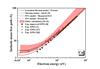 |
| Inelastic mean free path (IMFP) of copper in relation to electron energy. Theoretical prediction using conventional algorithm (red band), theoretical prediction using newly developed algorithm (red solid line), and experimental data with improved accuracy (■). |
Abstract:
The research team consisting of postdoctoral researcher Da Bo, former
postdoctoral researcher Hiroshi Shinotsuka, group leader Hideki
Yoshikawa and special researcher Shigeo Tanuma, Surface Chemical
Analysis Group, Nano Characterization Unit, NIMS; and professor Ding
Zejun, University of Science and Technology of China, has developed a
theoretical algorithm to accurately calculate the average distance
traveled by low-energy/low-speed electrons without energy loss that are
sensitive to the surface structures of materials through which they
travel while retaining their energy information. The results of this
research have been published in Physical Review Letters Vol.113, 063201
(2014). DOI: 10.1103/PhysRevLett.113.063201
Development of Algorithm for Accurate Calculation of Average Distance Travelled by Low-Speed Electrons without Energy Loss that Are Sensitive to Surface Structure
Tsukuba, Japan | Posted on September 11th, 2014The research team consisting of postdoctoral researcher Da Bo, former postdoctoral researcher Hiroshi Shinotsuka, group leader Hideki
Yoshikawa and special researcher Shigeo Tanuma, Surface Chemical
Analysis Group, Nano Characterization Unit, NIMS (Sukekatsu Ushioda,
president); and professor Ding Zejun, University of Science and
Technology of China, has developed a theoretical algorithm to accurately
calculate the average distance traveled by low-energy/low-speed
electrons without any energy loss that are sensitive to the surface
structures of materials through which they travel while retaining their
energy information. This information on the average traveling distance
is vital in terms of measuring the amount of electrons released from
materials and gaining information about the depth at which surface
analysis is conducted.
The nanometer-scale surface layers and interface layers influence the
properties of various materials such as catalysts, batteries,
semiconductors, sensors and anticorrosion materials. It is imperative to
identify the amount of elements present and chemical bonding state in
these layers in terms of improving the performance of functional
materials and developing new materials. And to achieve this, it is
essential to accurately analyze and measure electrons (bonding electrons)
that indicate the state of elements present in the surface and interface
layers. This procedure involves measurement of bonding electron energy
extracted from materials due to external stimuli applied to them in such
forms as X-rays and electrons, and of the intensity distribution of that
energy. During this process, it is critical to identify the depth from
the surface at which these measurements were taken. The range of the
measurement depth can be determined by measuring a physical quantity
called the inelastic mean free path (IMFP), which defines how far an
electron can travel in a material while retaining its original energy
level in a statistical sense. Experimental and theoretical attempts to
quantify IMFP have been pursued globally since the 1970s. However, since
it is difficult to take measurements on low-speed electrons that are
sensitive to the surface structure (especially at 200eV or below), this
quantification had been an issue for a long time.
In theory, accurate calculation of IMFP in a material is feasible
provided that the energy loss function of that material is fully known.
The energy loss function represents the level of interaction between the
material and electromagnetic waves, and is expressed in terms of the
change in the amount of energy lost from electrons and the change in
momentum due to corresponding scattering events occurring in the
material. The conventional model function (so-called optical energy loss
function) only enabled calculating a partial energy loss function under
limited conditions assuming zero-momentum, however, lacking of the
accompanied changing in momentum as electrons lose energy. As such, this
is an incomplete energy loss function in view of obtaining IMFP. The
conventional function was particularly problematic when that or similar
functions were applied to low-speed electrons that are sensitive to the
surface structure. To overcome this problem, we described the optical
energy loss function in terms of a composite function resulting from
combining many functions, and also used a new model function that
accurately expresses the change in momentum. With this method, we
succeeded in determining a nearly complete energy loss function. This
calculation method enabled us to more accurately perform theoretical
prediction of IMFP compared to the experimental value, which was
obtained by applying spectrometry (extended X‐ray absorption fine
structure spectrometry) to low-speed electrons of Copper and molybdenum
at the high-brilliant synchrotron radiation facility, and to explain the
relationship between energy measurement and the types of materials.
Through this endeavor, we found a hint to solve this long-lasting
problem.
Based on this research, more accurate quantification of elements and
analysis of chemical bonding states have become feasible in the several
atom thick surface layer of materials using electrons. The results of
this study will behave been published in the online version of Physical
Review Letters Vol.113, 063201 (2014).
DOI: 10.1103/PhysRevLett.113.063201.
B. Da, H. Shinotsuka, H. Yoshikawa, Z. J. Ding, and S. Tanuma
Extended Mermin Method for Calculating the Electron Inelastic Mean Free
Path
Physical Review Letters Vol.113, 063201 (2014).
DOI: 10.1103/PhysRevLett.113.063201.
####
About National Institute for Materials Science (NIMS)
Only one Public Institution for Materials Science in Japan
For more information, please click here
Contacts:
Press Office
Inquiry for this research:
Hideki Yoshikawa
Group Leader
Surface Chemical Analysis Group
Nano Characterization Unit
Advanced Key Technologies Division
NIMS
TEL:+81-29-859-2451
FAX:+81-29-859-2723
E-Mail: YOSHIKAWA.Hideki=nims.go.jp
(Please change "=" to
For general inquiry
NIMS Public Relations Office
TEL:+81-29-859-2026
FAX:+81-29-859-2017
Copyright © AlphaGalileo
If you have a comment, please Contact us.Issuers of news releases, not 7th Wave, Inc. or Nanotechnology Now, are solely responsible for the accuracy of the content.
Bookmark:


| Related News Press |
News and information
 Quantum computer improves AI predictions April 17th, 2026
Flexible sensor gains sensitivity under pressure April 17th, 2026
A reusable chip for particulate matter sensing April 17th, 2026
Detecting vibrational quantum beating in the predissociation dynamics of SF6 using time-resolved photoelectron spectroscopy April 17th, 2026
Imaging
Chemistry
Projecting light to dispense liquids: A new route to ultra-precise microdroplets January 30th, 2026
From sensors to smart systems: the rise of AI-driven photonic noses January 30th, 2026
"Nanoreactor" cage uses visible light for catalytic and ultra-selective cross-cycloadditions October 3rd, 2025
Chip Technology
A reusable chip for particulate matter sensing April 17th, 2026
Metasurfaces smooth light to boost magnetic sensing precision January 30th, 2026
Sensors
Flexible sensor gains sensitivity under pressure April 17th, 2026
Tiny nanosheets, big leap: A new sensor detects ethanol at ultra-low levels January 30th, 2026
From sensors to smart systems: the rise of AI-driven photonic noses January 30th, 2026
Sensors innovations for smart lithium-based batteries: advancements, opportunities, and potential challenges August 8th, 2025
Discoveries
Quantum computer improves AI predictions April 17th, 2026
Flexible sensor gains sensitivity under pressure April 17th, 2026
A reusable chip for particulate matter sensing April 17th, 2026
Detecting vibrational quantum beating in the predissociation dynamics of SF6 using time-resolved photoelectron spectroscopy April 17th, 2026
Materials/Metamaterials/Magnetoresistance
First real-time observation of two-dimensional melting process: Researchers at Mainz University unveil new insights into magnetic vortex structures August 8th, 2025
Researchers unveil a groundbreaking clay-based solution to capture carbon dioxide and combat climate change June 6th, 2025
A 1960s idea inspires NBI researchers to study hitherto inaccessible quantum states June 6th, 2025
Institute for Nanoscience hosts annual proposal planning meeting May 16th, 2025
Announcements
A fundamentally new therapeutic approach to cystic fibrosis: Nanobody repairs cellular defect April 17th, 2026
UC Irvine physicists discover method to reverse ‘quantum scrambling’ : The work addresses the problem of information loss in quantum computing system April 17th, 2026
Interviews/Book Reviews/Essays/Reports/Podcasts/Journals/White papers/Posters
A fundamentally new therapeutic approach to cystic fibrosis: Nanobody repairs cellular defect April 17th, 2026
UC Irvine physicists discover method to reverse ‘quantum scrambling’ : The work addresses the problem of information loss in quantum computing system April 17th, 2026
Tools
Metasurfaces smooth light to boost magnetic sensing precision January 30th, 2026
From sensors to smart systems: the rise of AI-driven photonic noses January 30th, 2026
Japan launches fully domestically produced quantum computer: Expo visitors to experience quantum computing firsthand August 8th, 2025
Battery Technology/Capacitors/Generators/Piezoelectrics/Thermoelectrics/Energy storage
Decoding hydrogen‑bond network of electrolyte for cryogenic durable aqueous zinc‑ion batteries January 30th, 2026
COF scaffold membrane with gate‑lane nanostructure for efficient Li+/Mg2+ separation January 30th, 2026
MXene nanomaterials enter a new dimension Multilayer nanomaterial: MXene flakes created at Drexel University show new promise as 1D scrolls January 30th, 2026
Research partnerships
Lab to industry: InSe wafer-scale breakthrough for future electronics August 8th, 2025
HKU physicists uncover hidden order in the quantum world through deconfined quantum critical points April 25th, 2025
 |
||
 |
||
| The latest news from around the world, FREE | ||
 |
||
|
|
||
| Premium Products | ||
 |
||
|
Only the news you want to read!
Learn More |
||
 |
||
|
Full-service, expert consulting
Learn More |
||
|
|
||