Home > Press > Symphony of nanoplasmonic and optical resonators leads to magnificent laser-like light emission
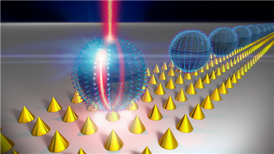 |
| Hybrid optoplasmonic system showing the operation of amplification. |
Abstract:
By combining plasmonics and optical microresonators, researchers at the University of Illinois at Urbana-Champaign have created a new optical amplifier (or laser) design, paving the way for power-on-a-chip applications.
Symphony of nanoplasmonic and optical resonators leads to magnificent laser-like light emission
Urbana, IL | Posted on August 26th, 2014"We have made optical systems at the microscopic scale that amplify light and produce ultra-narrowband spectral output," explained J. Gary Eden, a professor of electrical and computer engineering (ECE) at Illinois. "These new optical amplifiers are well-suited for routing optical power on a chip containing both electronic and optical components.
"Their potential applications in medicine are exciting because the amplifiers are actuated (‘pumped') by light that is able to pass through human skin. For this reason, these microsphere-based amplifiers are able to transmit signals from cells and buried biomedical sensors to electrical and optical networks outside the body."
The speed of currently available semiconductor electronics is limited to about 10 GHz due to heat generation and interconnects delay time issues. Though, not limited by speed, dielectric-based photonics are limited in size by the fundamental laws of diffraction. The researchers, led by Eden and ECE associate professor Logan Liu, found that plasmonics—metal nanostructures—can serve as a bridge between photonics and nanoelectronics, to combine the size of nanoelectronics and the speed of dielectric photonics.
"We have demonstrated a novel optoplasmonic system comprising plasmonic nanoantennas and optical microcavities capable of active nanoscale field modulation, frequency switching, and amplification of signals," states Manas Ranjan Gartia, lead author of the article, "Injection- Seeded Optoplasmonic Amplifier in the Visible," published in the journal Scientific Reports. "This is an important step forward for monolithically building on-chip light sources inside future chips that can use much less energy while providing superior speed performance of the chips."
At the heart of the amplifier is a microsphere (made of polystyrene or glass) that is approximately 10 microns in diameter. When activated by an intense beam of light, the sphere generates internally a narrowband optical signal that is produced by a process known as Raman scattering. Molecules tethered to the surface of the sphere by a protein amplify the Raman signal, and in concert with a nano-structured surface in contact to the sphere, the amplifier produces visible (red or green) light having a bandwidth that matches the internally-generated signal.
The proposed design is well-suited for routing narrowband optical power on-a-chip. Over the past five decades, optical oscillators and amplifiers have typically been based on the buildup of the field from the spontaneous emission background. Doing so limits the temporal coherence of the output, lengthens the time required for the optical field to grow from the noise, and often is responsible for complex, multiline spectra.
"In our design, we use Raman assisted injection-seeded locking to overcome the above problems. In addition to the spectral control afforded by injection-locking, the effective Q of the amplifier can be specified by the bandwidth of the injected Raman signal," Gartia said. This characteristic contrasts with previous WGM-based lasers and amplifiers for which the Q is determined solely by the WGM resonator.
In addition to Eden, Liu, and Gartia, co-authors of the paper include Sujin Seo, Junhwan Kim, Te-Wei Chang, Assistant Professor Gaurav Bahl from Department of Mechanical Science and Engineering, and Prof. Meng Lu, ECE alumnus and currently assistant professor at Iowa State University. The research was done at Micro and Nanotechnology Laboratory at Illinois.
- See more at: http://engineering.illinois.edu/news/article/9356#sthash.fAXqBh3A.dpuf
####
For more information, please click here
Contacts:
Gary Eden
217-333-4157
Gang Logan Liu
Department of Electrical and Computer Engineering
217/244-4349
Copyright © University of Illinois College of Engineering
If you have a comment, please Contact us.Issuers of news releases, not 7th Wave, Inc. or Nanotechnology Now, are solely responsible for the accuracy of the content.
Bookmark:


| Related News Press |
News and information
 Quantum computer improves AI predictions April 17th, 2026
Flexible sensor gains sensitivity under pressure April 17th, 2026
A reusable chip for particulate matter sensing April 17th, 2026
Detecting vibrational quantum beating in the predissociation dynamics of SF6 using time-resolved photoelectron spectroscopy April 17th, 2026
Chip Technology
A reusable chip for particulate matter sensing April 17th, 2026
Metasurfaces smooth light to boost magnetic sensing precision January 30th, 2026
Nanomedicine
A fundamentally new therapeutic approach to cystic fibrosis: Nanobody repairs cellular defect April 17th, 2026
New molecular technology targets tumors and simultaneously silences two ‘undruggable’ cancer genes August 8th, 2025
New imaging approach transforms study of bacterial biofilms August 8th, 2025
Electrifying results shed light on graphene foam as a potential material for lab grown cartilage June 6th, 2025
Sensors
Flexible sensor gains sensitivity under pressure April 17th, 2026
Tiny nanosheets, big leap: A new sensor detects ethanol at ultra-low levels January 30th, 2026
From sensors to smart systems: the rise of AI-driven photonic noses January 30th, 2026
Sensors innovations for smart lithium-based batteries: advancements, opportunities, and potential challenges August 8th, 2025
Discoveries
Quantum computer improves AI predictions April 17th, 2026
Flexible sensor gains sensitivity under pressure April 17th, 2026
A reusable chip for particulate matter sensing April 17th, 2026
Detecting vibrational quantum beating in the predissociation dynamics of SF6 using time-resolved photoelectron spectroscopy April 17th, 2026
Announcements
A fundamentally new therapeutic approach to cystic fibrosis: Nanobody repairs cellular defect April 17th, 2026
UC Irvine physicists discover method to reverse ‘quantum scrambling’ : The work addresses the problem of information loss in quantum computing system April 17th, 2026
Interviews/Book Reviews/Essays/Reports/Podcasts/Journals/White papers/Posters
A fundamentally new therapeutic approach to cystic fibrosis: Nanobody repairs cellular defect April 17th, 2026
UC Irvine physicists discover method to reverse ‘quantum scrambling’ : The work addresses the problem of information loss in quantum computing system April 17th, 2026
Photonics/Optics/Lasers
Metasurfaces smooth light to boost magnetic sensing precision January 30th, 2026
From sensors to smart systems: the rise of AI-driven photonic noses January 30th, 2026
Research partnerships
Lab to industry: InSe wafer-scale breakthrough for future electronics August 8th, 2025
HKU physicists uncover hidden order in the quantum world through deconfined quantum critical points April 25th, 2025
 |
||
 |
||
| The latest news from around the world, FREE | ||
 |
||
|
|
||
| Premium Products | ||
 |
||
|
Only the news you want to read!
Learn More |
||
 |
||
|
Full-service, expert consulting
Learn More |
||
|
|
||