Home > Press > CIQUS researchers develop an extremely simple procedure to obtain nanosized graphenes
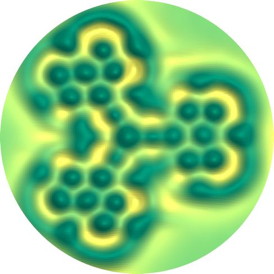 |
| Atomic force microscopy (AFM) image of a clover-shaped nanographenes Credit: Bruno Schuler, IBM – Zurich |
Abstract:
The prestigious journal Angewandte Chemie (link is external) has recently published a work by CiQUS researchers (University of Santiago de Compostela, Spain) in collaboration with IBM Research - Zurich (Switzerland), which describes an extremely simple method to obtain high quality nanographenes from easily available organic compounds.
NANOGRAPHENES: Molecular Assembly of Nanosized Graphenes
CIQUS researchers develop an extremely simple procedure to obtain nanosized graphenes
Santiago, Spain | Posted on July 15th, 2014Graphene is considered an unique material, which is leading to the emergence of a completely new technology. One of the biggest challenges in this new field is the development of methodologies for the preparation on this material with nanometric size and high quality: if the researchers get a perfect control over their size and geometry, they could explore new applications for high-performance electronic devices. The method discovered by CiQUS researchers allows to obtain well-defined nanographenes in one-pot from perylene, a very common organic compound.
This method is based on the reactivity of a group of molecules named arynes, which can act as "molecular glue" to paste graphene fragments together. The clover-shaped nanographenes obtained in this research were deposited on ultrathin insulating films, and imaged with atomic resolution by atomic force microscopy (AFM). The preparation of these materials with different size and shapes could be crucial to build graphene-based electronic circuits, molecular machinery and/or single molecule electronic devices.
The research work, led by Prof. Diego Peña, is a contribution of the research group COMMO, COMMO -belonging to CiQUS-, and includes the participation of Prof. Enrique Guitián, Prof. Dolores Pérez and the PhD student Sara Collazos. This COMMO group is pioneer on the synthesis of nanosized graphenes following bottom-up approaches through chemical methods in solution. The IBM Group (link is external) is specialist in the use of AFM with atomic resolution and in this work Dr. Leo Gross, Dr. Gerhard Meyer and PhD student Bruno Schuler were involved.
Both groups have already collaborated and published previous results in prestigious chemistry scientific journals as Science (2012), and currently they take part of the Large European Project PAMS (Planar Atomic and Molecular Scale Devices) (link is external), with a total budget over 9 million Euros. PAMS main objective is to develop electronic devices of nanometric-scale size, in order to get the extreme miniaturization of the equipment used in information technology and communication.
####
For more information, please click here
Contacts:
Fernando Casal
R&D Management
Center for Research in Biological Chemistry and Molecular Materials (CIQUS)
C/ Jenaro de la Fuente s/n
15782 University of Santiago de Compostela - Spain
Tel. (+34) 881 815 782
(+34) 600 942 443
Copyright © CIQUS
If you have a comment, please Contact us.Issuers of news releases, not 7th Wave, Inc. or Nanotechnology Now, are solely responsible for the accuracy of the content.
Bookmark:


| Related News Press |
News and information
 Quantum computer improves AI predictions April 17th, 2026
Flexible sensor gains sensitivity under pressure April 17th, 2026
A reusable chip for particulate matter sensing April 17th, 2026
Detecting vibrational quantum beating in the predissociation dynamics of SF6 using time-resolved photoelectron spectroscopy April 17th, 2026
Videos/Movies
ICFO researchers overcome long-standing bottleneck in single photon detection with twisted 2D materials August 8th, 2025
Graphene/ Graphite
Electrifying results shed light on graphene foam as a potential material for lab grown cartilage June 6th, 2025
Breakthrough in proton barrier films using pore-free graphene oxide: Kumamoto University researchers achieve new milestone in advanced coating technologies September 13th, 2024
Discoveries
Quantum computer improves AI predictions April 17th, 2026
Flexible sensor gains sensitivity under pressure April 17th, 2026
A reusable chip for particulate matter sensing April 17th, 2026
Detecting vibrational quantum beating in the predissociation dynamics of SF6 using time-resolved photoelectron spectroscopy April 17th, 2026
Announcements
A fundamentally new therapeutic approach to cystic fibrosis: Nanobody repairs cellular defect April 17th, 2026
UC Irvine physicists discover method to reverse ‘quantum scrambling’ : The work addresses the problem of information loss in quantum computing system April 17th, 2026
Interviews/Book Reviews/Essays/Reports/Podcasts/Journals/White papers/Posters
A fundamentally new therapeutic approach to cystic fibrosis: Nanobody repairs cellular defect April 17th, 2026
UC Irvine physicists discover method to reverse ‘quantum scrambling’ : The work addresses the problem of information loss in quantum computing system April 17th, 2026
 |
||
 |
||
| The latest news from around the world, FREE | ||
 |
||
|
|
||
| Premium Products | ||
 |
||
|
Only the news you want to read!
Learn More |
||
 |
||
|
Full-service, expert consulting
Learn More |
||
|
|
||