Home > Press > New NIST metamaterial gives light a one-way ticket
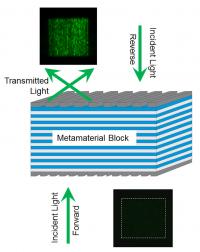 |
| This is a schematic of NIST's one-way metamaterial. Forward traveling green light (left) or red light passes through the multilayered block and comes out at an angle due to diffraction off of grates on the surface of the material. Light traveling in the opposite direction (right) is almost completely filtered by the metamaterial and can't pass through.
Credit: Xu/NIST |
Abstract:
The light-warping structures known as metamaterials have a new trick in their ever-expanding repertoire. Researchers at the National Institute of Standards and Technology (NIST) have built a silver, glass and chromium nanostructure that can all but stop visible light cold in one direction while giving it a pass in the other.* The device could someday play a role in optical information processing and in novel biosensing devices.
New NIST metamaterial gives light a one-way ticket
Gaithersburg, MD | Posted on July 2nd, 2014In recent years, scientists have designed nanostructured materials that allow microwave or infrared light to propagate in only one direction. Such structures hold potential for applications in optical communication—for instance, they could be integrated into photonic chips that split or combine signals carried by light waves. But, until now, no one had achieved one-way transmission of visible light, because existing devices could not be fabricated at scales small enough to manipulate visible light's short wavelengths. (So-called "one-way mirrors" don't really do this—they play tricks with relative light levels.)
To get around that roadblock, NIST researchers Ting Xu and Henri Lezec combined two light-manipulating nanostructures: a multi-layered block of alternating silver and glass sheets and metal grates with very narrow spacings.
The silver-glass structure is an example of a "hyperbolic" metamaterial, which treats light differently depending on which direction the waves are traveling. Because the structure's layers are only tens of nanometers thick—much thinner than visible light's 400 to 700 nanometer wavelengths—the block is opaque to visible light coming in from outside. Light can, however, propagate inside the material within a narrow range of angles.
Xu and Lezec used thin-film deposition techniques at the NIST NanoFab user facility to build a hyperbolic metamaterial block.Guided by computer simulations, they fabricated the block out of 20 extremely thin alternating layers of silicon dioxide glass and silver. To coax external light into the layered material, the researchers added to the block a set of chromium grates with narrow, sub-wavelength spacings chosen to bend incoming red or green light waves just enough to propagate inside the block. On the other side of the block, the researchers added another set of grates to kick light back out of the structure, although angled away from its original direction.
While the second set of grates let light escape the material, their spacing was slightly different from that of the first grates. As a result, the reverse-direction grates bent incoming light either too much or not enough to propagate inside the silver-glass layers. Testing their structures, the researchers found that around 30 times more light passed through in the forward direction than in reverse, a contrast larger than any other achieved thus far with visible light.
Combining materials that could be made using existing methods was the key to achieving one-way transmission of visible light, Lezec says. Without the intervening silver-and-glass blocks, the grates would have needed to be fabricated and aligned more precisely than is possible with current techniques. "This three-step process actually relaxes the fabrication constraints," Lezec says.
In the future, the new structure could be integrated into photonic chips that process information with light instead of electricity. Lezec thinks the device also could be used to detect tiny particles for biosensing applications. Like the chrome grates, nanoscale particles also can deflect light to angles steep enough to travel through the hyperbolic material and come out the other side, where the light would be collected by a detector. Xu has run simulations suggesting such a scheme could provide high-contrast particle detection and is hoping to test the idea soon. "I think it's a cool device where you would be able to sense the presence of a very small particle on the surface through a dramatic change in light transmission," says Lezec.
####
For more information, please click here
Contacts:
Mark Esser
301-975-8735
Copyright © National Institute of Standards and Technology (NIST)
If you have a comment, please Contact us.Issuers of news releases, not 7th Wave, Inc. or Nanotechnology Now, are solely responsible for the accuracy of the content.
Bookmark:


| Related Links |
| Related News Press |
News and information
 Quantum computer improves AI predictions April 17th, 2026
Flexible sensor gains sensitivity under pressure April 17th, 2026
A reusable chip for particulate matter sensing April 17th, 2026
Detecting vibrational quantum beating in the predissociation dynamics of SF6 using time-resolved photoelectron spectroscopy April 17th, 2026
Laboratories
Researchers develop molecular qubits that communicate at telecom frequencies October 3rd, 2025
A battery’s hopping ions remember where they’ve been: Seen in atomic detail, the seemingly smooth flow of ions through a battery’s electrolyte is surprisingly complicated February 16th, 2024
Govt.-Legislation/Regulation/Funding/Policy
Quantum computer improves AI predictions April 17th, 2026
Metasurfaces smooth light to boost magnetic sensing precision January 30th, 2026
New imaging approach transforms study of bacterial biofilms August 8th, 2025
Optical computing/Photonic computing
ICFO researchers overcome long-standing bottleneck in single photon detection with twisted 2D materials August 8th, 2025
Programmable electron-induced color router array May 14th, 2025
Sensors
Flexible sensor gains sensitivity under pressure April 17th, 2026
Tiny nanosheets, big leap: A new sensor detects ethanol at ultra-low levels January 30th, 2026
From sensors to smart systems: the rise of AI-driven photonic noses January 30th, 2026
Sensors innovations for smart lithium-based batteries: advancements, opportunities, and potential challenges August 8th, 2025
Discoveries
Quantum computer improves AI predictions April 17th, 2026
Flexible sensor gains sensitivity under pressure April 17th, 2026
A reusable chip for particulate matter sensing April 17th, 2026
Detecting vibrational quantum beating in the predissociation dynamics of SF6 using time-resolved photoelectron spectroscopy April 17th, 2026
Materials/Metamaterials/Magnetoresistance
First real-time observation of two-dimensional melting process: Researchers at Mainz University unveil new insights into magnetic vortex structures August 8th, 2025
Researchers unveil a groundbreaking clay-based solution to capture carbon dioxide and combat climate change June 6th, 2025
A 1960s idea inspires NBI researchers to study hitherto inaccessible quantum states June 6th, 2025
Institute for Nanoscience hosts annual proposal planning meeting May 16th, 2025
Announcements
A fundamentally new therapeutic approach to cystic fibrosis: Nanobody repairs cellular defect April 17th, 2026
UC Irvine physicists discover method to reverse ‘quantum scrambling’ : The work addresses the problem of information loss in quantum computing system April 17th, 2026
Interviews/Book Reviews/Essays/Reports/Podcasts/Journals/White papers/Posters
A fundamentally new therapeutic approach to cystic fibrosis: Nanobody repairs cellular defect April 17th, 2026
UC Irvine physicists discover method to reverse ‘quantum scrambling’ : The work addresses the problem of information loss in quantum computing system April 17th, 2026
Photonics/Optics/Lasers
Metasurfaces smooth light to boost magnetic sensing precision January 30th, 2026
From sensors to smart systems: the rise of AI-driven photonic noses January 30th, 2026
 |
||
 |
||
| The latest news from around the world, FREE | ||
 |
||
|
|
||
| Premium Products | ||
 |
||
|
Only the news you want to read!
Learn More |
||
 |
||
|
Full-service, expert consulting
Learn More |
||
|
|
||