Home > Press > Researchers synthesize previously unknown form of magnesium carbide
 |
Abstract:
An international team of researchers from the United States and France, along with the head of a state-funded "mega grant" laboratory based at MIPT, Artyom Oganov, has synthesized a previously unknown form of magnesium carbide. This material can be used for synthesizing carbon nanostructures and other compounds. Details can be found in an article published in the journal Inorganic Chemistry.
Researchers synthesize previously unknown form of magnesium carbide
Moscow, Russia | Posted on June 23rd, 2014A team of researchers from the Carnegie Institution for Science (United States), Paris-Sorbonne University, the European Synchrotron Radiation Facility in Grenoble,the SOLEIL synchrotron facility (France), the State University of New York at Stony Brookin the United States, and MIPT has synthesized and studied samples of a substance named beta magnesium carbide (Mg2C3).
To synthesize the compound, the group used presses that are able to create pressures of up to several tens of GPa (hundreds of thousands of atmospheric pressures) and that can heat a sample to more than 1,000 degrees Celsius. Using X-ray analysis, NMR (nuclear magnetic resonance) and optical spectroscopy they collected data showing that this substance has a unique atomic structure.
Experiments showed that the new version of magnesium carbide retains its structure after pressure is reduced to normal and temperatures return to normal room temperatures. It is still too early to speak about any devices that could use the obtained substance, the researchers say, but they add that, nevertheless,Mg2C3 is a promising element for synthesizing other compounds, including various carbon nanostructures.
MIPT's press service would like to thank Dr. Artyom Oganov for his generous help in writing this article.
Chemistry and Synchrotrons
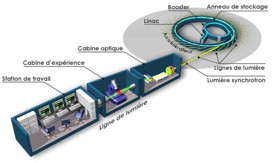
Originally intended for experiments in the field of elementary particle physics, accelerators have been an invaluable tool for research in many different areas. Turning a beam of charged particles produces X-rays, which exceeds the radiation from traditional cathode tubes (a standard X-ray source for medical equipment) by a number of parameters. Accelerators are capable of producing radiation many orders of magnitude brighter, providing record short impulses. Moreover, the radiation is monochromatic and with the required polarization.
Synchrotrons have enabled chemists to carry out X-ray diffraction analysis of samples of any nature, including both inorganic compounds and biomolecules. Modern accelerators can X-ray minerals, details of mechanisms and structures, archaeological artifacts, and determine the exact chemical composition of a sample. Furthermore, ultra short impulses of radiation allow scientists to take snapshots of certain phases of chemical reactions, "catching" short-living intermediate products.
Modern synchrotron radiation centers offer various pieces of equipment, including furnaces, presses and spectrometers.
####
For more information, please click here
Contacts:
Alexandra O. Borissova
7-495-408-6445
Copyright © Moscow Institute of Physics and Technology
If you have a comment, please Contact us.Issuers of news releases, not 7th Wave, Inc. or Nanotechnology Now, are solely responsible for the accuracy of the content.
Bookmark:


| Related News Press |
News and information
 Quantum computer improves AI predictions April 17th, 2026
Flexible sensor gains sensitivity under pressure April 17th, 2026
A reusable chip for particulate matter sensing April 17th, 2026
Detecting vibrational quantum beating in the predissociation dynamics of SF6 using time-resolved photoelectron spectroscopy April 17th, 2026
Chemistry
Projecting light to dispense liquids: A new route to ultra-precise microdroplets January 30th, 2026
From sensors to smart systems: the rise of AI-driven photonic noses January 30th, 2026
"Nanoreactor" cage uses visible light for catalytic and ultra-selective cross-cycloadditions October 3rd, 2025
Cambridge chemists discover simple way to build bigger molecules – one carbon at a time June 6th, 2025
Discoveries
Quantum computer improves AI predictions April 17th, 2026
Flexible sensor gains sensitivity under pressure April 17th, 2026
A reusable chip for particulate matter sensing April 17th, 2026
Detecting vibrational quantum beating in the predissociation dynamics of SF6 using time-resolved photoelectron spectroscopy April 17th, 2026
Announcements
A fundamentally new therapeutic approach to cystic fibrosis: Nanobody repairs cellular defect April 17th, 2026
UC Irvine physicists discover method to reverse ‘quantum scrambling’ : The work addresses the problem of information loss in quantum computing system April 17th, 2026
Interviews/Book Reviews/Essays/Reports/Podcasts/Journals/White papers/Posters
A fundamentally new therapeutic approach to cystic fibrosis: Nanobody repairs cellular defect April 17th, 2026
UC Irvine physicists discover method to reverse ‘quantum scrambling’ : The work addresses the problem of information loss in quantum computing system April 17th, 2026
Tools
Metasurfaces smooth light to boost magnetic sensing precision January 30th, 2026
From sensors to smart systems: the rise of AI-driven photonic noses January 30th, 2026
Japan launches fully domestically produced quantum computer: Expo visitors to experience quantum computing firsthand August 8th, 2025
Research partnerships
Lab to industry: InSe wafer-scale breakthrough for future electronics August 8th, 2025
HKU physicists uncover hidden order in the quantum world through deconfined quantum critical points April 25th, 2025
 |
||
 |
||
| The latest news from around the world, FREE | ||
 |
||
|
|
||
| Premium Products | ||
 |
||
|
Only the news you want to read!
Learn More |
||
 |
||
|
Full-service, expert consulting
Learn More |
||
|
|
||