Home > Press > Ultra-thin wires for quantum computing: Carefully fabricating nanofibers by heating and pulling may make for highly-efficient, optics-based, low-power atom traps
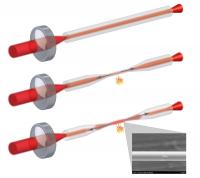 |
| This image depicts light propagating through an optical nanofiber during the pulling process with a SEM image of the 536 nanometer diameter waist.
Credit: J. E. Hoffman and E. Edwards / JQI at UMD |
Abstract:
Take a fine strand of silica fiber, attach it at each end to a slow-turning motor, gently torture it over an unflickering flame until it just about reaches its melting point and then pull it apart. The middle will thin out like a piece of taffy until it is less than half a micron across -- about 200 times thinner than a human hair.
Ultra-thin wires for quantum computing: Carefully fabricating nanofibers by heating and pulling may make for highly-efficient, optics-based, low-power atom traps
Washington, DC | Posted on June 17th, 2014That, according to researchers at the Joint Quantum Institute at the University of Maryland, is how you fabricate ultrahigh transmission optical nanofibers, a potential component for future quantum information devices, which they describe in AIP Publishing's journal AIP Advances.
Quantum computers promise enormous power, but are notoriously tricky to build. To encode information in qubits, the fundamental units of a quantum computer, the bits must be held in a precarious position called a superposition of states. In this fragile condition the bits exist in all of their possible configurations at the same time, meaning they can perform multiple parallel calculations.
The tendency of qubits to lose their superposition state too quickly, a phenomenon known as decoherence, is a major obstacle to the further development of quantum computers and any device dependent on superpositions. To address this challenge, researchers at the Joint Quantum Institute proposed a hybrid quantum processor that uses trapped atoms as the memory and superconducting qubits as the processor, as atoms demonstrate relatively long superposition survival times and superconducting qubits perform operations quickly.
"The idea is that we can get the best of both worlds," said Jonathan Hoffman, a graduate student in the Joint Quantum Institute who works in the lab of principal investigators Steven Rolston and Luis Orozco. However, a problem is that superconductors don't like high optical power or magnetic fields and most atomic traps use both, Hoffman said.
This is where the optical nanofibers come in: The Joint Quantum Institute team realized that nanofibers could create optics-based, low-power atom traps that would "play nice" with superconductors. Because the diameter of the fibers is so minute -- 530 nanometers, less than the wavelength of light used to trap atoms -- some of the light leaks outside of the fiber as a so-called evanescent wave, which can be used to trap atoms a few hundred nanometers from the fiber surface.
Hoffman and his colleagues have worked on optical nanofiber atom traps for the past few years. Their AIP Advances paper describes a new procedure they developed that maximizes the efficiency of the traps through careful and precise fabrication methods.
The group's procedure, which yields an improvement of two orders of magnitude less transmission loss than previous work, focuses on intensive preparation and cleaning of the pre-pulling environment the nanofibers are created in.
In the fabrication process, the fiber is brushed through the flame to prevent the formation of air currents, which can cause inconsistencies in diameter to arise, as it is pulled apart and tapered down. The flame source is a mixture of hydrogen and oxygen gas in a precise two-to-one ratio, to ensure that water vapor is the only byproduct. The motors are controlled by an algorithm based on the existing work of a group in Vienna, which calculates the trajectories of the motors to produce a fiber of the desired length and profile.
Previous pulling methods, such as carbon dioxide lasing and chemical etching, were limited by the laser's insufficient diameter and by a lesser degree of control over tapering length, respectively.
Future work includes interfacing the trapped atoms with the superconducting circuits held at 10 mKelvin in a dilution refrigerator, as well as guiding more complicated optical field patterns through the fiber (higher-order modes) and using these to trap atoms.
####
About American Institute of Physics
AIP Advances is a fully open access, online-only, community-led journal. It covers all areas of applied physical science. With its advanced web 2.0 functionality, the journal puts relevant content and discussion tools in the hands of the community to shape the direction of the physical sciences. See: aipadvances.aip.org
For more information, please click here
Contacts:
Jason Socrates Bardi
240-535-4954
Copyright © American Institute of Physics
If you have a comment, please Contact us.Issuers of news releases, not 7th Wave, Inc. or Nanotechnology Now, are solely responsible for the accuracy of the content.
Bookmark:


| Related Links |
| Related News Press |
News and information
 Quantum computer improves AI predictions April 17th, 2026
Flexible sensor gains sensitivity under pressure April 17th, 2026
A reusable chip for particulate matter sensing April 17th, 2026
Detecting vibrational quantum beating in the predissociation dynamics of SF6 using time-resolved photoelectron spectroscopy April 17th, 2026
Superconductivity
MXene nanomaterials enter a new dimension Multilayer nanomaterial: MXene flakes created at Drexel University show new promise as 1D scrolls January 30th, 2026
Lattice-driven charge density wave fluctuations far above the transition temperature in Kagome superconductor April 25th, 2025
Wireless/telecommunications/RF/Antennas/Microwaves
Researchers develop molecular qubits that communicate at telecom frequencies October 3rd, 2025
HKUST researchers develop new integration technique for efficient coupling of III-V and silicon February 16th, 2024
Discoveries
Quantum computer improves AI predictions April 17th, 2026
Flexible sensor gains sensitivity under pressure April 17th, 2026
A reusable chip for particulate matter sensing April 17th, 2026
Detecting vibrational quantum beating in the predissociation dynamics of SF6 using time-resolved photoelectron spectroscopy April 17th, 2026
Materials/Metamaterials/Magnetoresistance
First real-time observation of two-dimensional melting process: Researchers at Mainz University unveil new insights into magnetic vortex structures August 8th, 2025
Researchers unveil a groundbreaking clay-based solution to capture carbon dioxide and combat climate change June 6th, 2025
A 1960s idea inspires NBI researchers to study hitherto inaccessible quantum states June 6th, 2025
Institute for Nanoscience hosts annual proposal planning meeting May 16th, 2025
Announcements
A fundamentally new therapeutic approach to cystic fibrosis: Nanobody repairs cellular defect April 17th, 2026
UC Irvine physicists discover method to reverse ‘quantum scrambling’ : The work addresses the problem of information loss in quantum computing system April 17th, 2026
Interviews/Book Reviews/Essays/Reports/Podcasts/Journals/White papers/Posters
A fundamentally new therapeutic approach to cystic fibrosis: Nanobody repairs cellular defect April 17th, 2026
UC Irvine physicists discover method to reverse ‘quantum scrambling’ : The work addresses the problem of information loss in quantum computing system April 17th, 2026
Photonics/Optics/Lasers
Metasurfaces smooth light to boost magnetic sensing precision January 30th, 2026
From sensors to smart systems: the rise of AI-driven photonic noses January 30th, 2026
Quantum nanoscience
Beyond silicon: Electronics at the scale of a single molecule January 30th, 2026
MXene nanomaterials enter a new dimension Multilayer nanomaterial: MXene flakes created at Drexel University show new promise as 1D scrolls January 30th, 2026
ICFO researchers overcome long-standing bottleneck in single photon detection with twisted 2D materials August 8th, 2025
 |
||
 |
||
| The latest news from around the world, FREE | ||
 |
||
|
|
||
| Premium Products | ||
 |
||
|
Only the news you want to read!
Learn More |
||
 |
||
|
Full-service, expert consulting
Learn More |
||
|
|
||