Home > Press > Chemical Sensor on a Chip
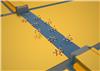 |
| The light is emitted by the laser (top), transported on the plasmonic waveguide (blue) and hits the detector (bottom right). How much of it is absorbed depends on the chemical composition of the liquid. |
Abstract:
They are invisible, but perfectly suited for analysing liquids and gases; infrared laser beams are absorbed differently by different molecules. This effect can for instance be used to measure the oxygen concentration in blood. At the Vienna University of Technology, this technique has now been miniaturized and implemented in the prototype for a new kind of sensor.
Chemical Sensor on a Chip
Vienna, Austria | Posted on June 12th, 2014Specially designed quantum cascade lasers and light detectors are created by the same production process. The gap between laser and detector is only 50 micrometres. It is bridged by a plasmonic waveguide made of gold and silicon nitride. This new approach allows for the simple and cheap production of tiny sensors for many different applications.
Laser and Detector
Simple solid-state lasers, such as the well-known red ruby laser, consist of only one material. Quantum cascade lasers, on the other hand, are made of a perfectly optimized layer system of different materials. That way, the properties such as the wavelength of the laser can be tuned. When a voltage is applied to the layer structure, the laser starts to emit light. But the structure can also work the other way around; when it is irradiated with light, an electric signal is created.
Now a method has been developed to create a laser and a detector at the same time, on one single chip, in such a way that the wavelength of the laser perfectly matches the wavelength to which the detector is sensitive. This bifunctional material was created atomic layer for atomic layer at the center for micro- and nanostructures at the Vienna University of Technology. "As both parts are created in one step, laser and detector do not have to be adjusted. They are already perfectly aligned", says Benedikt Schwarz.
Leading the Light to the Detector
In conventional systems, the laser light has to be transmitted to the detector using carefully placed lenses. Alternatively, optical fibres can be used, but they usually transport all the light inside, without letting it interact with the environment, and therefore they cannot be used as sensors.
In the new element created at the Vienna University of Technology, the optical connection between quantum cascade laser and detector works in a completely different way. It is a plasmonic waveguide, made of gold and silicon oxide. "The light interacts with the electrons in the metal in a very special way, so that the light is guided outside the gold surface", says Benedikt Schwarz. "That is why the light can be absorbed by the molecules on its way between laser and detector."
The sensor chip can be submerged in a liquid. By measuring the decrease of the detected light intensity due to the presence of light absorbing molecules, the composition of the liquid can be determined. The sensor was tested with a mixture of water and alcohol. The water concentration can be measured with an accuracy of 0.06%.
As the wavelength can be influenced by changing the design of the layered structure, this sensor concept can be applied to a wide variety of molecules such as carbohydrates or proteins, for many different applications in chemical, biological or medical analytics.
Published in "Nature Communications".
####
About Vienna University of Technology, TU Vienna
With its eight faculties - mathematics and geo-information, physics, technical chemistry, informatics, civil engineering, architecture and regional planning, mechanical engineering and business science, electrical engineering and information technology – the Vienna University of Technology covers the classic engineering disciplines.
The TU Vienna has a great pool of specialists who are acting in a wide range of different topics in research, teaching and as partners of the economy. More than 2000 scientists do their research and teaching at highly advanced and modern institutes – in summary about 70. Although fundamental research has priority at the TU Vienna applied research is also done. Moreover services are offered as high-tech problem solving and examination expertise for industry and economy. Innovation orientated companies are highly interested in co-operating with the Vienna University of Technology because of its high-tech and high-quality research and its openness for requests of the economy.
The Vienna University of Technology puts great emphasis on co-operation between its own institutes as well as with other universities. Therefore the TU Vienna participates in several European Union (EU) and other research programmes.
The aim of the university was and still is to belong to the best. The effort to reach this aim is also expressed in its mission statement: With the aim of providing technology for people, our mission is to develop scientific excellence and wide-ranging competence in our students.
For more information, please click here
Contacts:
Bettina Neunteufl
+43 (1) 58801 41025
Copyright © AlphaGalileo
If you have a comment, please Contact us.Issuers of news releases, not 7th Wave, Inc. or Nanotechnology Now, are solely responsible for the accuracy of the content.
Bookmark:


| Related News Press |
News and information
 Quantum computer improves AI predictions April 17th, 2026
Flexible sensor gains sensitivity under pressure April 17th, 2026
A reusable chip for particulate matter sensing April 17th, 2026
Detecting vibrational quantum beating in the predissociation dynamics of SF6 using time-resolved photoelectron spectroscopy April 17th, 2026
Nanomedicine
A fundamentally new therapeutic approach to cystic fibrosis: Nanobody repairs cellular defect April 17th, 2026
New molecular technology targets tumors and simultaneously silences two ‘undruggable’ cancer genes August 8th, 2025
New imaging approach transforms study of bacterial biofilms August 8th, 2025
Electrifying results shed light on graphene foam as a potential material for lab grown cartilage June 6th, 2025
Sensors
Flexible sensor gains sensitivity under pressure April 17th, 2026
Tiny nanosheets, big leap: A new sensor detects ethanol at ultra-low levels January 30th, 2026
From sensors to smart systems: the rise of AI-driven photonic noses January 30th, 2026
Sensors innovations for smart lithium-based batteries: advancements, opportunities, and potential challenges August 8th, 2025
Discoveries
Quantum computer improves AI predictions April 17th, 2026
Flexible sensor gains sensitivity under pressure April 17th, 2026
A reusable chip for particulate matter sensing April 17th, 2026
Detecting vibrational quantum beating in the predissociation dynamics of SF6 using time-resolved photoelectron spectroscopy April 17th, 2026
Announcements
A fundamentally new therapeutic approach to cystic fibrosis: Nanobody repairs cellular defect April 17th, 2026
UC Irvine physicists discover method to reverse ‘quantum scrambling’ : The work addresses the problem of information loss in quantum computing system April 17th, 2026
Interviews/Book Reviews/Essays/Reports/Podcasts/Journals/White papers/Posters
A fundamentally new therapeutic approach to cystic fibrosis: Nanobody repairs cellular defect April 17th, 2026
UC Irvine physicists discover method to reverse ‘quantum scrambling’ : The work addresses the problem of information loss in quantum computing system April 17th, 2026
Photonics/Optics/Lasers
Metasurfaces smooth light to boost magnetic sensing precision January 30th, 2026
From sensors to smart systems: the rise of AI-driven photonic noses January 30th, 2026
 |
||
 |
||
| The latest news from around the world, FREE | ||
 |
||
|
|
||
| Premium Products | ||
 |
||
|
Only the news you want to read!
Learn More |
||
 |
||
|
Full-service, expert consulting
Learn More |
||
|
|
||