Home > Press > Charging Portable Electronics in 10 Minutes: Researchers develop new architecture for lithium-ion battery anodes that far outperform the current standard
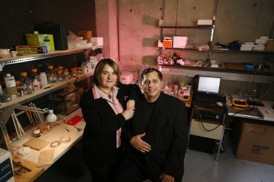 |
| Mihri and Cengiz Ozkan, both professors in the Bourns College of Engineering. |
Abstract:
Researchers at the University of California, Riverside Bourns College of Engineering have developed a three-dimensional, silicon-decorated, cone-shaped carbon-nanotube cluster architecture for lithium ion battery anodes that could enable charging of portable electronics in 10 minutes, instead of hours.
Charging Portable Electronics in 10 Minutes: Researchers develop new architecture for lithium-ion battery anodes that far outperform the current standard
Riverside, CA | Posted on June 10th, 2014Lithium ion batteries are the rechargeable battery of choice for portable electronic devices and electric vehicles. But, they present problems. Batteries in electric vehicles are responsible for a significant portion of the vehicle mass. And the size of batteries in portable electronics limits the trend of down-sizing.
Silicon is a type of anode material that is receiving a lot of attention because its total charge capacity is 10 times higher than commercial graphite based lithium ion battery anodes. Consider a packaged battery full-cell. Replacing the commonly used graphite anode with silicon anodes will potentially result in a 63 percent increase of total cell capacity and a battery that is 40 percent lighter and smaller.
In a paper, Silicon Decorated Cone Shaped Carbon Nanotube Clusters for Lithium Ion Battery Anode, recently published in the journal SMALL, UC Riverside researchers developed a novel structure of three-dimensional silicon decorated cone-shaped carbon nanotube clusters architecture via chemical vapor deposition and inductively coupled plasma treatment.
Lithium ion batteries based on this novel architecture demonstrate a high reversible capacity and excellent cycling stability. The architecture demonstrates excellent electrochemical stability and irreversibility even at high charge and discharge rates, nearly 16 times faster than conventionally used graphite based anodes.
The researchers believe the ultrafast rate of charge and discharge can be attributed to two reasons, said Wei Wang, lead author of the paper.
One, the seamless connection between graphene covered copper foil and carbon nanotubes enhances the active material-current collector contact integrity which facilitates charge and thermal transfer in the electrode system.
Two, the cone-shaped architecture offers small interpenetrating channels for faster electrolyte access into the electrode which may enhance the rate performance.
Wang is a graduate student advised by Cengiz S. Ozkan, a mechanical engineering professor at UC Riverside's Bourns College of Engineering; and Mihrimah Ozkan, an electrical engineering professor. Both of them are co-authors of the paper.
Other co-authors are Isaac Ruiz, Kazi Ahmed, Hamed Bay, Aaron George, who are all graduate students, and Johnny Wang, an undergraduate student.
####
For more information, please click here
Contacts:
Sean Nealon
951-827-1287
Copyright © University of California - Riverside
If you have a comment, please Contact us.Issuers of news releases, not 7th Wave, Inc. or Nanotechnology Now, are solely responsible for the accuracy of the content.
Bookmark:


| Related News Press |
News and information
 Quantum computer improves AI predictions April 17th, 2026
Flexible sensor gains sensitivity under pressure April 17th, 2026
A reusable chip for particulate matter sensing April 17th, 2026
Detecting vibrational quantum beating in the predissociation dynamics of SF6 using time-resolved photoelectron spectroscopy April 17th, 2026
Graphene/ Graphite
Electrifying results shed light on graphene foam as a potential material for lab grown cartilage June 6th, 2025
Breakthrough in proton barrier films using pore-free graphene oxide: Kumamoto University researchers achieve new milestone in advanced coating technologies September 13th, 2024
Discoveries
Quantum computer improves AI predictions April 17th, 2026
Flexible sensor gains sensitivity under pressure April 17th, 2026
A reusable chip for particulate matter sensing April 17th, 2026
Detecting vibrational quantum beating in the predissociation dynamics of SF6 using time-resolved photoelectron spectroscopy April 17th, 2026
Announcements
A fundamentally new therapeutic approach to cystic fibrosis: Nanobody repairs cellular defect April 17th, 2026
UC Irvine physicists discover method to reverse ‘quantum scrambling’ : The work addresses the problem of information loss in quantum computing system April 17th, 2026
Interviews/Book Reviews/Essays/Reports/Podcasts/Journals/White papers/Posters
A fundamentally new therapeutic approach to cystic fibrosis: Nanobody repairs cellular defect April 17th, 2026
UC Irvine physicists discover method to reverse ‘quantum scrambling’ : The work addresses the problem of information loss in quantum computing system April 17th, 2026
Battery Technology/Capacitors/Generators/Piezoelectrics/Thermoelectrics/Energy storage
Decoding hydrogen‑bond network of electrolyte for cryogenic durable aqueous zinc‑ion batteries January 30th, 2026
COF scaffold membrane with gate‑lane nanostructure for efficient Li+/Mg2+ separation January 30th, 2026
MXene nanomaterials enter a new dimension Multilayer nanomaterial: MXene flakes created at Drexel University show new promise as 1D scrolls January 30th, 2026
 |
||
 |
||
| The latest news from around the world, FREE | ||
 |
||
|
|
||
| Premium Products | ||
 |
||
|
Only the news you want to read!
Learn More |
||
 |
||
|
Full-service, expert consulting
Learn More |
||
|
|
||