Home > Press > Virus structure inspires novel understanding of onion-like carbon nanoparticles
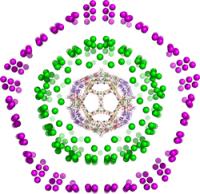 |
| This image shows a virus nested within fullerene cages called carbon onions.
Credit: Dechant et al. |
Abstract:
Symmetry is ubiquitous in the natural world. It occurs in gemstones and snowflakes and even in biology, an area typically associated with complexity and diversity. There are striking examples: the shapes of virus particles, such as those causing the common cold, are highly symmetrical and look like tiny footballs.
Virus structure inspires novel understanding of onion-like carbon nanoparticles
UK | Posted on April 10th, 2014A research programme led by Reidun Twarock at the University of York, UK has developed new mathematical tools to better understand the implications of this high degree of symmetry in these systems. The group pioneered a mathematical theory that reveals unprecedented insights into how different components of a virus, the protein container encapsulating the viral genome and the packaged genome within, mutually constrain each other's structures [Acta Cryst. (2013). A69, 140-150 doi:10.1107/S0108767312047150].
A paper recently published in Acta Crystallographica Section A: Foundations and Advances [Acta Cryst. (2014). A70, 162-167 doi: 10.1107/S2053273313034220] in collaboration with Pierre-Philippe Dechant from the University of Durham, UK shows that these mathematical tools apply more widely in the natural world and interestingly also account for the structures of Russian-doll-like arrangements of carbon cages known as carbon onions. It was known previously that individual shells could be modeled using symmetry techniques, but the fact that the entire structure is collectively constrained by a single symmetry principle is a surprising new result.
Such insights are crucial for understanding how different components contribute collectively to function. In the case of viruses this work has resulted in a new understanding of the interplay of the viral genome and protein capsid in virus formation, which in turn has opened up novel opportunities for anti-viral intervention that are actively being explored. Similarly, we expect that the work on carbon onions will provide a basis for a better understanding of the structural constraints on their overall organisation and formation, which in the future can be exploited in nanotechnology applications.
####
For more information, please click here
Contacts:
Jonathan Agbenyega
44-124-434-2878
Copyright © International Union of Crystallography
If you have a comment, please Contact us.Issuers of news releases, not 7th Wave, Inc. or Nanotechnology Now, are solely responsible for the accuracy of the content.
Bookmark:


| Related News Press |
News and information
 Quantum computer improves AI predictions April 17th, 2026
Flexible sensor gains sensitivity under pressure April 17th, 2026
A reusable chip for particulate matter sensing April 17th, 2026
Detecting vibrational quantum beating in the predissociation dynamics of SF6 using time-resolved photoelectron spectroscopy April 17th, 2026
Possible Futures
A fundamentally new therapeutic approach to cystic fibrosis: Nanobody repairs cellular defect April 17th, 2026
UC Irvine physicists discover method to reverse ‘quantum scrambling’ : The work addresses the problem of information loss in quantum computing system April 17th, 2026
Nanomedicine
A fundamentally new therapeutic approach to cystic fibrosis: Nanobody repairs cellular defect April 17th, 2026
New molecular technology targets tumors and simultaneously silences two ‘undruggable’ cancer genes August 8th, 2025
New imaging approach transforms study of bacterial biofilms August 8th, 2025
Electrifying results shed light on graphene foam as a potential material for lab grown cartilage June 6th, 2025
Discoveries
Quantum computer improves AI predictions April 17th, 2026
Flexible sensor gains sensitivity under pressure April 17th, 2026
A reusable chip for particulate matter sensing April 17th, 2026
Detecting vibrational quantum beating in the predissociation dynamics of SF6 using time-resolved photoelectron spectroscopy April 17th, 2026
Announcements
A fundamentally new therapeutic approach to cystic fibrosis: Nanobody repairs cellular defect April 17th, 2026
UC Irvine physicists discover method to reverse ‘quantum scrambling’ : The work addresses the problem of information loss in quantum computing system April 17th, 2026
Interviews/Book Reviews/Essays/Reports/Podcasts/Journals/White papers/Posters
A fundamentally new therapeutic approach to cystic fibrosis: Nanobody repairs cellular defect April 17th, 2026
UC Irvine physicists discover method to reverse ‘quantum scrambling’ : The work addresses the problem of information loss in quantum computing system April 17th, 2026
Nanobiotechnology
A fundamentally new therapeutic approach to cystic fibrosis: Nanobody repairs cellular defect April 17th, 2026
New molecular technology targets tumors and simultaneously silences two ‘undruggable’ cancer genes August 8th, 2025
New imaging approach transforms study of bacterial biofilms August 8th, 2025
Electrifying results shed light on graphene foam as a potential material for lab grown cartilage June 6th, 2025
Alliances/Trade associations/Partnerships/Distributorships
Chicago Quantum Exchange welcomes six new partners highlighting quantum technology solutions, from Chicago and beyond September 23rd, 2022
University of Illinois Chicago joins Brookhaven Lab's Quantum Center June 10th, 2022
 |
||
 |
||
| The latest news from around the world, FREE | ||
 |
||
|
|
||
| Premium Products | ||
 |
||
|
Only the news you want to read!
Learn More |
||
 |
||
|
Full-service, expert consulting
Learn More |
||
|
|
||