Home > Press > Atoms in a nanocrystal cooperate, much like in biomolecules
 |
| Photo courtesy Prashant Jain
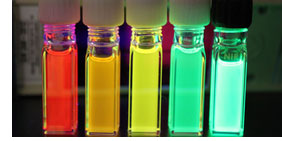
Nanocrystals of cadmium selenide, known for their brilliant luminescence, display intriguing chemical behavior resulting from positive cooperation between atoms, a behavior akin to that found in biomolecules. |
Abstract:
Researchers have long thought that biological molecules and synthetic nanocrystals were similar only in size. Now, University of Illinois at Urbana-Champaign chemists have found that they can add reactivity to the list of shared traits. Atoms in a nanocrystal can cooperate with each other to facilitate binding or switching, a phenomenon widely found in biological molecules.
Atoms in a nanocrystal cooperate, much like in biomolecules
Champaign, IL | Posted on December 16th, 2013The finding could catalyze manufacturing of nanocrystals for smart sensors, solar cells, tiny transistors for optical computers, and medical imaging. Led by chemistry professor Prashant Jain, the team published its findings in the journal Nature Communications.
"In geological, industrial and domestic environments, the nanoscale grains of any material undergo chemical transitions when they are put under reactive conditions," Jain said. "Iron rusting over time and diamond forming from carbon are examples of two commonly occurring transitions. Understanding how these transitions occur on the scale of the tiniest grains of the material is a major motivation of our work."
Scientists can exploit such transitions to make nanocrystals that conform to a particular structure. They can make a nanocrystal of one material and transform it into another material, essentially using the original nanocrystal framework as a template for creating a nanocrystal of the new material with the same size and shape. This lets researchers create nanocrystals of new materials in shapes and structures they may not be able to otherwise.
In the new study, the researchers transformed tiny crystals of the material cadmium selenide to crystals of copper selenide. Copper selenide nanocrystals have a number of interesting properties that can be used for solar energy harvesting, optical computing and laser surgery. Transformation from cadmium selenide creates nanocrystals with a purity difficult to attain from other methods.
The researchers, including graduate student Sarah White, used advanced microscopy and spectroscopy techniques to determine the dynamics of the atoms within the crystals during the transformation and found that the transformation occurs not as a slow diffusion process, but as a rapid switching thanks to co-operativity.
The researchers saw that once the cadmium-selenide nanocrystal has taken up a few initial copper "seed" impurities, atoms in the rest of the lattice can cooperate to rapidly swap out the rest of the cadmium for copper. Jain compares the crystals to hemoglobin, the molecule in red blood cells that carries oxygen. Once one oxygen molecule has bound to hemoglobin, other binding sites within hemoglobin slightly change conformation to more easily pick up more oxygen. He posits that similarly, copper impurities might cause a structural change in the nanocrystal, making it easier for more copper ions to infiltrate the nanocrystal in a rapid cascade.
The researchers reproduced the experiment with silver, in addition to copper, and saw similar, though slightly less speedy, cooperative behavior.
Now, Jain's team is using its advanced imaging to watch transitions happen in single nanocrystals, in real time.
"We have a sophisticated optical microscope in our lab, which has now allowed us to catch a single nanocrystal in the act of making a transition," Jain said. "This is allowing us to learn hidden details about how the transition actually proceeds. We are also learning how one nanocrystal behaves differently from another."
Next, the researchers plan to explore biomolecule-like cooperative phenomena in other solid-state materials and processes. For example, co-operativity in catalytic processes could have major implications for solar energy or manufacturing of expensive specialty chemicals.
"In the long term, we are interested in exploiting the co-operative behavior to design artificial smart materials that respond in a switch-like manner like hemoglobin in our body does," Jain said.
Jain also is affiliated with the department of physics and the Frederick Seitz Materials Research Laboratory at the U. of I.
####
For more information, please click here
Contacts:
Liz Ahlberg
Physical Sciences Editor
217-244-1073
Prashant Jain
217-333-3417
Copyright © University of Illinois at Urbana-Champaign
If you have a comment, please Contact us.Issuers of news releases, not 7th Wave, Inc. or Nanotechnology Now, are solely responsible for the accuracy of the content.
Bookmark:


| Related Links |
 The paper, “Co-operativity in a nanocrystalline solid-state transition,” is available online:
| Related News Press |
News and information
Quantum computer improves AI predictions April 17th, 2026
Flexible sensor gains sensitivity under pressure April 17th, 2026
A reusable chip for particulate matter sensing April 17th, 2026
Detecting vibrational quantum beating in the predissociation dynamics of SF6 using time-resolved photoelectron spectroscopy April 17th, 2026
Imaging
Chemistry
Projecting light to dispense liquids: A new route to ultra-precise microdroplets January 30th, 2026
From sensors to smart systems: the rise of AI-driven photonic noses January 30th, 2026
"Nanoreactor" cage uses visible light for catalytic and ultra-selective cross-cycloadditions October 3rd, 2025
Discoveries
Quantum computer improves AI predictions April 17th, 2026
Flexible sensor gains sensitivity under pressure April 17th, 2026
A reusable chip for particulate matter sensing April 17th, 2026
Detecting vibrational quantum beating in the predissociation dynamics of SF6 using time-resolved photoelectron spectroscopy April 17th, 2026
Announcements
A fundamentally new therapeutic approach to cystic fibrosis: Nanobody repairs cellular defect April 17th, 2026
UC Irvine physicists discover method to reverse ‘quantum scrambling’ : The work addresses the problem of information loss in quantum computing system April 17th, 2026
Interviews/Book Reviews/Essays/Reports/Podcasts/Journals/White papers/Posters
A fundamentally new therapeutic approach to cystic fibrosis: Nanobody repairs cellular defect April 17th, 2026
UC Irvine physicists discover method to reverse ‘quantum scrambling’ : The work addresses the problem of information loss in quantum computing system April 17th, 2026
Tools
Metasurfaces smooth light to boost magnetic sensing precision January 30th, 2026
From sensors to smart systems: the rise of AI-driven photonic noses January 30th, 2026
Japan launches fully domestically produced quantum computer: Expo visitors to experience quantum computing firsthand August 8th, 2025
Energy
Sensors innovations for smart lithium-based batteries: advancements, opportunities, and potential challenges August 8th, 2025
Simple algorithm paired with standard imaging tool could predict failure in lithium metal batteries August 8th, 2025
Solar/Photovoltaic
Spinel-type sulfide semiconductors to operate the next-generation LEDs and solar cells For solar-cell absorbers and green-LED source October 3rd, 2025
KAIST researchers introduce new and improved, next-generation perovskite solar cell November 8th, 2024
Groundbreaking precision in single-molecule optoelectronics August 16th, 2024
Development of zinc oxide nanopagoda array photoelectrode: photoelectrochemical water-splitting hydrogen production January 12th, 2024
 |
||
 |
||
| The latest news from around the world, FREE | ||
 |
||
|
|
||
| Premium Products | ||
 |
||
|
Only the news you want to read!
Learn More |
||
 |
||
|
Full-service, expert consulting
Learn More |
||
|
|
||