Home > Press > New milestone could help magnets end era of computer transistors
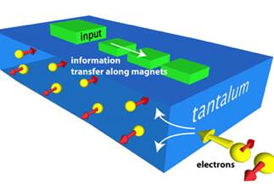 |
| As current passes through a strip of tantalum, electrons with opposite spins separate. Researchers used the resulting polarization to create a nanomagnetic switch that could one day replace computer transistors. Image by Debanjan Bhowmik, UC Berkeley |
Abstract:
New work by researchers at the University of California, Berkeley, could soon transform the building blocks of modern electronics by making nanomagnetic switches a viable replacement for the conventional transistors found in all computers.
New milestone could help magnets end era of computer transistors
Berkeley, CA | Posted on November 18th, 2013Semiconductor-based transistors, the on-off switches that direct the flow of electricity and form a computer's nervous system, have been consuming greater chunks of power at increasingly hotter temperatures as processing speeds grow. For more than a decade, researchers have been pursuing magnets as an alternative to transistors because they require far less energy needs when switching. However, until now, the power needed to generate the magnetic field to orient the magnets so they can easily clock on and off has negated much of the energy savings that would have been gained by moving away from transistors.
UC Berkeley researchers overcame this limitation by exploiting the special properties of the rare, heavy metal tantalum.
In a paper published online Sunday, Nov. 17, in the journal Nature Nanotechnology, the researchers describe how they created a so-called Spin Hall effect by using nanomagnets placed on top of tantalum wire and then sending a current through the metal. Electrons in the current will randomly spin in either a clockwise or counterclockwise direction. When the current is sent through tantalum's atomic core, the metal's physical properties naturally sort the electrons to opposing sides based on their direction of spin. This creates the polarization researchers exploited in order to switch magnets in a logic circuit without the need for a magnetic field.
"This is a breakthrough in the push for low-powered computing," said study principal investigator Sayeef Salahuddin, UC Berkeley assistant professor of electrical engineering and computer sciences. "The power consumption we are seeing is up to 10,000 times lower than state-of-the-art schemes for nanomagnetic computing. Our experiments are the proof of concept that magnets could one day be a realistic replacement for transistors."
Other co-authors of the study are graduate student and lead author Debanjan Bhowmik, and Long You, a research scholar.
The Defense Advanced Research Projects Agency, Semiconductor Research Corp. and the National Science Foundation helped support this work.
####
For more information, please click here
Contacts:
Writer:
Sarah Yang
Media Relations
(510) 643-7741
Sayeef Salahuddin
(510) 642-4662
Copyright © University of California, Berkeley
If you have a comment, please Contact us.Issuers of news releases, not 7th Wave, Inc. or Nanotechnology Now, are solely responsible for the accuracy of the content.
Bookmark:


| Related Links |
| Related News Press |
News and information
 Quantum computer improves AI predictions April 17th, 2026
Flexible sensor gains sensitivity under pressure April 17th, 2026
A reusable chip for particulate matter sensing April 17th, 2026
Detecting vibrational quantum beating in the predissociation dynamics of SF6 using time-resolved photoelectron spectroscopy April 17th, 2026
Govt.-Legislation/Regulation/Funding/Policy
Quantum computer improves AI predictions April 17th, 2026
Metasurfaces smooth light to boost magnetic sensing precision January 30th, 2026
New imaging approach transforms study of bacterial biofilms August 8th, 2025
Chip Technology
A reusable chip for particulate matter sensing April 17th, 2026
Metasurfaces smooth light to boost magnetic sensing precision January 30th, 2026
Nanoelectronics
Lab to industry: InSe wafer-scale breakthrough for future electronics August 8th, 2025
Interdisciplinary: Rice team tackles the future of semiconductors Multiferroics could be the key to ultralow-energy computing October 6th, 2023
Key element for a scalable quantum computer: Physicists from Forschungszentrum Jülich and RWTH Aachen University demonstrate electron transport on a quantum chip September 23rd, 2022
Reduced power consumption in semiconductor devices September 23rd, 2022
Discoveries
Quantum computer improves AI predictions April 17th, 2026
Flexible sensor gains sensitivity under pressure April 17th, 2026
A reusable chip for particulate matter sensing April 17th, 2026
Detecting vibrational quantum beating in the predissociation dynamics of SF6 using time-resolved photoelectron spectroscopy April 17th, 2026
Announcements
A fundamentally new therapeutic approach to cystic fibrosis: Nanobody repairs cellular defect April 17th, 2026
UC Irvine physicists discover method to reverse ‘quantum scrambling’ : The work addresses the problem of information loss in quantum computing system April 17th, 2026
Interviews/Book Reviews/Essays/Reports/Podcasts/Journals/White papers/Posters
A fundamentally new therapeutic approach to cystic fibrosis: Nanobody repairs cellular defect April 17th, 2026
UC Irvine physicists discover method to reverse ‘quantum scrambling’ : The work addresses the problem of information loss in quantum computing system April 17th, 2026
Military
Quantum engineers ‘squeeze’ laser frequency combs to make more sensitive gas sensors January 17th, 2025
Chainmail-like material could be the future of armor: First 2D mechanically interlocked polymer exhibits exceptional flexibility and strength January 17th, 2025
Single atoms show their true color July 5th, 2024
NRL charters Navy’s quantum inertial navigation path to reduce drift April 5th, 2024
 |
||
 |
||
| The latest news from around the world, FREE | ||
 |
||
|
|
||
| Premium Products | ||
 |
||
|
Only the news you want to read!
Learn More |
||
 |
||
|
Full-service, expert consulting
Learn More |
||
|
|
||