Home > Press > Researchers discover evidence to support controversial theory of 'buckyball' formation: Discovery could have a bearing on medical imaging, cancer treatment
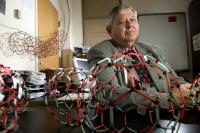 |
| Harry Dorn, a professor at the Virginia Tech Carilion Research Institute, poses with models of "buckyballs." His research supports the theory that a soccer ball-shaped nanoparticle commonly called a buckyball is the result of a breakdown of larger structures rather than being built atom-by-atom from the ground up.
Credit: Virginia Tech |
Abstract:
Researchers at the Virginia Tech Carilion Research Institute have reported the first experimental evidence that supports the theory that a soccer ball-shaped nanoparticle commonly called a buckyball is the result of a breakdown of larger structures rather than being built atom-by-atom from the ground up.
Researchers discover evidence to support controversial theory of 'buckyball' formation: Discovery could have a bearing on medical imaging, cancer treatment
Blacksburg, VA | Posted on September 16th, 2013Technically known as fullerenes, these spherical carbon molecules have shown great promise for uses in medicine, solar energy, and optoelectronics. But finding applications for these peculiar structures has been difficult because no one knows exactly how they are formed.
Two theories compete regarding the molecular mechanisms that make fullerenes. The first and oldest is the "bottom-up" theory, which says these carbon cages are built atom-by-atom, like the construction of a Lego model. The second, more recent, theory takes a "top-down" approach, suggesting that fullerenes form when much larger structures break into constituent parts.
After several years of debate with little more than computational models in support of how the top-down theory might work, researchers led by Harry Dorn, a professor at the research institute, have discovered the missing link: asymmetrical fullerenes that are formed from larger structures appear to settle into stable fullerenes.
The discovery appeared online Sept. 15 in the journal Nature Chemistry.
"Understanding the molecular mechanics of how fullerenes and their many variations are formed is not just a curiosity," said Dorn, who has been researching metallofullerenes - fullerenes with a few atoms of metal held within - for more than two decades. "It would give us insights into new, better ways to prepare them. Fullerenes and metallofullerenes are already involved in hundreds of biomedical studies. The ability to create large numbers of a wide variety of metallofullerenes would be a giant building block that would take the field to new heights."
The medicinal promise of metallofullerenes stems from the atoms of metal caged within them. Because the metal atoms are trapped in a cage of carbon, they do not react with the outside world, making their side-effect risks low in both number and intensity.
For example, one particular metallofullerene with gadolinium at its core has been shown to be up to 40 times better as a contrast agent in magnetic resonance imaging scans for diagnostic imaging than options now commercially available. Current experiments are also directed at using metallofullerenes to carry therapeutic radioactive ions to target cancer tissue.
"A better understanding of the formation of fullerenes and metallofullerenes may allow the development of new contrast agents for magnetic resonance imaging at commercial-level quantities," said Jianyuan Zhang, a graduate student in Dorn's laboratory and the first author of the paper. "These larger quantities will facilitate a next generation of contrast agents with multiple targets."
Dorn's new study hinges on the isolation and purification of approximately 100 micrograms — roughly the size of several specks of pepper — of a particular metallofullerene consisting of 84 carbon atoms with two additional carbon atoms and two yttrium atoms trapped inside.
When Dorn and his colleagues determined the metallofullerene's exact structure using nuclear magnetic resonance imaging and single crystal X-ray analysis, they made a startling discovery —the asymmetrical molecule could theoretically collapse to form nearly every known fullerene and metallofullerene.
All the process would require would be a few minor perturbations — the breaking of only a few molecular bonds — and the cage would become highly symmetrical and stable.
This insight, Dorn said, supports the theory that fullerenes are formed from graphene — a single sheet of carbon just one atom thick — when key molecular bonds begin to break down. And although the study focuses on fullerenes with yttrium trapped inside, it also shows that the carbon distribution looks similar for empty cages, suggesting regular fullerenes form the same way.
"Not only are the findings presented in Dr. Dorn's paper extremely interesting, but the study represents a real milestone in the field," said Takeshi Akasaka, a professor of chemistry at the University of Tsukuba in Japan and an authority in the field of metallofullerene research, who was not involved in the study. "The study presents physical evidence for a process of metallofullerene creation that most scientists in the field initially scoffed at."
Dorn said scientists have questioned the bottom-up theory of fullerene formation ever since it was discovered that fullerenes were formed from asteroids colliding with Earth and fullerenes were found in interstellar space.
"With this study, we hope to be that much closer to understanding their formation and creating entirely new classes of fullerenes and metallofullerenes that could be useful in medicine as well as in other fields that haven't even occurred to us yet," Dorn said.
"Dr. Dorn's insight into the fundamental process whereby fullerenes are formed is a major contribution to the field," said Michael Friedlander, executive director of the Virginia Tech Carilion Research Institute. "Understanding the molecular steps in their formation is key to realizing fully the potential of this versatile and potentially potent family of chemicals in medicine. Dr. Dorn's contributions to understanding these molecules are paving the way for the formulation of targeted novel diagnostics, therapeutics, and the combination of both—theranostics. This approach will provide an important component for tomorrow's arsenal of precision medicine."
Dorn and Zhang's research collaborators include Faye Bowles, a graduate student researcher; Marilyn Olmstead, a professor of chemistry; and Alan Balch, a distinguished professor of chemistry; all from the University of California, Davis.
Also participating were Daniel Bearden, a research scientist with the Hollings Marine Laboratory at the National Institute of Standards and Technology, and Tim Fuhrer, now an assistant professor of chemistry at Radford University.
Researchers from Virginia Tech who worked on the study include Richard Helm, an associate professor of biochemistry; W. Keith Ray, a senior research associate in biochemistry; Youqing Ye, a graduate student in chemistry; Caitlyn Dixon, an undergraduate student in chemistry; and Kim Harich, an analytical chemist senior in biochemistry.
####
For more information, please click here
Contacts:
Paula Byron
540-526-2027
Copyright © Virginia Tech
If you have a comment, please Contact us.Issuers of news releases, not 7th Wave, Inc. or Nanotechnology Now, are solely responsible for the accuracy of the content.
Bookmark:


| Related News Press |
News and information
 Quantum computer improves AI predictions April 17th, 2026
Flexible sensor gains sensitivity under pressure April 17th, 2026
A reusable chip for particulate matter sensing April 17th, 2026
Detecting vibrational quantum beating in the predissociation dynamics of SF6 using time-resolved photoelectron spectroscopy April 17th, 2026
Laboratories
Researchers develop molecular qubits that communicate at telecom frequencies October 3rd, 2025
A battery’s hopping ions remember where they’ve been: Seen in atomic detail, the seemingly smooth flow of ions through a battery’s electrolyte is surprisingly complicated February 16th, 2024
Govt.-Legislation/Regulation/Funding/Policy
Quantum computer improves AI predictions April 17th, 2026
Metasurfaces smooth light to boost magnetic sensing precision January 30th, 2026
New imaging approach transforms study of bacterial biofilms August 8th, 2025
Nanotubes/Buckyballs/Fullerenes/Nanorods/Nanostrings/Nanosheets
Tiny nanosheets, big leap: A new sensor detects ethanol at ultra-low levels January 30th, 2026
Enhancing power factor of p- and n-type single-walled carbon nanotubes April 25th, 2025
Chainmail-like material could be the future of armor: First 2D mechanically interlocked polymer exhibits exceptional flexibility and strength January 17th, 2025
Innovative biomimetic superhydrophobic coating combines repair and buffering properties for superior anti-erosion December 13th, 2024
Nanomedicine
A fundamentally new therapeutic approach to cystic fibrosis: Nanobody repairs cellular defect April 17th, 2026
New molecular technology targets tumors and simultaneously silences two ‘undruggable’ cancer genes August 8th, 2025
New imaging approach transforms study of bacterial biofilms August 8th, 2025
Electrifying results shed light on graphene foam as a potential material for lab grown cartilage June 6th, 2025
Optical computing/Photonic computing
ICFO researchers overcome long-standing bottleneck in single photon detection with twisted 2D materials August 8th, 2025
Programmable electron-induced color router array May 14th, 2025
Discoveries
Quantum computer improves AI predictions April 17th, 2026
Flexible sensor gains sensitivity under pressure April 17th, 2026
A reusable chip for particulate matter sensing April 17th, 2026
Detecting vibrational quantum beating in the predissociation dynamics of SF6 using time-resolved photoelectron spectroscopy April 17th, 2026
Materials/Metamaterials/Magnetoresistance
First real-time observation of two-dimensional melting process: Researchers at Mainz University unveil new insights into magnetic vortex structures August 8th, 2025
Researchers unveil a groundbreaking clay-based solution to capture carbon dioxide and combat climate change June 6th, 2025
A 1960s idea inspires NBI researchers to study hitherto inaccessible quantum states June 6th, 2025
Institute for Nanoscience hosts annual proposal planning meeting May 16th, 2025
Announcements
A fundamentally new therapeutic approach to cystic fibrosis: Nanobody repairs cellular defect April 17th, 2026
UC Irvine physicists discover method to reverse ‘quantum scrambling’ : The work addresses the problem of information loss in quantum computing system April 17th, 2026
Energy
Sensors innovations for smart lithium-based batteries: advancements, opportunities, and potential challenges August 8th, 2025
Simple algorithm paired with standard imaging tool could predict failure in lithium metal batteries August 8th, 2025
Photonics/Optics/Lasers
Metasurfaces smooth light to boost magnetic sensing precision January 30th, 2026
From sensors to smart systems: the rise of AI-driven photonic noses January 30th, 2026
Research partnerships
Lab to industry: InSe wafer-scale breakthrough for future electronics August 8th, 2025
HKU physicists uncover hidden order in the quantum world through deconfined quantum critical points April 25th, 2025
Solar/Photovoltaic
Spinel-type sulfide semiconductors to operate the next-generation LEDs and solar cells For solar-cell absorbers and green-LED source October 3rd, 2025
KAIST researchers introduce new and improved, next-generation perovskite solar cell November 8th, 2024
Groundbreaking precision in single-molecule optoelectronics August 16th, 2024
Development of zinc oxide nanopagoda array photoelectrode: photoelectrochemical water-splitting hydrogen production January 12th, 2024
 |
||
 |
||
| The latest news from around the world, FREE | ||
 |
||
|
|
||
| Premium Products | ||
 |
||
|
Only the news you want to read!
Learn More |
||
 |
||
|
Full-service, expert consulting
Learn More |
||
|
|
||