Home > Press > Airbrushing Could Facilitate Large-Scale Manufacture of Carbon Nanofibers
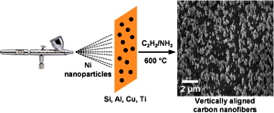 |
| This image illustrates how researchers use an airbrush to grow vertically aligned carbon nanofibers. Click to enlarge. Image: Joseph Tracy |
Abstract:
"Airbrushed Nickel Nanoparticles for Large-Area Growth of Vertically Aligned Carbon Nanofibers on Metal (Al, Cu, Ti) Surfaces"
Authors: Mehmet F. Sarac, Bryan D. Anderson, Ryan C. Pearce, Justin G. Railsback, Adedapo A. Oni, Ryan M. White, James M. LeBeau, Anatoli V. Melechko, and Joseph B. Tracy, North Carolina State University; Dale K. Hensley, Oak Ridge National Laboratory
Published: online Sept. 9, ACS Applied Materials & Interfaces
DOI: 10.1021/am401889t
Abstract: Vertically aligned carbon nanofibers (VACNFs) were grown by plasma-enhanced chemical vapor deposition (PECVD) using Ni nanoparticle (NP) catalysts that were deposited by airbrushing onto Si, Al, Cu, and Ti substrates. Airbrushing is a simple method for depositing catalyst NPs over large areas that is compatible with roll-to-roll processing. The distribution and morphology of VACNFs are affected by the airbrushing parameters and the composition of the metal foil. Highly concentrated Ni NPs in heptane give more uniform distributions than pentane and hexanes, resulting in more uniform coverage of VACNFs. For VACNF growth on metal foils, Si micropowder was added as a precursor for Si-enriched coatings formed in situ on the VACNFs that impart mechanical rigidity. Interactions between the catalyst NPs and the metal substrates impart control over the VACNF morphology. Growth of carbon nanostructures on Cu is particularly noteworthy because the miscibility of Ni with Cu poses challenges for VACNF growth, and carbon nanostructures anchored to Cu substrates are desired as anode materials for Li-ion batteries and for thermal interface materials.
Airbrushing Could Facilitate Large-Scale Manufacture of Carbon Nanofibers
Raleigh, NC | Posted on September 11th, 2013Researchers from North Carolina State University used airbrushing techniques to grow vertically aligned carbon nanofibers on several different metal substrates, opening the door for incorporating these nanofibers into gene delivery devices, sensors, batteries and other technologies.
"Because we're using an airbrush, this technique could easily be incorporated into large-scale, high-throughput manufacturing processes," says Dr. Anatoli Melechko, an adjunct associate professor of materials science and engineering at NC State and co-author of a paper describing the work. "In principle, you could cover an entire building with it."
"It's common to use nickel nanoparticles as catalysts to grow carbon nanofibers, and we were able to coat metal substrates with nickel nanoparticles using an airbrush," says Dr. Joseph Tracy, an associate professor of materials science and engineering at NC State and senior author of the paper. "Airbrushing gives us a fairly uniform coating of the substrate and it can be applied to a large area at room temperature in a short period of time."
After applying the nickel nanoparticles, the researchers airbrushed the substrate with a layer of silicon powder and heated the coated substrate to 600 degrees Celsius in a reactor filled with acetylene and ammonia gas. In the reactor, carbon nanofibers formed under the nickel nanoparticles and were held upright by a silicon-enriched coating. The finished product resembles a forest of nanofibers running perpendicular to the substrate. The researchers tested this technique successfully on aluminum, copper and titanium substrates.
"Growing carbon nanofibers on a metal substrate means the interface between the two materials is highly conductive, which makes the product more useful as an electrode material for use in a range of potential applications," says Mehmet Sarac, a Ph.D. student at NC State and lead author of the paper.
The paper, "Airbrushed Nickel Nanoparticles for Large-Area Growth of Vertically Aligned Carbon Nanofibers on Metal (Al, Cu, Ti) Surfaces," was published online Sept. 9 in ACS Applied Materials & Interfaces. The paper was co-authored by NC State Ph.D. students Bryan Anderson, and Adedapo Oni; former NC State graduate students Dr. Ryan Pearce and Justin Railsback; former NC State postdoctoral researcher Dr. Ryan White; Dr. James LeBeau, an assistant professor of materials science and engineering at NC State; and Dale Hensley of Oak Ridge National Laboratory. The work was supported by the National Science Foundation, the Defense Threat Reduction Agency, the U.S. Department of Energy and the Republic of Turkey's Ministry of National Education.
####
For more information, please click here
Contacts:
Matt Shipman
919-515-6386
Copyright © North Carolina State University
If you have a comment, please Contact us.Issuers of news releases, not 7th Wave, Inc. or Nanotechnology Now, are solely responsible for the accuracy of the content.
Bookmark:


| Related Links |
| Related News Press |
News and information
 Quantum computer improves AI predictions April 17th, 2026
Flexible sensor gains sensitivity under pressure April 17th, 2026
A reusable chip for particulate matter sensing April 17th, 2026
Detecting vibrational quantum beating in the predissociation dynamics of SF6 using time-resolved photoelectron spectroscopy April 17th, 2026
Nanomedicine
A fundamentally new therapeutic approach to cystic fibrosis: Nanobody repairs cellular defect April 17th, 2026
New molecular technology targets tumors and simultaneously silences two ‘undruggable’ cancer genes August 8th, 2025
New imaging approach transforms study of bacterial biofilms August 8th, 2025
Electrifying results shed light on graphene foam as a potential material for lab grown cartilage June 6th, 2025
Sensors
Flexible sensor gains sensitivity under pressure April 17th, 2026
Tiny nanosheets, big leap: A new sensor detects ethanol at ultra-low levels January 30th, 2026
From sensors to smart systems: the rise of AI-driven photonic noses January 30th, 2026
Sensors innovations for smart lithium-based batteries: advancements, opportunities, and potential challenges August 8th, 2025
Discoveries
Quantum computer improves AI predictions April 17th, 2026
Flexible sensor gains sensitivity under pressure April 17th, 2026
A reusable chip for particulate matter sensing April 17th, 2026
Detecting vibrational quantum beating in the predissociation dynamics of SF6 using time-resolved photoelectron spectroscopy April 17th, 2026
Announcements
A fundamentally new therapeutic approach to cystic fibrosis: Nanobody repairs cellular defect April 17th, 2026
UC Irvine physicists discover method to reverse ‘quantum scrambling’ : The work addresses the problem of information loss in quantum computing system April 17th, 2026
Battery Technology/Capacitors/Generators/Piezoelectrics/Thermoelectrics/Energy storage
Decoding hydrogen‑bond network of electrolyte for cryogenic durable aqueous zinc‑ion batteries January 30th, 2026
COF scaffold membrane with gate‑lane nanostructure for efficient Li+/Mg2+ separation January 30th, 2026
MXene nanomaterials enter a new dimension Multilayer nanomaterial: MXene flakes created at Drexel University show new promise as 1D scrolls January 30th, 2026
Nanobiotechnology
A fundamentally new therapeutic approach to cystic fibrosis: Nanobody repairs cellular defect April 17th, 2026
New molecular technology targets tumors and simultaneously silences two ‘undruggable’ cancer genes August 8th, 2025
New imaging approach transforms study of bacterial biofilms August 8th, 2025
Electrifying results shed light on graphene foam as a potential material for lab grown cartilage June 6th, 2025
 |
||
 |
||
| The latest news from around the world, FREE | ||
 |
||
|
|
||
| Premium Products | ||
 |
||
|
Only the news you want to read!
Learn More |
||
 |
||
|
Full-service, expert consulting
Learn More |
||
|
|
||